Thanks for your message. We will get back to you shortly.
If you want to send us one more message click
Business, FinTech, Healthcare, Real Estate, Technology, UppLabs
March 10, 2026
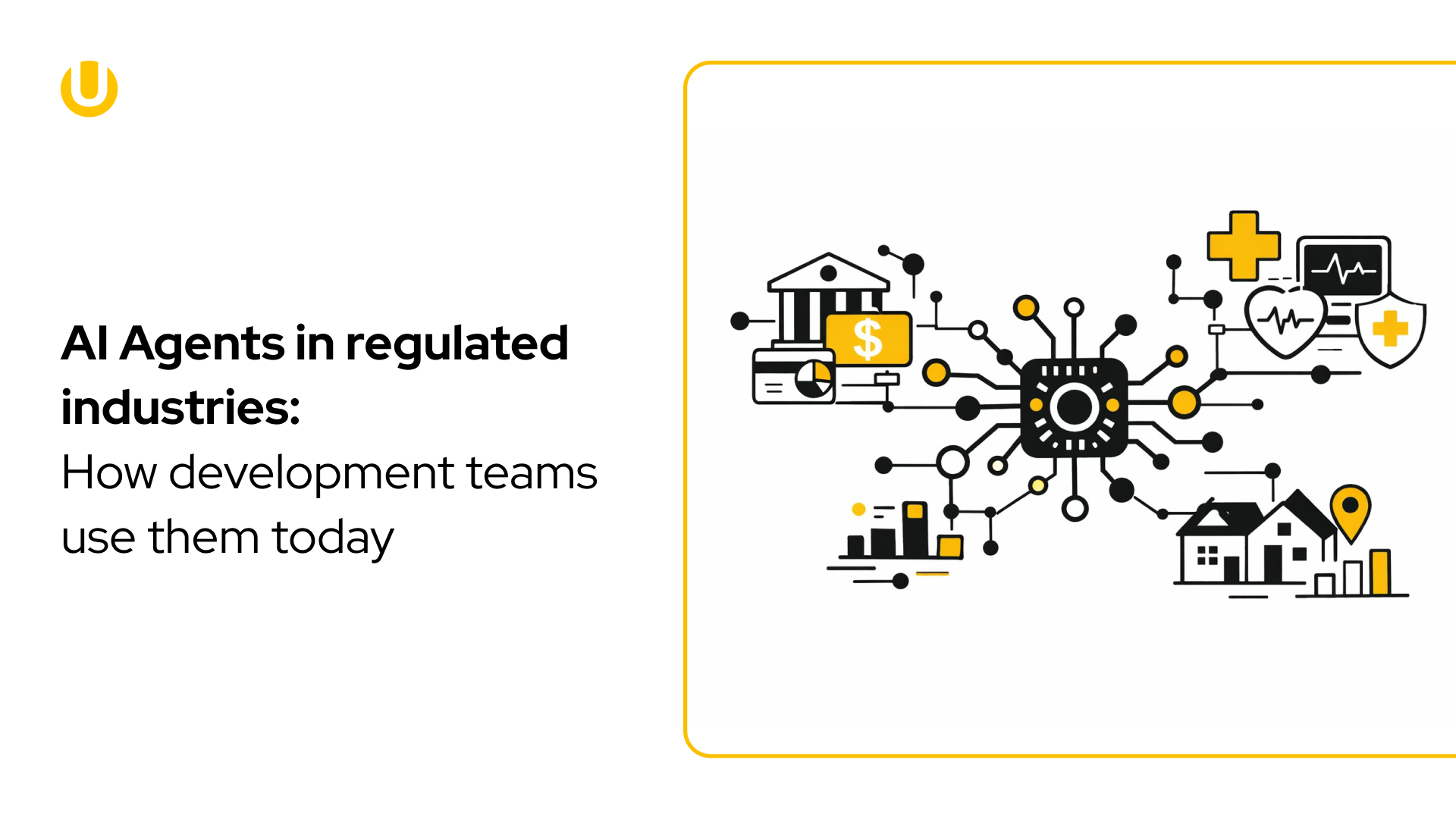
Software development has always been shaped by the industries it serves. Building a consumer app is a different discipline than building a trading platform or an electronic health record system. The stakes are higher, the compliance requirements are stricter, and the cost of a poorly-scoped feature or a missed edge case is measured not in user complaints but in regulatory fines, patient outcomes, or broken transactions.
That context matters when we talk about AI agents in software development. The conversation in most tech circles gravitates toward productivity gains — faster code generation, automated testing, reduced time to first commit. Those benefits are real. But for development teams working in fintech, healthcare, and real estate, the more compelling story is about something harder to quantify: better decisions, earlier in the process.
At Upplabs, we’ve been integrating AI tooling into our development workflows for clients across all three of these industries. One platform that’s become central to how we orchestrate that work is OpenClaw — an AI agent management platform that lets development teams deploy, coordinate, and supervise AI agents across complex workflows. This article explains what that looks like in practice, industry by industry.
Financial technology development sits at an uncomfortable intersection. Business stakeholders want features shipped fast. Compliance teams want every change documented, reviewed, and auditable. Engineering teams are caught in the middle, often spending as much time on process overhead as on actual development.
AI agents, when properly managed, can absorb a significant portion of that overhead.
In a recent engagement building a lending platform, our team used OpenClaw to coordinate a set of agents handling different layers of the development lifecycle: one agent monitoring regulatory requirement changes (CFPB guidance, state-level lending rules), another cross-referencing those changes against the existing codebase to flag potentially affected logic, and a third drafting initial compliance documentation for engineering review.
None of these agents were making decisions autonomously. That’s a key distinction. OpenClaw gives teams the infrastructure to run AI agents in supervised workflows, where human reviewers stay in the loop at defined checkpoints. In high-stakes fintech environments, full autonomy isn’t the goal — speed with oversight is.
The practical outcome was meaningful: engineers spent less time reading regulatory documents and more time writing code that accounted for what those documents actually required. Compliance reviews became faster because the initial documentation pass was already done. Code reviews became more focused because agents had pre-flagged sections of the codebase likely to be affected by new requirements.
There’s also a role for AI agents in fintech QA. Fraud detection logic, transaction processing edge cases, rate calculation errors — these are the bugs that matter most and are hardest to catch manually at scale. Agent-driven test generation, where an AI analyzes business logic and produces targeted test scenarios, has become a reliable part of our QA workflow for financial clients.
Healthcare software development is unforgiving. A misunderstood requirement in an EHR integration, a missed data type in a HL7 message, an incorrect assumption about how a clinical workflow actually operates — these aren’t just bugs. They affect care delivery.
The challenge is that healthcare requirements are often communicated through a mix of clinical language, regulatory documents, and institutional processes that engineering teams aren’t trained to parse. The translation layer between clinical intent and technical implementation has historically been thin and error-prone.
AI agents, operating within a structured platform like OpenClaw, can serve as a persistent translation layer — not to replace clinical analysts, but to support them.
One pattern we’ve used effectively: an agent that lives alongside the product backlog, continuously cross-referencing user stories and acceptance criteria against HIPAA technical safeguards and relevant clinical standards. When a story is written in a way that would require PHI to be handled outside of an approved data flow, the agent surfaces a flag before the ticket reaches engineering. This is not a novel idea conceptually — teams have always wanted earlier feedback loops — but AI makes it practical at the velocity of modern agile development.
OpenClaw’s approach to agent supervision matters a lot in healthcare contexts. HIPAA compliance isn’t just about what data an agent accesses — it’s about who authorized that access, when, and for what purpose. OpenClaw provides the audit trail and permission structure that lets organizations use AI tooling without creating new compliance surface area. Agents can be scoped to specific data environments, their actions logged, and their outputs reviewed before anything reaches a production system.
We’ve also used agent-driven workflows for healthcare API integration projects. When connecting to payer systems, pharmacy networks, or lab interfaces, the specification documentation is dense and frequently inconsistent. Agents that can read interface specs, generate stub implementations, and flag ambiguities for human review compress a process that used to take weeks into something much more manageable.
The goal isn’t to automate clinical judgment. It’s to handle the volume of technical translation work that currently consumes engineering time, so the humans making actual decisions have better information and more of their attention available.
Real estate technology is deceptively complex. On the surface, it looks like data management and workflow automation. In practice, it’s a web of jurisdictional variation, document processing, integration with legacy MLS systems, title and escrow logic, and user experiences that need to feel simple despite the underlying complexity.
Development teams building real estate platforms — whether for brokerages, proptech startups, or investment firms — face a specific challenge: requirements change constantly as they encounter edge cases specific to different markets, property types, or transaction structures. A feature that works cleanly in a standard single-family residential transaction often breaks when applied to a multi-unit commercial deal or a 1031 exchange.
AI agents are well-suited to this kind of variability management.
In one engagement building a transaction management platform, we deployed an OpenClaw-managed agent workflow that monitored support escalations and mapped recurring issues back to specific feature areas and requirement gaps. Rather than waiting for a quarterly retrospective to surface patterns, engineering teams received weekly digests — agent-generated, human-reviewed — connecting real user friction to specific backlog items.
This kind of feedback loop compression changes how product decisions get made. Instead of prioritizing based on gut feel or whoever made the most noise in the last planning meeting, teams have structured signal about where the actual friction is.
We’ve also used AI agents in the document processing layer of real estate workflows. Purchase agreements, addenda, inspection reports, title commitments — real estate transactions generate a significant volume of semi-structured documents that humans currently parse manually. Agent-assisted extraction and validation, where an agent processes documents and flags anomalies for human review, reduces processing time without removing the human judgment that catches the cases that matter.
OpenClaw’s orchestration capabilities are particularly useful here because document workflows in real estate aren’t linear. An agent processing a title commitment might need to trigger a different agent to cross-reference property records, which might surface something that requires a human review step before the workflow continues. Managing that kind of conditional, multi-step flow across agents is where a dedicated orchestration platform earns its place.
Across all three industries, a few patterns hold:
🛡️ Human oversight is non-negotiable.
In regulated environments, AI agents that operate without defined checkpoints aren’t just risky — they’re a compliance liability. The value of a platform like OpenClaw is that it makes supervision practical. Teams can move fast because they have the infrastructure to catch things before they matter.
⚙️ The best use cases are high-volume, high-repetition tasks with clear success criteria.
Compliance cross-referencing, test generation, document extraction, requirement gap flagging — these are areas where AI agents add consistent value because the work is measurable and the failure modes are well-understood.
👥 Agents augment expertise; they don’t replace it.
The engineers, analysts, and compliance professionals who understand these industries deeply remain essential. What changes is how much of their time gets consumed by work that doesn’t require their expertise. Agents handle the volume; humans handle the judgment.
🧠 Orchestration matters.
A single AI agent handling a narrow task is useful. A coordinated set of agents handling different parts of a complex workflow is transformative. Getting that coordination right — permissions, logging, handoffs, escalation paths — is where platforms like OpenClaw provide the infrastructure that makes the difference between a proof of concept and a production system.
The industries with the most to gain from AI-assisted development are also the ones that can least afford to get it wrong. That’s not a contradiction — it’s a design constraint. The question isn’t whether to use AI agents in fintech, healthcare, and real estate development. The question is how to deploy them in ways that are auditable, supervised, and actually integrated into how engineering teams work.
At Upplabs, our experience has been that the answer lies less in the capability of any individual AI model and more in the infrastructure around it. OpenClaw has become a core part of how we deploy that infrastructure for clients who need AI to move fast without sacrificing the oversight that their industries require.
If you’re building software in a regulated industry and want to talk through how AI agents might fit into your development workflow, we’d be glad to have that conversation.
Upplabs is a software development company specializing in fintech, healthcare, and real estate technology. Learn more at upplabs.com
Business, Healthcare, Technology
March 3, 2026
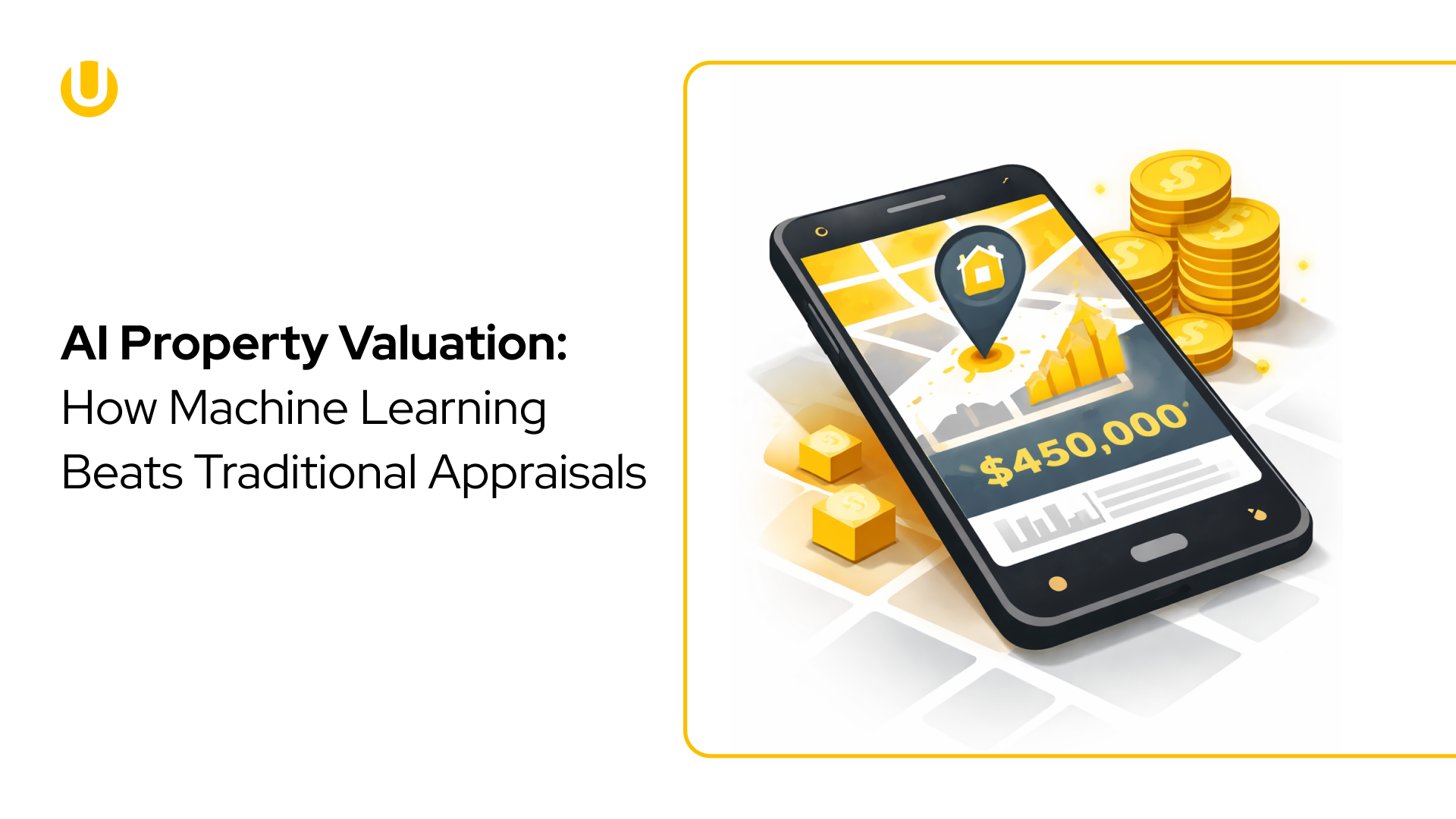
Picture this: two identical houses on the same street. Same square footage, same condition, same everything. Yet one appraises for $472,000 and the other for $750,000. The difference? The appraiser knew the race of the homeowner.
This isn't a hypothetical scenario—it's based on a real case that made national headlines in 2022. And it's just one symptom of a much larger problem: traditional property appraisals are broken. They're slow, expensive, subjective, and increasingly proven to be biased.
Business, Healthcare, Technology
August 12, 2021
The digital innovations take hospitals and medical facilities into a new stage of development. The technologies simplify the daily process and automate the healthcare system. Some medical institutions use ready-made software solutions, others prefer to choose the custom software, depending on the type of institution and the daily tasks needed to be optimized. In this article, we’ll cover different types of medical software, reveal their benefits, and think of the ways to implement them.
Business, Healthcare, Technology
February 12, 2021
Today the world is experiencing the rebirth of telemedicine: virtual receptions in time of a global lockdown is one of the safest ways to consult patients and prevent the spread of coronavirus in hospitals. Launching a telemedicine app can be a great success and a revolutionary decision for healthcare institutions. But what hidden pitfalls of the telemedicine software can we face today and how to avoid them – that is the question we are going to answer in this article.
Business, Events, Healthcare, UppLabs
January 11, 2021
IFAH (previously known as the Smart Health Conference) is one of the world's top healthcare conferences that explores the latest innovations in the industry. Having hosted numerous healthcare conferences across the globe, IFAH brings together business leaders and industry pioneers to help them turn their ideas into reality. This year you are welcome to Las Vegas to join Global Healthcare Conference in April 2021!

Business, Healthcare, Technology
January 4, 2021
Healthcare remains one of the largest and fastest-growing industries in the world. This year, Covid-19 has shown the critical need to deliver innovative and modern healthcare solutions. The entire healthcare industry changes so quickly that you can’t be sure anymore if your legacy software system solves all the problems. Does it integrate with changes or support the new standards? How to find out and what to do next? Why do we need an update and what challenges can we face? This article has the purpose of answering all of these questions.
Business, FinTech, Healthcare, Real Estate, Technology
December 17, 2020
Successful migration opens up new opportunities. Let’s identify the reasons to rebuild your solution to a new technical stack and the main challenges during the legacy system migration.

Business, Healthcare, UppLabs
November 18, 2020
Being aware of the vulnerability of health information, the US government passed the Health Insurance Portability and Accountability Act (HIPAA) in 1996...

Business, Healthcare, Technology
July 29, 2020
Healthcare remains one of the largest and fastest-growing industries in the world. As an industry expert, with the start of the COVID-19 epidemic, UppLabs was interested in finding out how the outbreak influenced the state of the industry and what changes business owners were forced to accept. But even regardless of the current situation with quarantine, there are some healthcare industry challenges that still remain a concern among healthcare business owners.
Business, Healthcare, Technology
July 3, 2020
What does exactly the RPA mean for healthcare solutions and what benefits does it bring? Let’s keep a closer eye on this topic.
Business, Clients, Healthcare, Technology, UppLabs
June 12, 2020
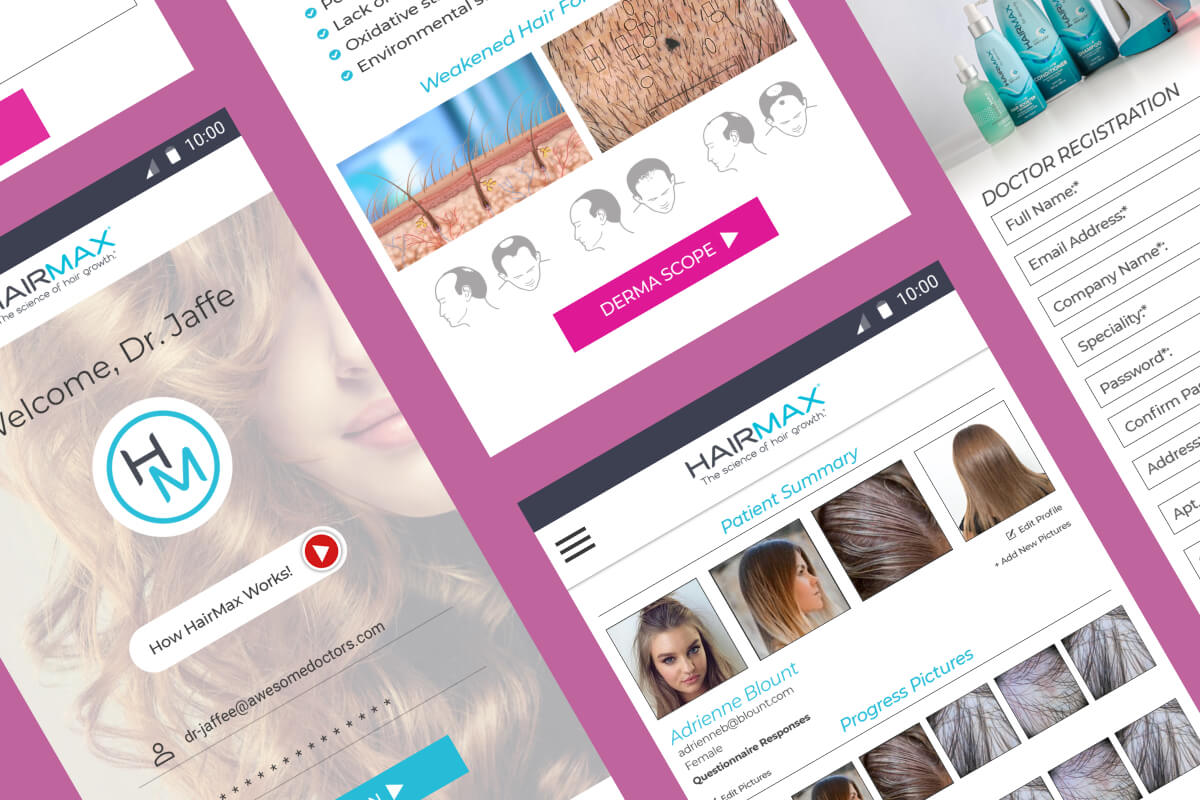
UppLabs successfully delivers projects for customers from all around the world. One of the last projects we had was the development of a mobile application for trichologists to prevent hair loss of their clients which was called HairMax.
Healthcare, Social contributions, Technology, UppLabs
May 29, 2020
As a company with a social mission, UppLabs couldn’t stay aloof the situation with the COVID-19 outbreak. According to general statistics, one-third of the US population having depression. And in forced isolation conditions lots of people find themselves struggling with anxiety, depression, loneliness, stress, and fear. Many of them can’t reach out to their doctor, the rest don’t know they ever needed to reach out to somebody. So we decided to help them online. Please meet a chatbot and a website to help people with depression!
Ready to discuss your idea?

WAIT! Book Your FREE Technical Session Call!
Got any questions before you enroll or maybe you'd like a full behind-the- scenes demo? Schedule a call with the team below!
Book Call Now Limited Slots Available