Picture this: two identical houses on the same street. Same square footage, same condition, same everything. Yet one appraises for $472,000 and the other for $750,000. The difference? The appraiser knew the race of the homeowner.

This isn’t a hypothetical scenario—it’s based on a real case that made national headlines in 2022. And it’s just one symptom of a much larger problem: traditional property appraisals are broken. They’re slow, expensive, subjective, and increasingly proven to be biased.

Enter machine learning. AI-powered property valuation is fundamentally changing how real estate gets valued, and the results are compelling: 96% accuracy rates, instant valuations, and the potential to eliminate human bias. But like any powerful technology, it comes with its own set of challenges.

Why Traditional Appraisals Are Failing

Let’s be honest about the problems with traditional appraisals:

They’re Inconsistent

Low appraisals affect 8-10% of real estate transactions. That might not sound like much until you realize it means roughly one in ten deals faces potential collapse because the appraiser’s subjective assessment doesn’t match the market. The process relies heavily on “comparable sales,” but what counts as comparable is surprisingly subjective. Is a house a mile away comparable? Half a mile? Same neighborhood but different school district?

Two appraisers looking at the same property can arrive at wildly different values, and both can technically be “right” within the standards. That’s not a feature—it’s a bug.

They’re Slow and Expensive

Traditional appraisals take 7-10 days and cost $300-$600. In a hot market where properties sell in days, that’s an eternity. Sellers wait, buyers wait, deals fall through. The process involves physical inspections, manual comparable selection, and extensive paperwork. It’s basically unchanged since the 1970s.

Meanwhile, Zillow’s Zestimate updates instantly based on new market data. It’s not perfect, but instant beats slow when you’re trying to price a listing.

They Carry Historical Bias

Here’s the uncomfortable truth: appraisal bias is real and measurable. A 2024 Freddie Mac study found that 12.5% of homes in Black communities appraised below contract price, compared to 7.4% in white neighborhoods and 9.4% in Latino areas. That’s a significant disparity that affects wealth building across entire communities.

The problem has deep historical roots. Frederick Babcock’s influential 1931 appraisal manual explicitly stated that racial composition affected property values. While those overtly racist standards were officially removed by the mid-1970s, the effects persist. Some appraisers working today were literally trained when those standards were in place.

And even well-intentioned appraisers can carry unconscious bias that affects valuations. The industry is 85% white and 78% male—not exactly representative of the diverse communities being appraised.

How AI Changes the Game

Machine learning models approach property valuation completely differently. Instead of relying on one appraiser’s judgment about three comparable sales, they analyze thousands of data points across millions of transactions.

The Data Advantage

AI valuation systems pull from sources traditional appraisers can’t efficiently process:

  • MLS records: Every listing, sale, and price change in real-time
  • Public records: Tax assessments, deeds, permits, zoning changes
  • Market indicators: Economic data, employment trends, mortgage rates
  • Geospatial data: Proximity to schools, transit, amenities, infrastructure projects
  • Visual analysis: Computer vision algorithms that assess condition from photos
  • Unstructured data: Listing descriptions, neighborhood sentiment, development plans

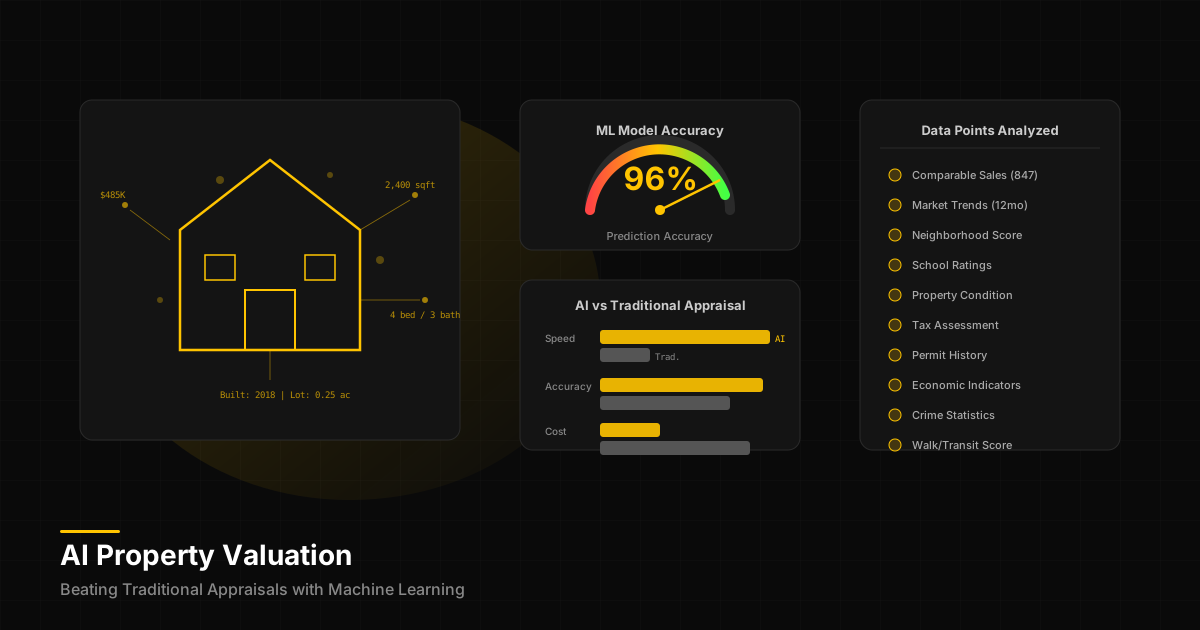
A 2025 study from the University of Manchester demonstrated an AI system achieving 96% accuracy by combining millions of property transactions with energy performance data, local economic indicators, and market forces. That’s not just matching traditional appraisals—it’s surpassing them.

The Models That Power It

The most effective AI valuation systems use ensemble approaches combining multiple algorithms:

Gradient Boosting (XGBoost, LightGBM): Excellent at finding non-linear relationships between features. These models identify complex patterns like how school quality interacts with commute time and neighborhood age.

Random Forests: Great for handling mixed data types and providing feature importance rankings. They tell you which factors actually drive value in specific submarkets.

Neural Networks: Excel at processing images and unstructured data. They can assess property condition, architectural style, and even curb appeal from photos.

Time-Series Models: Capture seasonal patterns, market momentum, and trend changes that affect pricing.

The key is combining these approaches. A single model might be brittle, but an ensemble that weighs multiple predictions tends to be more robust and accurate.

Real-World Performance

The results speak for themselves:

Speed: Instant valuations vs. 7-10 day traditional appraisals

Cost: Pennies per valuation vs. $300-$600 for traditional appraisals

Accuracy: Top systems achieve 95-96% accuracy (median prediction error under 5%)

Consistency: Same inputs = same output every time, eliminating appraiser-to-appraiser variance

Scalability: Value entire portfolios or submarkets instantly

A recent implementation reduced valuation errors by up to 30% compared to traditional methods while processing valuations in milliseconds rather than days.

The Bias Question: Does AI Help or Hurt?

Here’s where things get complicated. AI can reduce bias—or amplify it, depending on how it’s built.

The Potential for Fairness

AI models don’t care about the race of the homeowner. They can’t see family photos or make assumptions based on someone’s accent during a walkthrough. In theory, they should be more objective.

Well-designed systems can actively promote fairness by:

  • Using broader geographic ranges for comparables, reducing neighborhood-based disparities
  • Focusing on objective features (square footage, bedrooms, lot size) rather than subjective assessments
  • Identifying and correcting for systematic undervaluation patterns in specific areas
  • Providing transparent explanations for valuations that can be audited for bias

The Risk of Perpetuating Bias

But here’s the catch: if you train an AI model on historical data that contains bias, the model learns that bias. If Black neighborhoods have been systematically undervalued for decades, a naive ML model will learn to undervalue them too.

This is exactly what regulators worry about. Federal agencies have made it clear that using AI doesn’t exempt you from fair housing laws. The algorithms themselves can create disparate impact liability if they produce discriminatory outcomes.

What this means in practice: You can’t just throw data at an XGBoost model and call it a day. You need to actively test for and mitigate bias through careful feature selection, fairness constraints, and ongoing monitoring.

Building Fair AI Valuation Systems

If you’re building or implementing AI property valuation, here’s how to do it responsibly:

1. Clean Your Data

Remove features that could serve as proxies for protected characteristics:

Risky features: Specific street addresses (use broader geographic zones), school names (use ratings/performance metrics), detailed neighborhood names if they correlate with demographics

Safe features: Square footage, lot size, bedrooms/bathrooms, property age, condition scores, distance to amenities, market-level indicators

2. Test for Disparate Impact

Analyze your model’s predictions across demographic groups:

  • Compare median valuations in comparable neighborhoods with different racial compositions
  • Check if your model systematically over- or under-predicts in certain areas
  • Use statistical tests (like the 80% rule) to identify disparities

If you find disparities, you need to document them and implement corrections before deployment.

3. Build in Explainability

Black-box models don’t fly in real estate. You need to explain why a property got a particular valuation. Use techniques like SHAP (SHapley Additive exPlanations) to show which features drove the prediction.

When a valuation is contested, you should be able to say: “The model valued this property at $450K because comparable sales in the last 6 months averaged $445K, it’s 10% larger than average, but the age penalty offset the size bonus.” Vague “the algorithm said so” doesn’t cut it.

4. Monitor Continuously

Models drift as markets change. Set up ongoing monitoring:

  • Track prediction errors by geography and property type
  • Compare predictions to actual sale prices when available
  • Re-test for bias quarterly
  • Retrain models when market conditions shift significantly

5. Combine AI with Human Oversight

The best systems use AI for initial valuations and flag outliers for human review. If a prediction seems way off based on local knowledge, have an expert look at it. AI should augment human judgment, not replace it entirely.

Real-World Applications

AI property valuation isn’t theoretical—it’s being deployed right now across the industry:

For Buyers and Sellers

Zillow’s Zestimate and Redfin’s estimate provide instant ballpark valuations. While not appraisal-grade, they help buyers know if a listing is priced fairly and help sellers set realistic expectations before listing.

For Lenders

Automated Valuation Models (AVMs) are increasingly used for refinancing and home equity loans where risk is lower. They speed up approvals and reduce costs. For purchase mortgages, lenders often use AVMs for initial screening then order traditional appraisals for high-value properties.

For Investors

Portfolio managers use AI to value thousands of properties simultaneously, identify undervalued opportunities, and forecast market trends. The ability to analyze entire submarkets in minutes beats traditional methods by orders of magnitude.

For Property Tax Assessment

Cities are adopting AI for mass appraisals to ensure fair property tax assessments across thousands or millions of properties. This promotes equity by reducing assessor-to-assessor variation.

What the Future Holds

The AI in real estate market is projected to reach $1.3 trillion by 2030, growing at nearly 34% annually. Property valuation is leading this charge, with AI potentially automating 37% of real estate tasks—representing $34 billion in efficiency gains.

Expect to see:

  • Hybrid models: AI handles routine valuations, humans handle complex or high-value properties
  • Computer vision advances: Models that assess condition, renovations, and even estimate repair costs from photos
  • Integration with BIM: Building Information Modeling data feeding directly into valuation models for unprecedented accuracy
  • Real-time updates: Valuations that adjust instantly as new comparable sales or market data becomes available
  • Regulatory clarity: Standards for AVM quality, bias testing, and transparency requirements

The federal government has already proposed Quality Control Standards for AVMs, requiring testing for bias and accuracy. This regulatory attention will push the industry toward more responsible AI implementation.

The Bottom Line

AI doesn’t just match traditional appraisals—it surpasses them in speed, cost, and often accuracy. But it’s not magic, and it’s not automatically fair.

The technology is mature enough for production use right now. Systems achieving 95%+ accuracy are commercially available. The question isn’t whether AI can value properties well—it’s whether we’ll build these systems responsibly.

For real estate platforms, lenders, and PropTech companies, AI valuation represents a massive efficiency opportunity. But getting it right requires:

  • Thoughtful feature engineering to avoid bias proxies
  • Rigorous testing for disparate impact
  • Explainable models that can justify their predictions
  • Ongoing monitoring and retraining
  • Smart combination of AI efficiency with human expertise

Done right, AI property valuation can make real estate markets more efficient, accessible, and fair. Done wrong, it risks automating and scaling the very biases we’re trying to eliminate. The technology is ready. The question is whether the industry is.


Key Takeaways

  1. Traditional appraisals have serious problems: inconsistency (8-10% fail), high cost ($300-$600), slow turnaround (7-10 days), and documented racial bias
  2. AI achieves 95-96% accuracy by analyzing millions of data points: MLS records, public data, market indicators, geospatial data, and visual analysis
  3. Speed and cost advantages are massive: instant valuations at pennies per property vs. week-long waits and hundreds of dollars
  4. Bias is a double-edged sword: AI can reduce human bias OR perpetuate historical bias depending on implementation
  5. Responsible implementation requires: clean data, disparate impact testing, explainability, continuous monitoring, and human oversight
  6. Market growth is explosive: $1.3T by 2030, $34B in efficiency gains, 37% task automation potential