Building an AI product has never been easier. Building one that customers actually need, trust, and are willing to pay for remains a much harder challenge.
AI MVP development helps companies validate customer demand, technical feasibility, and business viability before investing in full-scale engineering. Instead of building complex AI systems based on assumptions, businesses can test focused solutions, measure results, and make evidence-based investment decisions.
With the right AI MVP development services, companies can reduce development risks, accelerate market entry, and establish a technical foundation for future growth.
TL;DR
- AI MVP validates customer demand, technical feasibility, and business viability.
- AI proof of concept tests technical feasibility, while MVP development evaluates real product value.
- Successful development starts with a business problem rather than technology selection.
- Architecture should balance model reliability, scalability, security, and inference costs.
- AI product validation combines customer behavior, model performance, and business metrics.
What Is an AI MVP?
AI MVP (Artificial Intelligence Minimum Viable Product) is an initial functional version of an AI-powered product designed to validate a business hypothesis with real users while minimizing investment and technical complexity. Unlike traditional software MVPs, AI-powered products must validate not only customer demand but also model reliability, data quality, and operational economics.
Minimum viable product AI development focuses on three dimensions of viability: product, technical, and economic. Customers must experience measurable value, AI must deliver sufficiently reliable results, and operational savings or revenue must justify development and running costs.
For example, an insurance AI MVP could focus on document classification, data extraction, and human verification before introducing automated decisions. UppLabs' Claimora case study illustrates how AI-powered document processing can address operational bottlenecks and reduce manual work.
AI Proof of Concept vs MVP
AI proof of concept vs MVP represents a choice between testing technical feasibility and validating actual product value. Both approaches reduce uncertainty but address different stages of product development. Proof of concept (PoC) establishes whether an AI solution can work under defined conditions. MVP development introduces that capability into a usable product, while a pilot evaluates performance within a controlled operational environment.
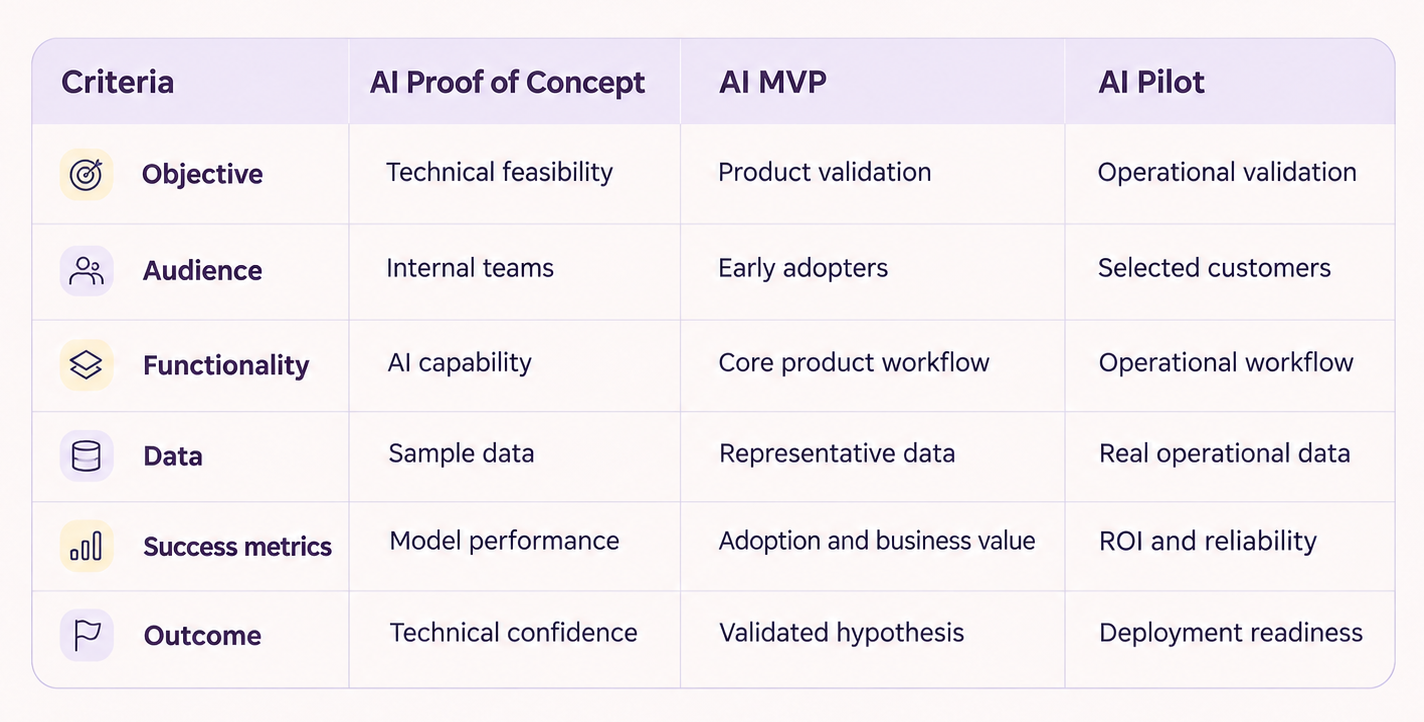
Start with a PoC when model performance or data quality remains uncertain. Proceed directly to MVP development when technical feasibility and customer needs are sufficiently understood.
How to Build an AI MVP
Successful AI MVP development follows a structured process that connects technical decisions with measurable business outcomes. Each stage should reduce uncertainty before additional resources are committed.
1. Define the Business Problem
Identify a specific customer problem that AI can solve more effectively than existing software or manual processes. Define target users, workflow inefficiencies, expected improvements, and measurable business success criteria before selecting the technology stack.
2. Assess Data and AI Readiness
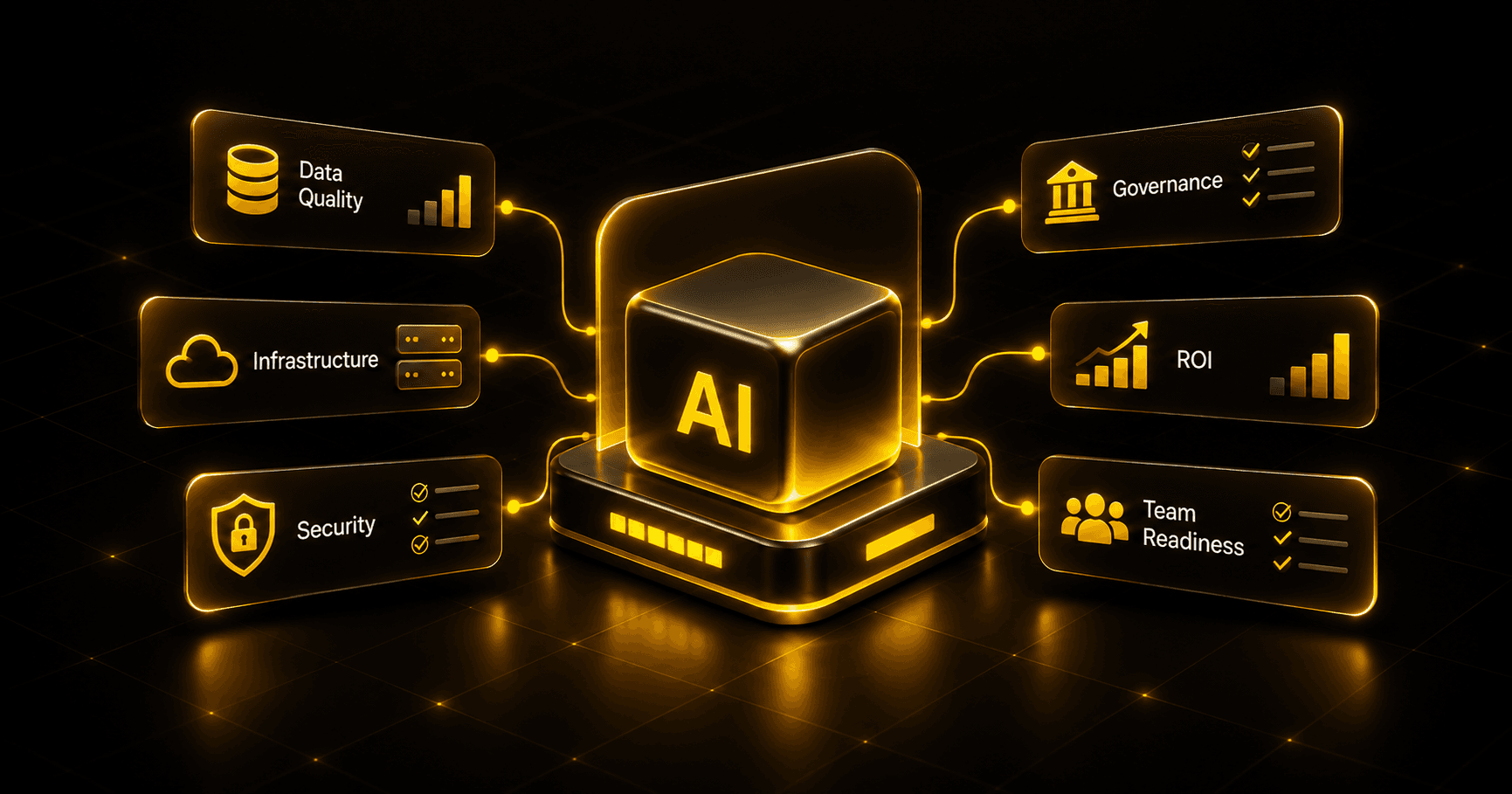
Reliable AI requires relevant, accessible, and sufficiently accurate data. Evaluate data availability, ownership, quality, privacy restrictions, and integration requirements before selecting a model. Our AI readiness assessment guide explains how businesses can evaluate their technical and operational foundations before implementing AI. Early assessment helps identify potential limitations before they become expensive development challenges.
3. Define the Minimum Feature Set
Focus on the smallest complete workflow capable of delivering measurable customer value. Features unrelated to the core business hypothesis should remain outside the initial release. For an AI document processing product, essential functionality might include document upload, automated extraction, result verification, and structured data export. Advanced analytics and autonomous decisions can follow after validation.
4. Select Architecture and AI Model
Model selection should reflect product requirements rather than technology trends. Existing AI APIs, open-source models, retrieval-augmented generation (RAG), and custom machine learning models address different business needs. UppLabs' AI and machine learning development services help businesses select and integrate appropriate AI technologies. This approach balances implementation complexity with performance and long-term scalability.
5. Develop and Launch
Integrate AI capabilities into a functional product with a user interface, backend services, authentication, and analytics. Include error handling, feedback collection, model evaluation, and security controls from the beginning.
6. Validate and Iterate
Real-world usage reveals issues that isolated model benchmarks cannot identify. Analyze customer feedback, AI errors, and operational metrics to prioritize improvements based on evidence rather than assumptions.
AI MVP Architecture
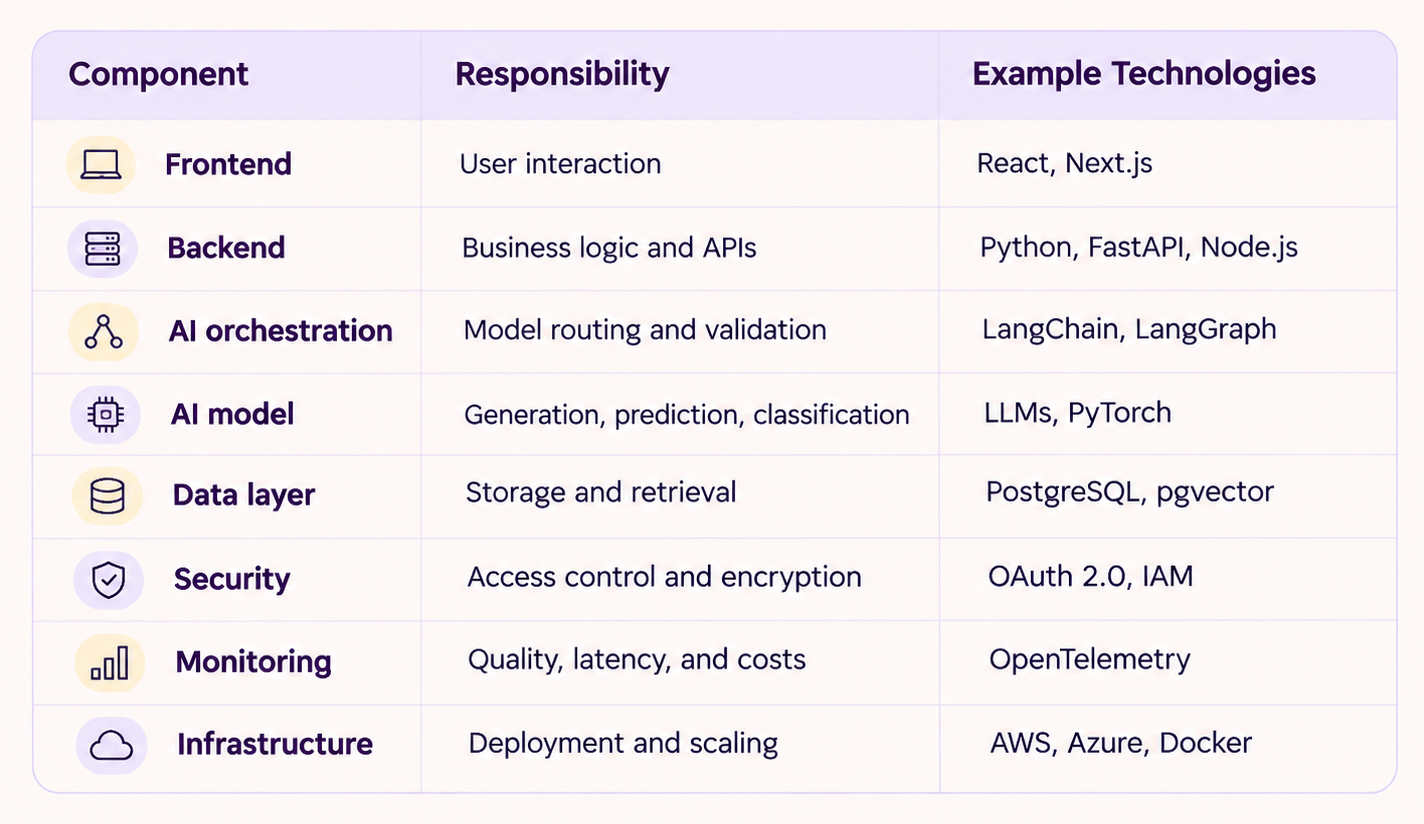
Effective AI MVP architecture balances development speed, reliability, and future scalability. Modular design allows teams to replace models, improve data pipelines, and extend functionality without rebuilding the entire application.
Core AI MVP Architecture Components
Choosing the Right MVP AI Model
Selecting an MVP AI model requires evaluating accuracy, latency, privacy, customization, and operating costs. Existing AI APIs accelerate development, while retrieval-augmented generation (RAG) enables access to proprietary knowledge and documents.Fine-tuned models support specialized tasks, whereas custom machine learning models are suitable for prediction, classification, and risk scoring. Hybrid architectures combine AI capabilities with deterministic business rules when greater control and reliability are required.Industry requirements also influence architecture. UppLabs' clinical AI assistant implementation illustrates the importance of healthcare data integration, AI capabilities, and human oversight within a unified system.
AI Product Validation
AI product validation determines whether a product solves a meaningful customer problem reliably and economically. Positive feedback during demonstrations is insufficient without evidence of sustained usage and measurable business impact.
How to Validate AI Product Performance
Product teams should evaluate four dimensions:
- Customer value: Activation, retention, task completion, and willingness to pay.
- AI reliability: Accuracy, hallucinations, incorrect outputs, and human correction rates.
- Operational efficiency: Processing time, response latency, and manual intervention.
- Business viability: Inference costs, revenue potential, and cost per successful task.
Define measurable success thresholds before launching the MVP. Compare results against existing workflows to determine whether AI delivers sufficient improvement. For example, an AI document processing product may demonstrate high extraction accuracy but still require significant manual verification. Measuring accuracy alongside review time and cost per processed document provides a more realistic understanding of product value.
AI Driven Product Validation
AI-driven product validation helps teams analyze customer feedback, identify behavioral patterns, and detect recurring product issues. Automated analysis can classify complaints, identify workflow bottlenecks, and support data-driven development priorities. However, AI-generated insights should complement customer interviews and observed behavior. Sustainable product-market fit requires evidence of repeatable customer value.
AI MVP Development Decision Framework
Choosing between discovery, prototyping, MVP development, and scaling depends on the available evidence. Businesses should prioritize activities that address their most significant remaining uncertainty.
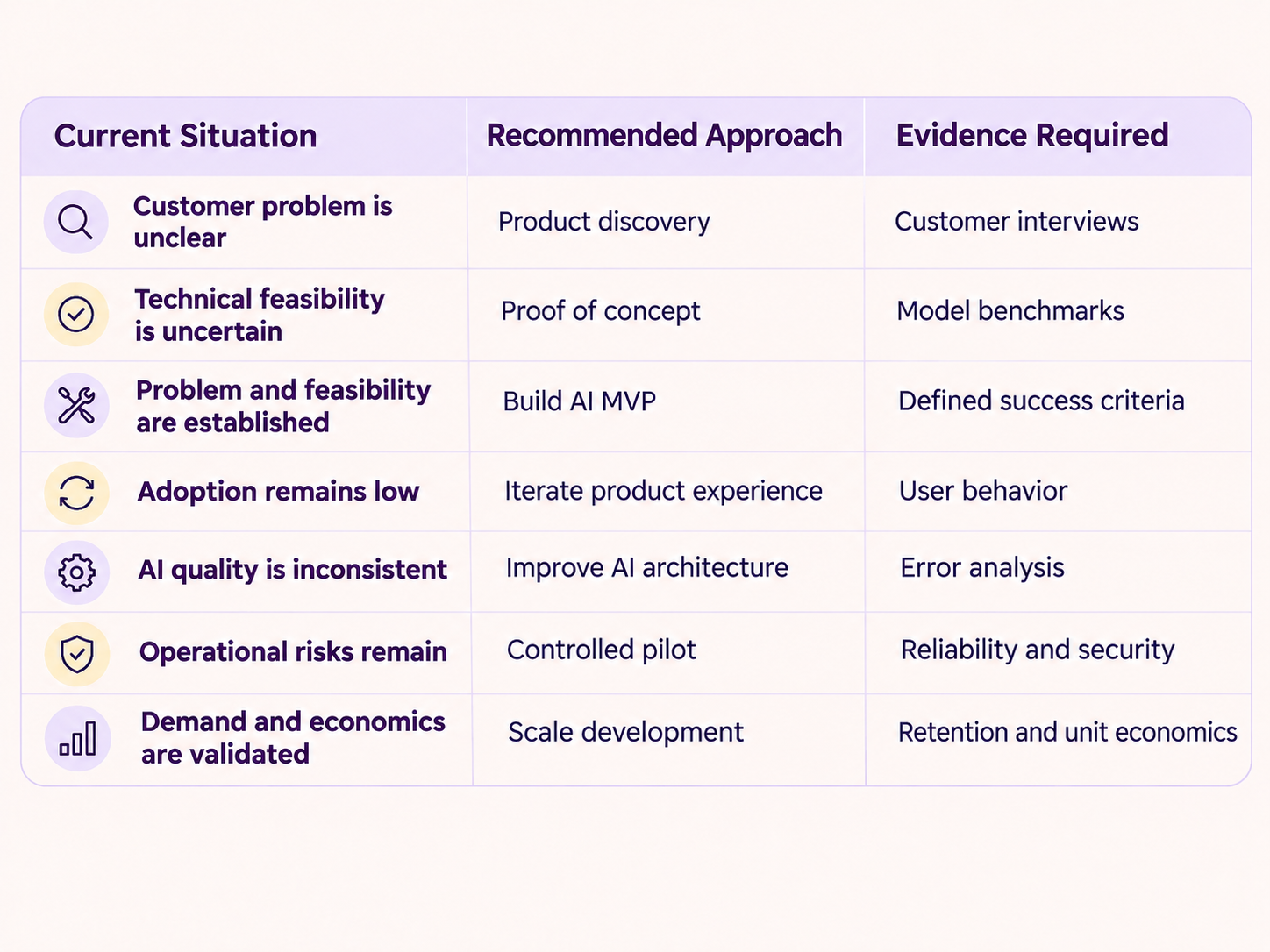
Businesses should establish clear decision thresholds before development begins. Strong model performance alone does not justify scaling if customer adoption remains low or operating costs exceed the value generated. For companies evaluating multiple AI opportunities, AI consulting services can help prioritize initiatives based on business impact, technical readiness, and implementation complexity. Structured assessment ensures that development resources address opportunities with measurable business potential.
AI MVP Development Cost and Timeline
Focused AI MVP projects can take several weeks, while solutions involving custom models, multiple integrations, or regulated data may require several months. Development costs depend on product discovery, UX/UI design, data preparation, model selection, backend engineering, and security requirements. Operational expenses are equally important. Model usage, infrastructure, monitoring, data storage, and human verification directly influence long-term profitability. Businesses can reduce initial investment by limiting product scope, using existing AI models where appropriate, and prioritizing essential integrations. UppLabs' MVP development services help companies define an appropriate development scope, architecture, and timeline based on individual business requirements.
Common AI MVP Development Mistakes
Many AI initiatives struggle because teams prioritize technical capabilities over measurable business outcomes. Selecting models before validating customer needs, building unnecessary features, and overlooking data quality increase development costs and delay market validation.
Ignoring inference costs, model evaluation, and human oversight creates additional risks as products move toward production. Risk-sensitive industries such as FinTech and Healthcare require particular attention to reliability, security, and AI governance.
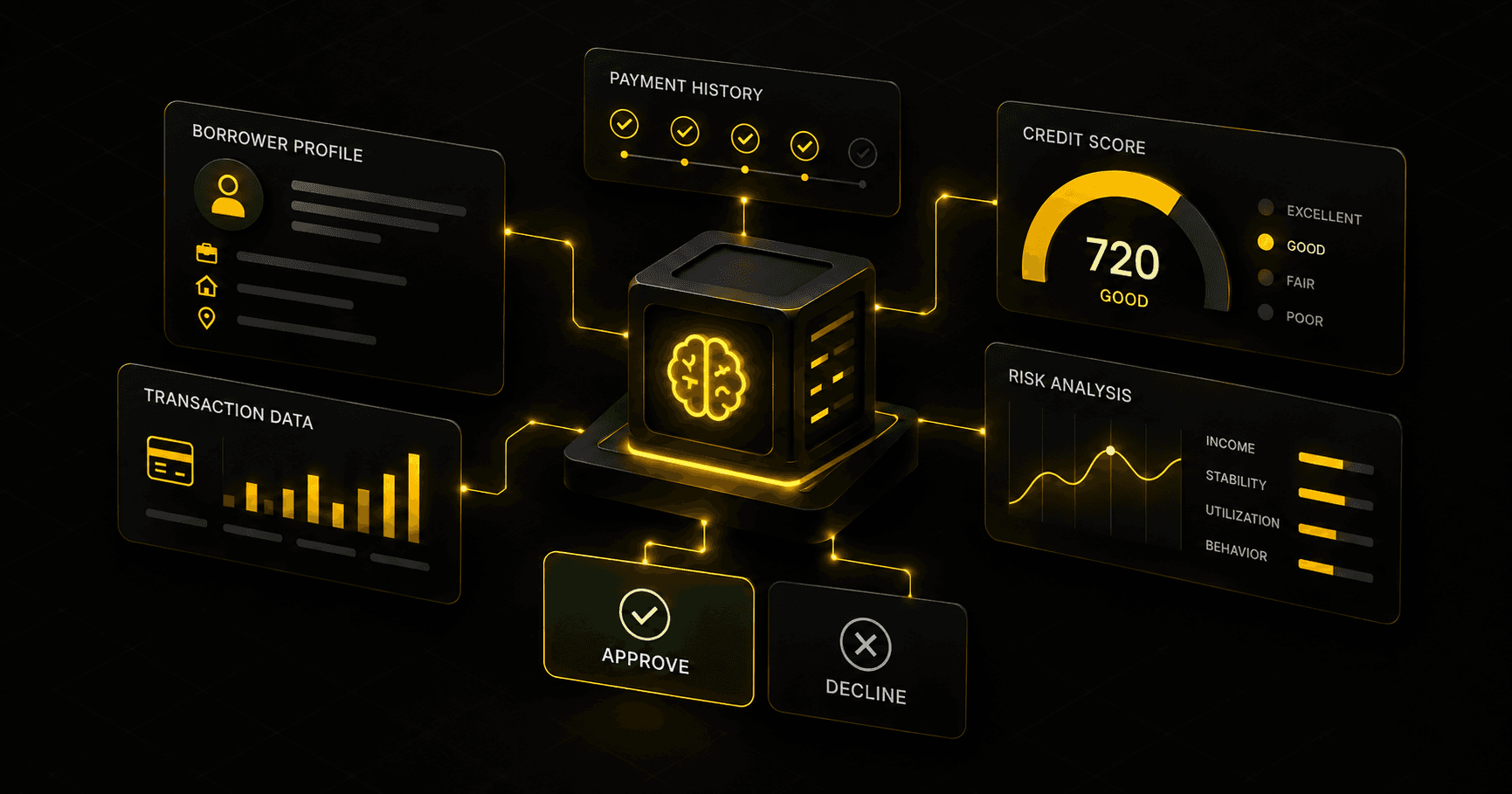
Our guide to AI fraud detection in FinTech explores how AI can support decision-making within established business workflows. Combining intelligent automation with appropriate controls helps businesses manage risks without sacrificing operational efficiency.
How to Choose an AI MVP Development Company
Choosing an AI MVP development company requires evaluating both engineering expertise and product development capabilities. Experienced AI MVP builders should understand how technical decisions affect commercial outcomes.
Look for a development partner with:
- Practical AI product development experience.
- Product discovery and validation expertise.
- Flexible architecture and integration capabilities.
- Security and AI governance knowledge.
- Transparent development milestones.
UppLabs combines AI engineering with end-to-end product development across FinTech, Healthcare, and PropTech. Our approach connects business objectives with technical implementation, helping companies validate opportunities before committing to larger investments.
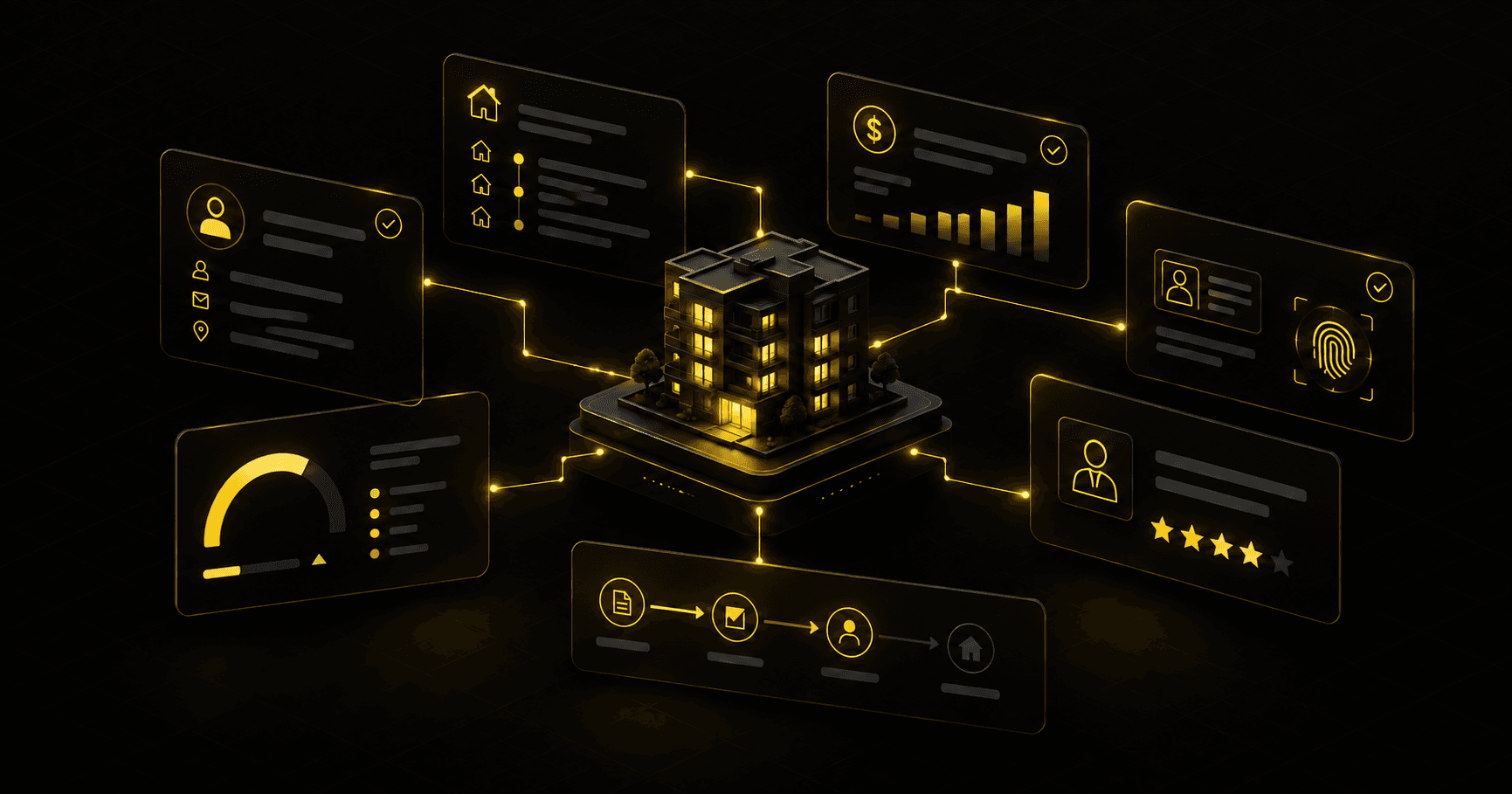
Projects such as HomeToro demonstrate our MVP development experience, while Amiqa illustrates AI integration within business workflows. Explore our portfolio and case studies to see how technology addresses industry-specific business challenges.
Turn Your AI Idea Into a Validated Product
Successful AI products begin with evidence, not assumptions. UppLabs helps businesses validate AI opportunities, select appropriate architectures, and develop products that address genuine market needs.
Whether you need to test an AI concept, launch an MVP, or prepare an existing prototype for production, our team can help define the right development strategy. Contact UppLabs to discuss your AI MVP project and establish a roadmap from initial hypothesis to market-ready product.
FAQ
What is MVP AI meaning in product development?
MVP AI meaning refers to the minimum viable version of an AI-powered product used to test a business hypothesis with real users. It helps validate customer demand, technical feasibility, and business viability before investing in full-scale development.
What is the MVP in AI meaning compared to traditional software?
MVP in AI means building a functional product that evaluates both customer value and AI performance. Traditional MVPs primarily validate functionality and demand, while AI MVPs additionally assess model reliability, data quality, and operating costs.
Can I use an AI MVP builder instead of custom development?
AI MVP builder platforms can accelerate prototyping through prebuilt models and low-code tools. Custom development is more appropriate for complex integrations, proprietary data, specialized workflows, and regulated industries.
How long does AI MVP development take?
Focused AI MVP development may take several weeks when requirements are clear and suitable models are available. Complex architectures, custom model training, extensive integrations, or regulatory requirements can extend development to several months.
Do I need a custom AI model to build an AI MVP?
Custom models are not always necessary for initial development. Existing AI APIs, open-source models, and RAG architectures can provide sufficient functionality to validate many business hypotheses before investing in proprietary model development.
What do AI MVP development services include?
AI MVP development services typically include product discovery, feasibility assessment, architecture design, model selection, UX/UI design, development, testing, deployment, and validation. Specific deliverables depend on business requirements, technical complexity, and target market.