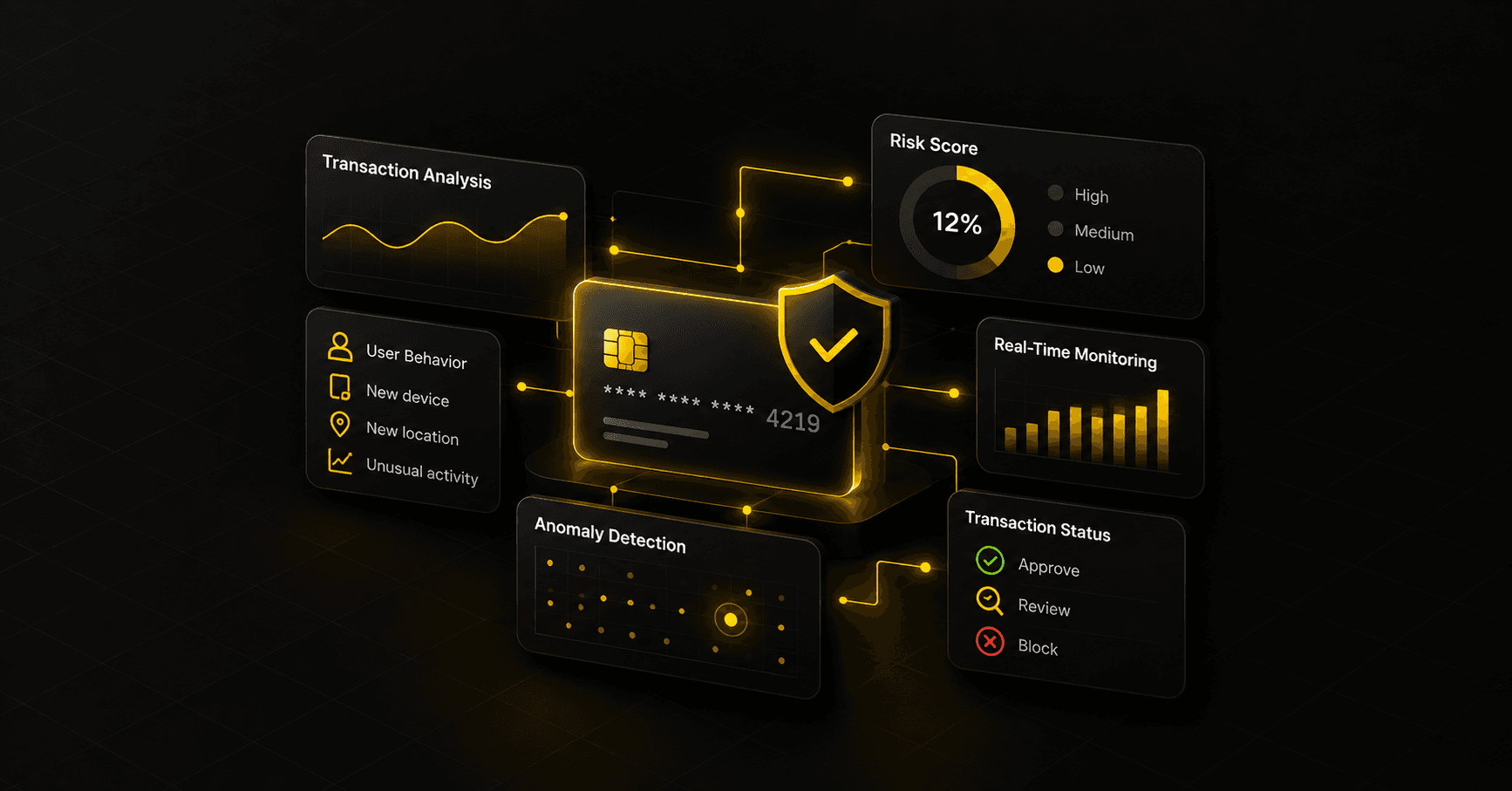
Fraudulent transaction can look completely normal until you compare it with everything happening around it. The amount may be reasonable. The account may be legitimate. The credentials may even be correct. But the device is new, the location is unusual, several payment attempts happened within minutes, and the customer's behavior does not match their previous activity. This is where fraud detection in fintech is moving beyond static rules.
Modern AI fraud detection systems analyze transaction data, behavioral patterns, device signals, historical activity, and other risk indicators together. Instead of asking whether a transaction violates one predefined rule, machine learning fraud detection estimates how closely the activity resembles legitimate or fraudulent behavior, often while the transaction is still in progress.
For fintech companies, the challenge is therefore no longer simply how to detect fraudulent transactions. It is how to build a fraud detection system that identifies evolving threats in real time without creating unnecessary friction for legitimate customers.
TL;DR
- AI fraud detection combines transaction data, behavioral signals, device information, historical patterns, and risk rules to identify suspicious activity.
- Machine learning fraud detection can identify patterns that static rules may miss and adapt as transaction behavior changes.
- Real-time fraud detection requires more than a trained model: data pipelines, feature processing, low-latency scoring, decision logic, monitoring, and feedback loops are equally important.
- Fraud risk scoring is usually more practical than a simple fraud/not-fraud decision because transactions can be approved, reviewed, challenged, or blocked according to risk.
- The right fraud detection architecture depends on transaction volume, available historical data, latency requirements, fraud patterns, regulatory requirements, and the cost of false positives.
What Is AI Fraud Detection?
AI fraud detection is the use of machine learning and related analytical techniques to identify transactions or user behavior that may indicate fraud. Traditional financial fraud detection has relied heavily on predefined rules. A transaction might be flagged because its value exceeds a threshold, originates from a particular location, or several transactions occur within a short period. Those rules remain useful. The problem is that fraud rarely stays static. A machine learning fraud detection model can evaluate relationships between many signals simultaneously and learn patterns from historical transaction data. This makes it possible to detect activity that does not violate an obvious rule but differs significantly from normal customer behavior.
The distinction is particularly important for fraud detection in financial services, where systems may need to process large transaction volumes while making decisions quickly enough to avoid interrupting payments. AI does not eliminate rules. In production systems, the stronger approach is often to combine rules, machine learning models, behavioral analytics, and human review. That is the core difference when comparing AI vs rule-based fraud detection: rules encode known conditions, while machine learning can help identify patterns and relationships that were not explicitly programmed.
How Does AI Fraud Detection Work?
AI fraud detection works by turning transaction and contextual data into risk signals, evaluating those signals with rules and fraud detection algorithms, and producing a decision or risk score. Imagine a customer who normally makes small domestic purchases from the same mobile device. Suddenly, the account initiates several higher-value transactions from a new device and unfamiliar location. None of those attributes necessarily proves fraud. Together, however, they create a pattern worth evaluating.
Real-time transaction monitoring system may analyze signals such as:
- transaction amount, currency, merchant, location, and time;
- account history and transaction velocity;
- device identity, IP address, geolocation, and session information;
- deviations from established behavioral patterns;
- previous fraud signals, chargebacks, and known suspicious patterns.
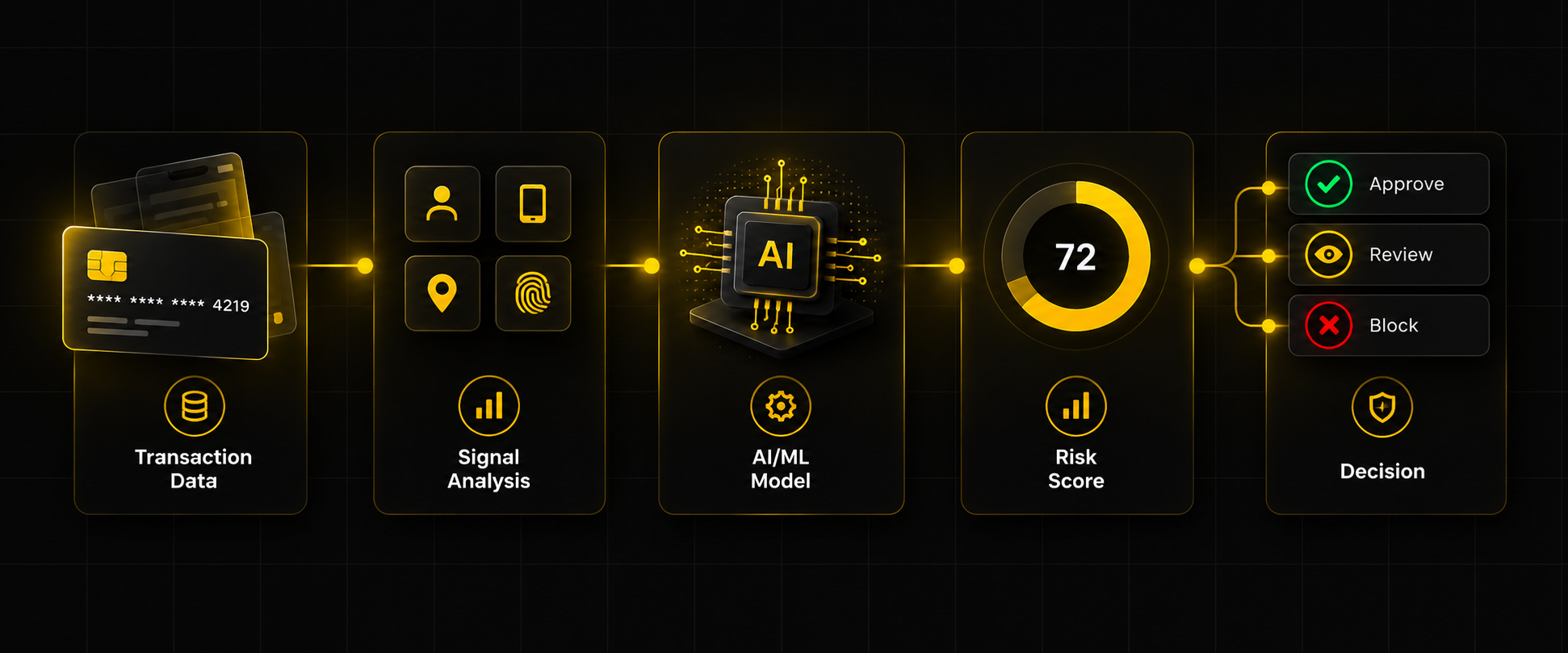
The fraud detection model then produces a probability or risk score. Business logic can use that score to approve the transaction, request additional verification, send it to manual review, or block it. This is why suspicious transaction detection should not be treated as a single ML prediction. It is a decision pipeline.
UppLabs applies this principle in its FinTech AI solutions, where fraud detection combines transaction analysis with behavioral and device signals. UppLabs also provides an interactive AI Fraud Detection Engine demonstrating multi-signal fraud risk scoring, velocity analysis, device analysis, confidence scoring, and approve/review/block recommendations.
How Is Machine Learning Used in Fraud Detection?
Machine learning is useful when fraud cannot be reliably represented by a manageable set of static rules. Instead of programming every suspicious scenario manually, teams train a fraud detection model using historical transaction data and relevant features. The model learns relationships associated with legitimate and fraudulent activity.
Supervised learning
When a company has sufficient labeled historical data, supervised learning can learn from transactions already classified as legitimate or fraudulent. The resulting model can estimate the probability that a new transaction belongs to either class. The difficulty is that fraud datasets are rarely balanced. Legitimate transactions normally outnumber confirmed fraudulent ones, while fraud patterns themselves change over time.
Unsupervised learning and anomaly detection
When labels are limited or teams need to identify previously unseen patterns, anomaly detection can help identify activity that differs significantly from established behavior. Anomaly detection in finance is particularly useful as an additional signal because unusual activity is not automatically fraudulent. A customer traveling abroad, making an unusually large purchase, or using a new device may look anomalous while still being legitimate. Effective fraud prevention therefore combines anomalies with context rather than blocking every deviation.
Behavioral analytics
Behavioral analytics for fraud detection adds another dimension. Instead of evaluating only the transaction itself, the system can compare current activity with the user's previous patterns. A payment may appear normal globally but be highly unusual for one specific account. This combination of supervised models, anomaly detection, behavioral signals, and deterministic rules is often more robust than relying on a single technique.
From Transaction Monitoring to Real-Time Fraud Detection
Transaction monitoring answers one question: what is happening?
“Real-time fraud detection must answer another: what should we do about it before the transaction completes?”
That difference has major architectural consequences.
Batch process that reviews transactions hours later may support investigations and reporting, but it cannot stop payment fraud at authorization time. Real-time transaction monitoring needs to collect and evaluate the required signals within the latency budget of the payment flow. The underlying fraud detection architecture therefore matters as much as model accuracy.
Production system typically needs a transaction ingestion layer, access to historical and contextual data, feature processing, model inference, a rules or decision layer, and monitoring. It also needs a feedback mechanism so confirmed fraud, legitimate transactions, chargebacks, and reviewer decisions can improve future detection.
UppLabs has implemented this type of approach in a real fintech project. Its Fintech Digital Gateway case study describes a payment platform where an ML-based system learns from transaction patterns and identifies anomalies in milliseconds, while Redis provides fast access to the data needed during processing. The broader platform uses a microservices architecture and was designed to handle high transaction volumes.
That example highlights an important engineering point: real-time fraud detection is not only an ML problem. It is also a data and software architecture problem.
Fraud Risk Scoring Instead of a Binary Decision
Not every suspicious transaction should be blocked. Binary model creates two outcomes: legitimate or fraudulent. Real-world transaction fraud detection often needs more flexibility. Fraud risk scoring assigns a risk level to each transaction based on the combined evidence. Transaction risk scoring can then support different responses.
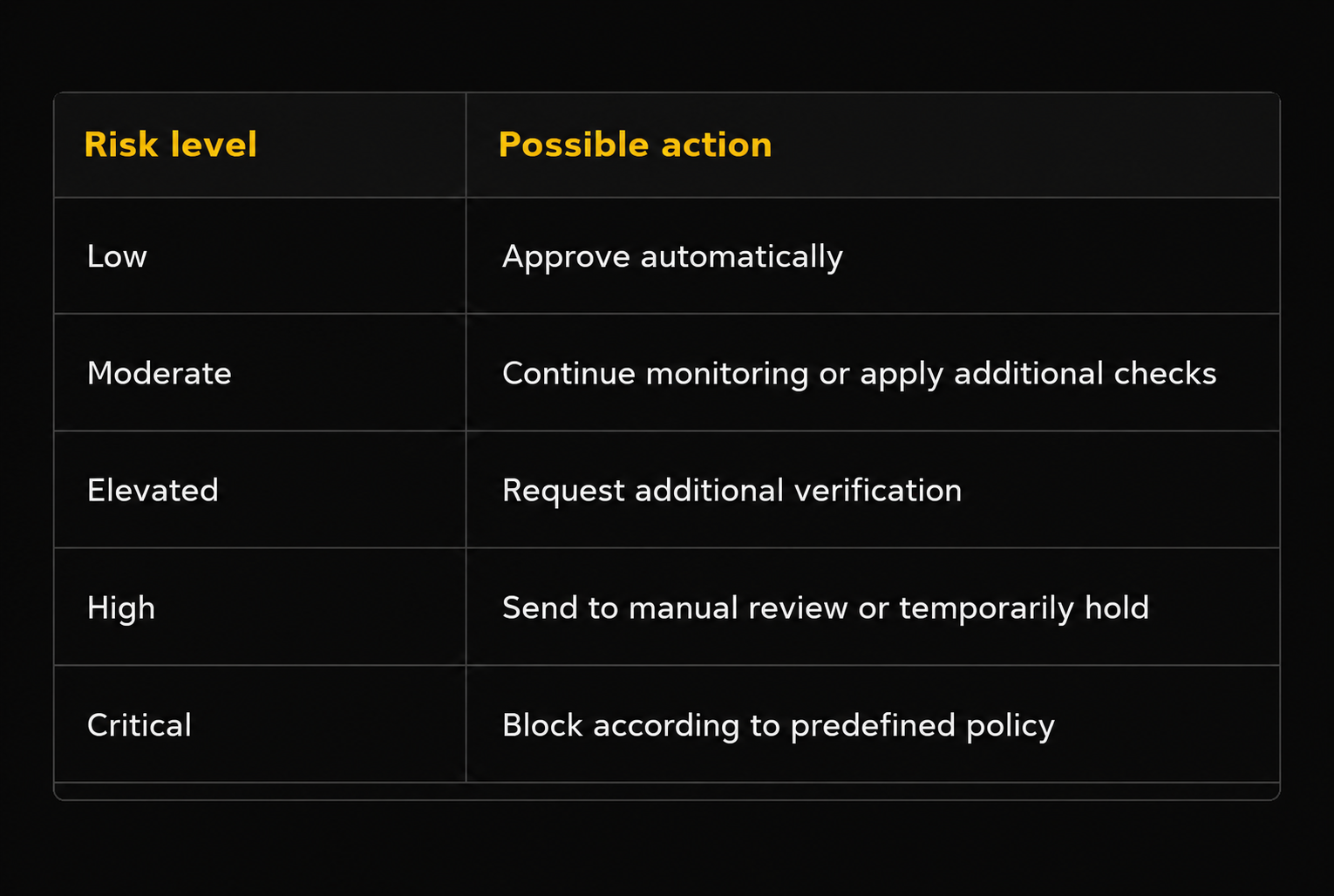
This approach allows fintech companies to align fraud prevention with business risk. It also helps address one of the hardest problems in payment fraud detection: false positives in fraud detection. Blocking fraud is valuable. Blocking legitimate customers is expensive too.
Excessive false positives can increase payment declines, manual review workloads, support requests, and customer frustration. Optimizing only for the percentage of fraud detected can therefore produce a system that performs well on paper but poorly in production. The goal should be to optimize the entire decision process.
Fraud Detection Software Is More Than the Model
A common mistake is to think that building AI fraud detection software primarily means choosing the best algorithm. The model is only one component. A useful fraud detection system also needs reliable access to transaction and behavioral data, consistent feature definitions, low-latency infrastructure, model versioning, monitoring, security controls, explainability, and feedback from real outcomes.
The difference becomes clearer when looking at the system as layers:
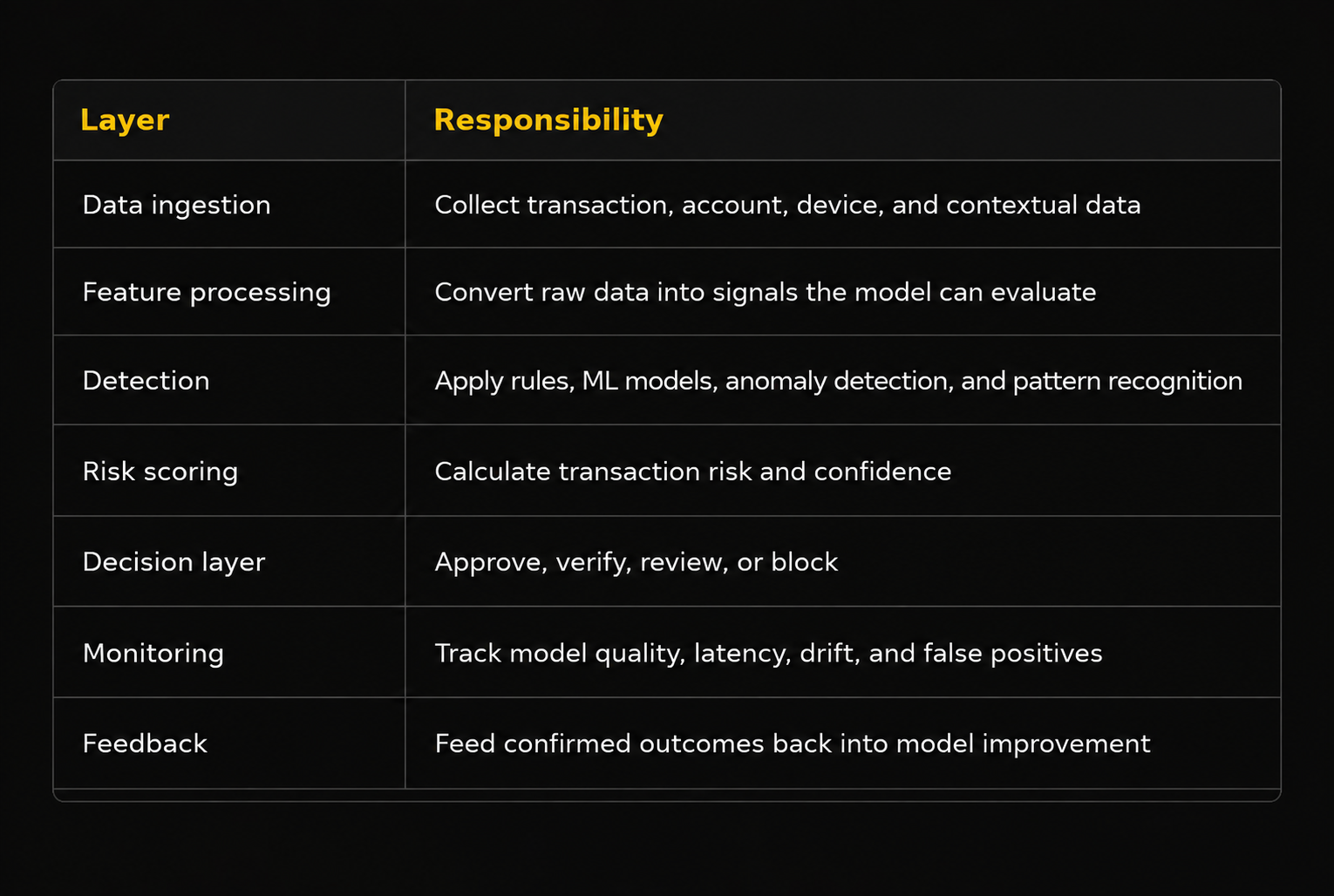
A fraud detection API may expose the scoring capability to payment services or other product components, but the API itself does not solve the underlying data and model lifecycle problems. This is one reason fintech development requires architecture decisions that go beyond AI. UppLabs' guide to the best FinTech development tech stack discusses how security, scalability, compliance, and AI/ML requirements influence technology choices in financial products.
Fraud Detection in Banking, Payments, and Financial Services
The underlying principles are similar, but financial fraud detection looks different depending on the product. Fraud detection in banking may involve account takeover, unusual transfers, abnormal login behavior, or suspicious changes to customer activity. Payment fraud detection may place greater emphasis on transaction velocity, device signals, payment history, location, and merchant context. Other fintech products may need to identify identity fraud, suspicious withdrawals, manipulated accounts, or coordinated behavior across multiple users.
The important point is that there is no universal fraud detection model. Model trained for one transaction environment may perform poorly in another because the users, products, data, risk tolerance, and fraud patterns are different. This is also why custom AI/ML implementation can make sense when fraud detection is central to the product. UppLabs' Fintech Software Development service combines financial software engineering with AI capabilities including real-time fraud detection, risk assessment, payments, and compliance-oriented architecture.
The Biggest Challenges in Machine Learning Fraud Detection
The hardest part of machine learning fraud detection is usually not training the first model. It is keeping the complete system useful as the environment changes. Fraud patterns evolve. Customer behavior changes. New products introduce new transaction patterns. Attackers deliberately test the boundaries of detection systems.
Teams therefore need to manage several problems at once: data quality, class imbalance, model drift, latency, explainability, security, and the operational cost of false positives. Model monitoring is essential. A model that performed well six months ago may gradually become less useful even though the software around it continues to function normally.
Human feedback matters as well. Manual review outcomes, confirmed fraud, disputes, chargebacks, and legitimate transactions can all become valuable feedback for future training. The objective is not to deploy a model once. It is to create a fraud detection system that can evolve.
Best Practices for Building an AI Fraud Detection System
For teams designing AI fraud detection software, the following principles reduce both technical and business risk:
- Start with the fraud scenarios and decisions you need to support, not with a preferred ML algorithm.
- Combine multiple signals instead of relying on transaction amount or a single anomaly.
- Use rules and machine learning together when they solve different parts of the problem.
- Measure false positives, false negatives, decision latency, manual review volume, and customer impact alongside detection performance.
- Build monitoring, explainability, retraining, and feedback loops into the architecture from the beginning.
The same principle applies to broader AI development: the model needs to fit the workflow and infrastructure around it. UppLabs discusses this broader integration approach in its article on AI agents in FinTech and other regulated industries, including the importance of human checkpoints and domain-specific validation.
Decision Framework: What Fraud Detection Approach Do You Need?
Before choosing fraud detection algorithms, software, or architecture, answer these questions:
- What fraud scenarios are you actually trying to detect?
- What transaction, user, device, and historical data can you access in real time?
- Do you have enough labeled fraud data for supervised learning?
- How quickly must the system return a decision?
- What is more expensive for your business: missed fraud or a false positive?
- Should the system approve/block transactions automatically or support human review?
- How will confirmed outcomes return to the model as feedback?
These answers determine whether you need a relatively simple rules-and-risk system, an ML-based scoring layer, anomaly detection, or a more sophisticated real-time fraud detection architecture.
They also help answer another practical question: build or buy?
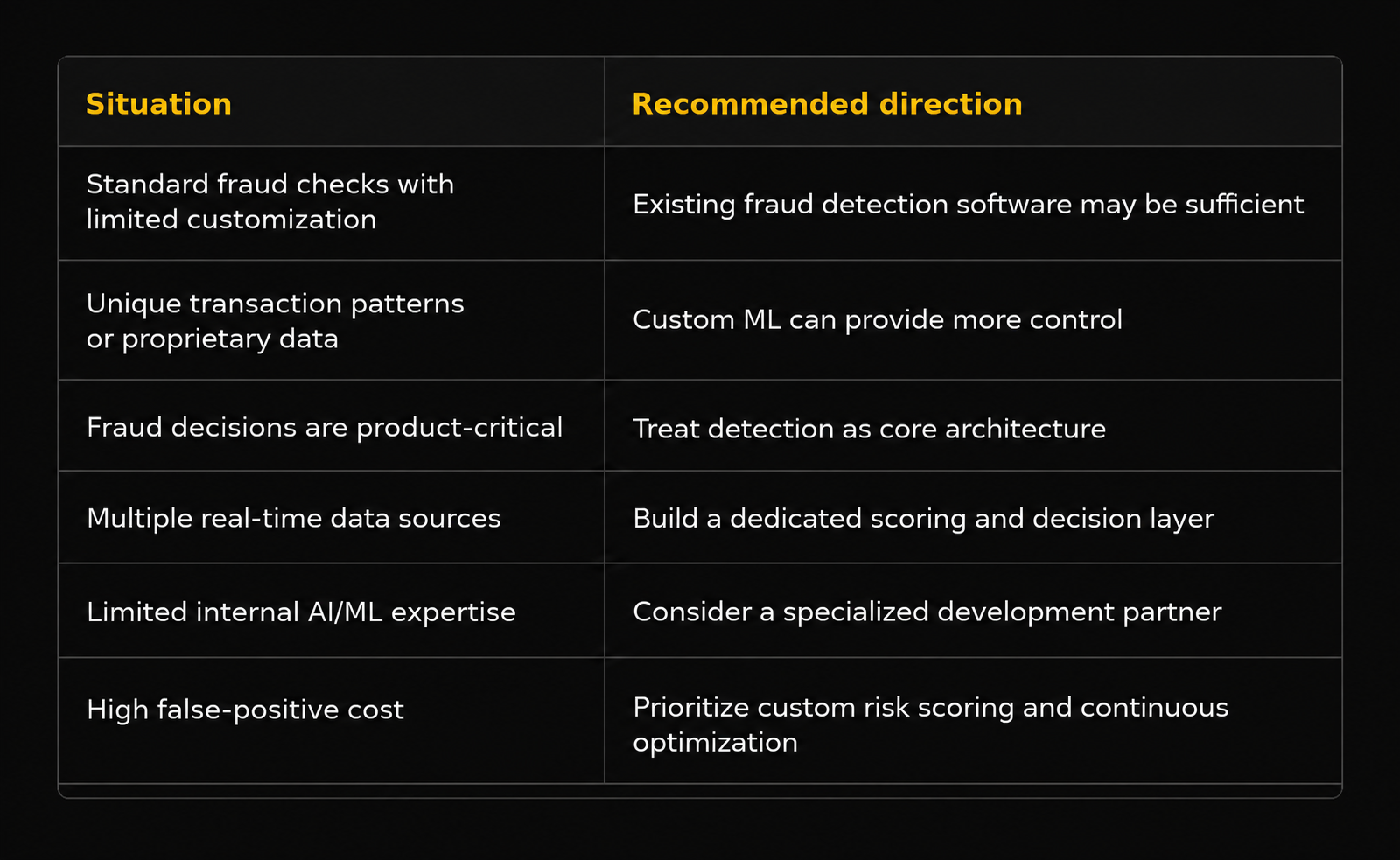
Build Fraud Detection Around Your Transactions, Not a Generic Model
The strongest fraud detection in fintech is not necessarily the system with the most complex model. It is the system that makes the right decision quickly enough, using the right signals, for the specific financial product it protects. That requires more than machine learning algorithms for fraud detection. It requires reliable data, real-time processing, risk scoring, decision logic, monitoring, feedback loops, security, and an architecture that can evolve as fraud patterns change.
For fintech companies developing payment platforms, banking products, financial marketplaces, or other transaction-heavy systems, this is where AI becomes useful: not as an isolated model, but as part of the product's risk infrastructure.
UppLabs builds AI-first fintech products and has experience with payment infrastructure, machine learning fraud detection, transaction processing, and secure financial software architecture. Explore UppLabs' FinTech AI solutions or see the Fintech Digital Gateway project to see how these components can work together in a real product.
FAQ
What is AI fraud detection?
AI fraud detection uses machine learning and analytical techniques to evaluate transactions, user behavior, and contextual signals for patterns associated with fraud. It can complement traditional rules by detecting relationships and anomalies that were not explicitly programmed.
How does machine learning detect fraud?
Machine learning models learn patterns from transaction data and use those patterns to estimate the risk of new activity. Systems can combine supervised learning, anomaly detection, behavioral analysis, rules, and risk scoring depending on the available data and fraud scenarios.
What algorithms are used for fraud detection?
There is no single best algorithm. Fraud detection algorithms may include classification models, tree-based models, neural networks, clustering, anomaly detection methods, and ensemble approaches. The appropriate method depends on the available data, latency requirements, explainability needs, and type of fraud being detected.
How do you detect fraudulent transactions in real time?
Real-time detection requires transaction and contextual data to be processed while the transaction is occurring. A detection layer evaluates relevant features, models and rules calculate risk, and the decision system determines whether to approve, verify, review, or block the transaction.
AI vs rule-based fraud detection: which is better?
Neither approach needs to operate alone. Rules are effective for explicit, known conditions and policy requirements, while AI can identify more complex patterns and adapt to changing transaction behavior. Many production systems benefit from combining both.
What causes false positives in fraud detection?
False positives occur when legitimate activity resembles patterns associated with fraud. Poor-quality data, overly aggressive thresholds, insufficient context, changing customer behavior, or model drift can all increase false positives. Risk scoring and continuous monitoring help balance fraud prevention with customer experience.