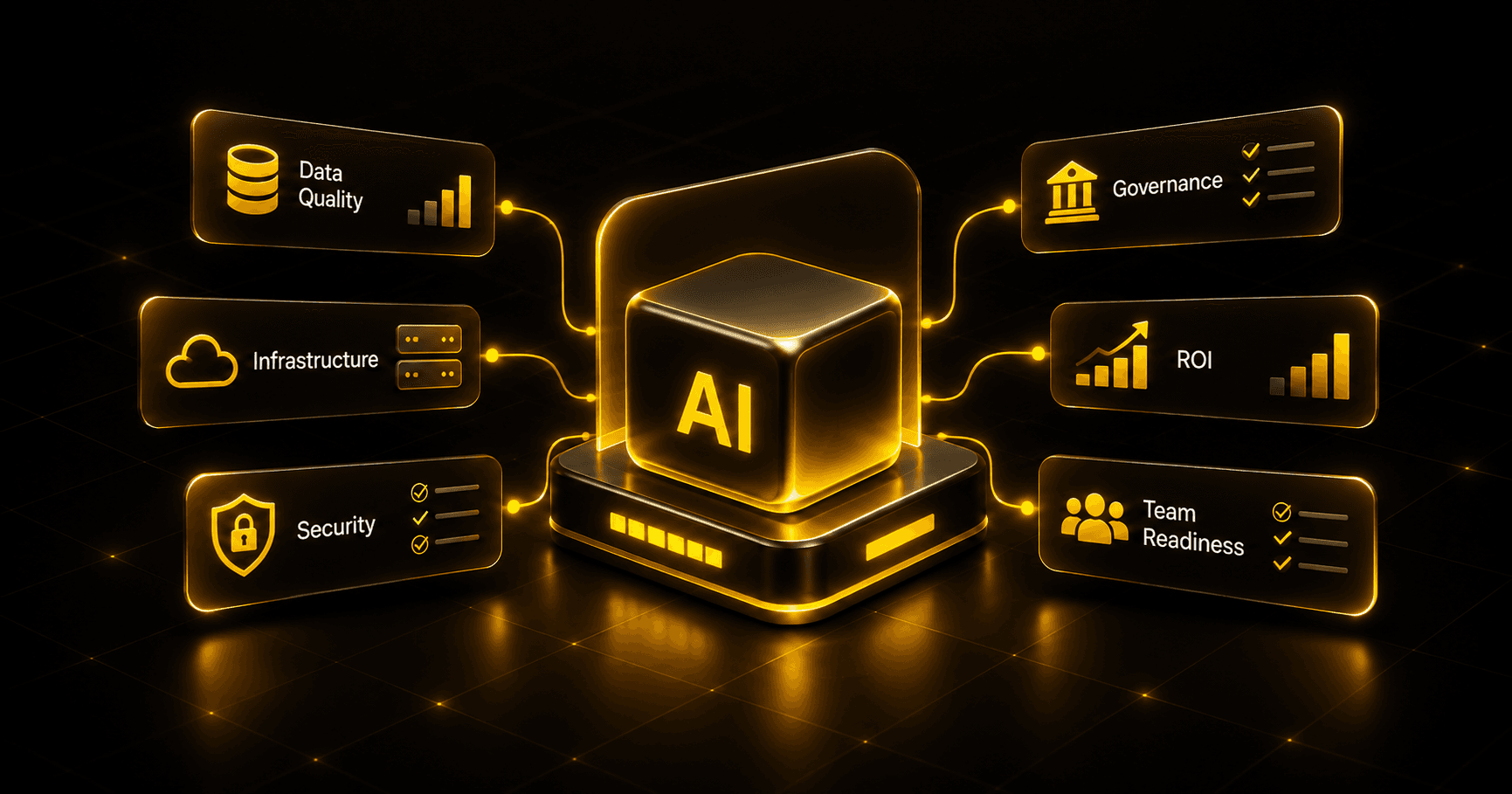
AI budgets are easy to approve when everyone sees an opportunity. Harder question comes next: is your business actually ready to turn that investment into measurable value?
Many AI initiatives start with a model or tool before teams have reliable data, clear ownership, integration capacity, or a business problem worth solving. Result is often a promising pilot that never reaches production.
AI readiness assessment reverses that order. Instead of asking “Which AI should we build?”, it asks whether your data, infrastructure, team, workflows, governance, and business priorities can support AI successfully.
TL;DR
- AI readiness assessment evaluates whether business goals, data, infrastructure, people, and governance can support successful AI adoption.
- Strong AI readiness starts with a valuable use case, not a model or vendor.
- Data quality and accessibility often matter more than model sophistication.
- Infrastructure must support integration, security, monitoring, and production workloads.
- AI readiness report should identify gaps, prioritize use cases, and define practical next steps.
- Companies with significant gaps should fix foundations first; companies with strong readiness can move into pilot or production development.
What Is an AI Readiness Assessment?
AI readiness assessment is a structured evaluation of whether an organization has the business, technical, data, and operational foundations needed to adopt AI successfully.
“AI readiness is not about how much AI a company already uses. It is about whether the business has the data, systems, ownership, and measurable use cases needed to make AI work in practice.”
Assessment should answer practical questions:
Can available data support the use case? Can existing systems integrate with AI components? Does the team know who owns model outcomes? Can ROI be measured? Are compliance, security, and human-review requirements understood?
Strong assessment turns those answers into an actionable AI readiness report.
UppLabs' Enterprise AI Transformation use case shows how disconnected initiatives can be prioritized by ROI and feasibility before larger investments continue.
AI Readiness Framework: What to Evaluate
Practical AI readiness framework should connect business value with technical feasibility.
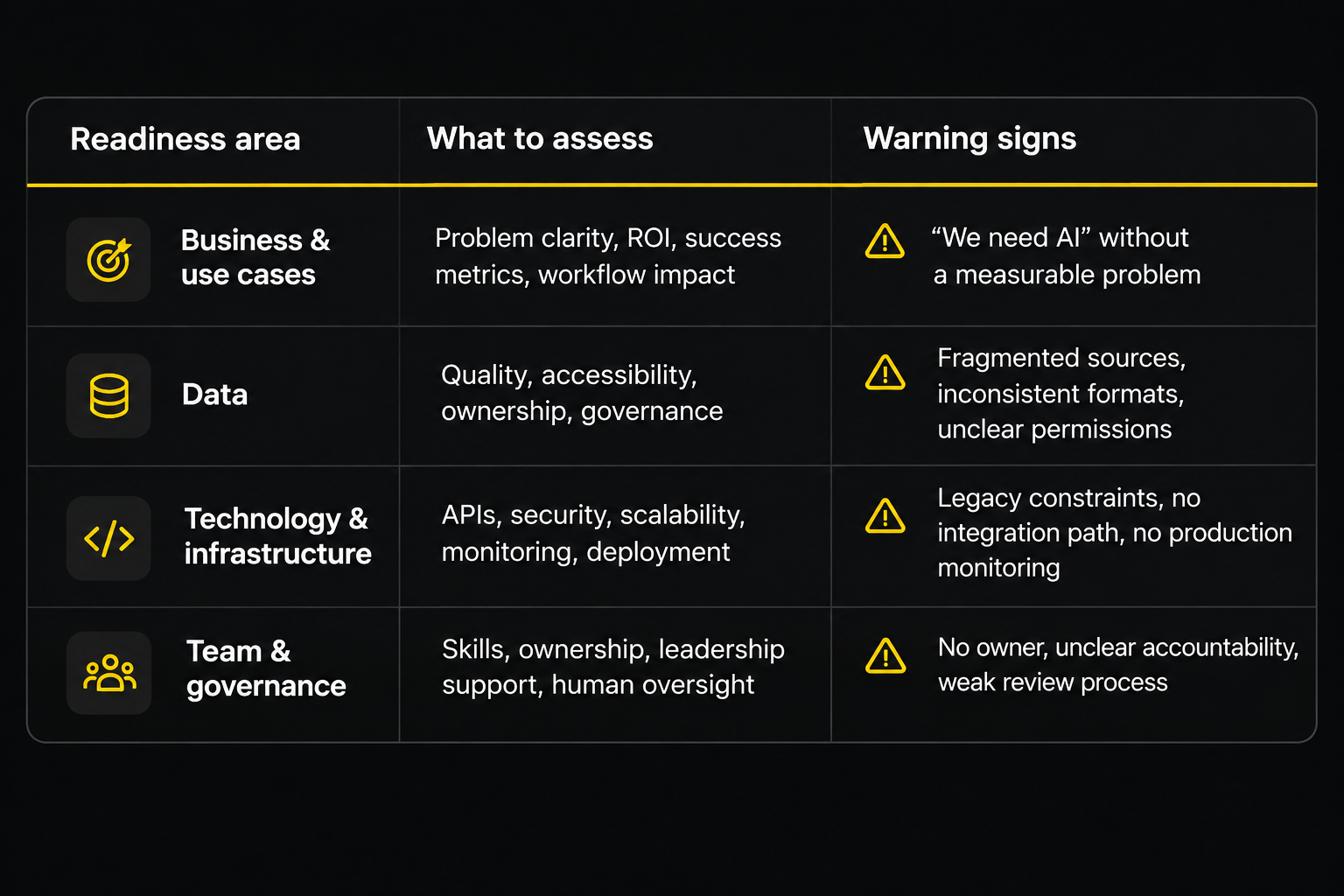
Strong enterprise AI readiness does not require perfect scores everywhere. Readiness means knowing which gaps affect the selected use case and whether they can be resolved within a realistic timeline and budget.
Start With Use-Case Clarity
Most AI conversations start too far downstream. Teams discuss LLMs, RAG, agents, fine-tuning, or predictive models before defining what decision or workflow AI should improve.
Better sequence starts with business impact. Useful use case should have a clear user, repeatable input, identifiable output, measurable baseline, and enough economic value to justify implementation.
Customer support automation, for example, may look attractive because ticket volume is high. Real opportunity depends on whether requests are repetitive, required knowledge is accessible, escalation rules are clear, and outcomes can be measured.
Healthcare use cases may require stricter controls. UppLabs' Clinical AI Assistant combined structured clinical data, RAG, NLP, human approval, EHR integrations, and HIPAA-aware architecture because simple LLM access would not have been sufficient.
Use-case clarity is one of the strongest indicators of ai implementation readiness.
Evaluate Data Before Choosing a Model
AI systems depend heavily on data quality. Questions should cover whether required data exists, whether it is accessible, whether historical outcomes are available, whether formats are consistent, and whether legal or contractual restrictions affect use.
Quantity alone is not enough. Millions of records provide limited value when they are duplicated, incomplete, poorly structured, or disconnected from the outcome a model needs to predict.
Data readiness also changes by AI type. RAG applications need reliable documents, metadata, update processes, and permission controls. Predictive models need relevant historical patterns. Agents need tool access with clearly defined permissions.
UppLabs' AI consulting services include data readiness assessment because data maturity often determines what AI initiatives are feasible before implementation starts.
Check Infrastructure and Integration Readiness
Production AI rarely operates alone. Models need APIs, authentication, data pipelines, logging, storage, monitoring, fallback behavior, and connections to existing applications.
Infrastructure assessment should focus on how AI will operate inside the current environment.
Legacy systems can still support AI if integration boundaries are clear. Modern cloud environments can still fail when permissions, observability, or data flows are poorly designed.
Latency and cost also matter. Real-time fraud detection has different requirements from document processing. Customer-facing AI needs predictable response times. High-volume workflows need cost controls.
UppLabs' AI Banking Assistant is a good example of why production AI requires more than a model: knowledge retrieval, integrations, escalation, security, and ongoing operations all matter.
Assess Team Capability and Ownership
Successful AI adoption needs more than ML engineers. Domain experts understand workflows. Product leaders define outcomes. Engineering teams integrate AI into production. Security and compliance teams define constraints.
Ownership should be explicit before development begins. Who approves AI output? Who monitors quality? Who handles low-confidence cases? Who owns the business KPI?
Answers become especially important for automated decision systems and AI agents. Team capability is therefore part of business readiness for AI, not something to solve after launch.
AI Readiness Checklist
Practical ai readiness checklist should cover:
- clear business problem and measurable outcome;
- usable and accessible data;
- integration path into existing systems;
- security and compliance requirements;
- infrastructure for deployment and monitoring;
- ownership and human-review process;
- technical and domain expertise;
- realistic budget and implementation roadmap.
Assessment should also distinguish between gaps that block implementation and gaps that can be addressed during a pilot.
Missing monitoring may not prevent a controlled prototype. Missing access to required data can make the idea unviable.
AI Readiness Assessment Tool vs Full Assessment
AI readiness assessment tool works well when leadership needs a fast baseline.
UppLabs' AI Readiness Assessment uses a structured questionnaire to evaluate data, infrastructure, team capability, and use-case clarity.
Complex organizations usually need deeper analysis when several business units, legacy systems, regulated data or significant budgets are involved.
Full assessment can review real datasets, architecture, workflows, security constraints, ROI, vendor options, and implementation dependencies.
Tool-based assessment identifies where to investigate. Detailed assessment validates whether assumptions hold in the real environment.
What Should an AI Readiness Report Include?
“Useful AI readiness report should not just describe maturity. It should show what to build first, what is blocking implementation, and what needs to change before AI investment can scale.”
Where are we now?
Current maturity across data, infrastructure, people, governance, and use cases.
What should we build first?
Prioritized opportunities based on value, feasibility, risk, and time-to-value.
What must change before implementation?
Data, integrations, infrastructure, security, team capability, or governance needed to move forward.
Decision Framework: Are You Ready to Invest in AI?
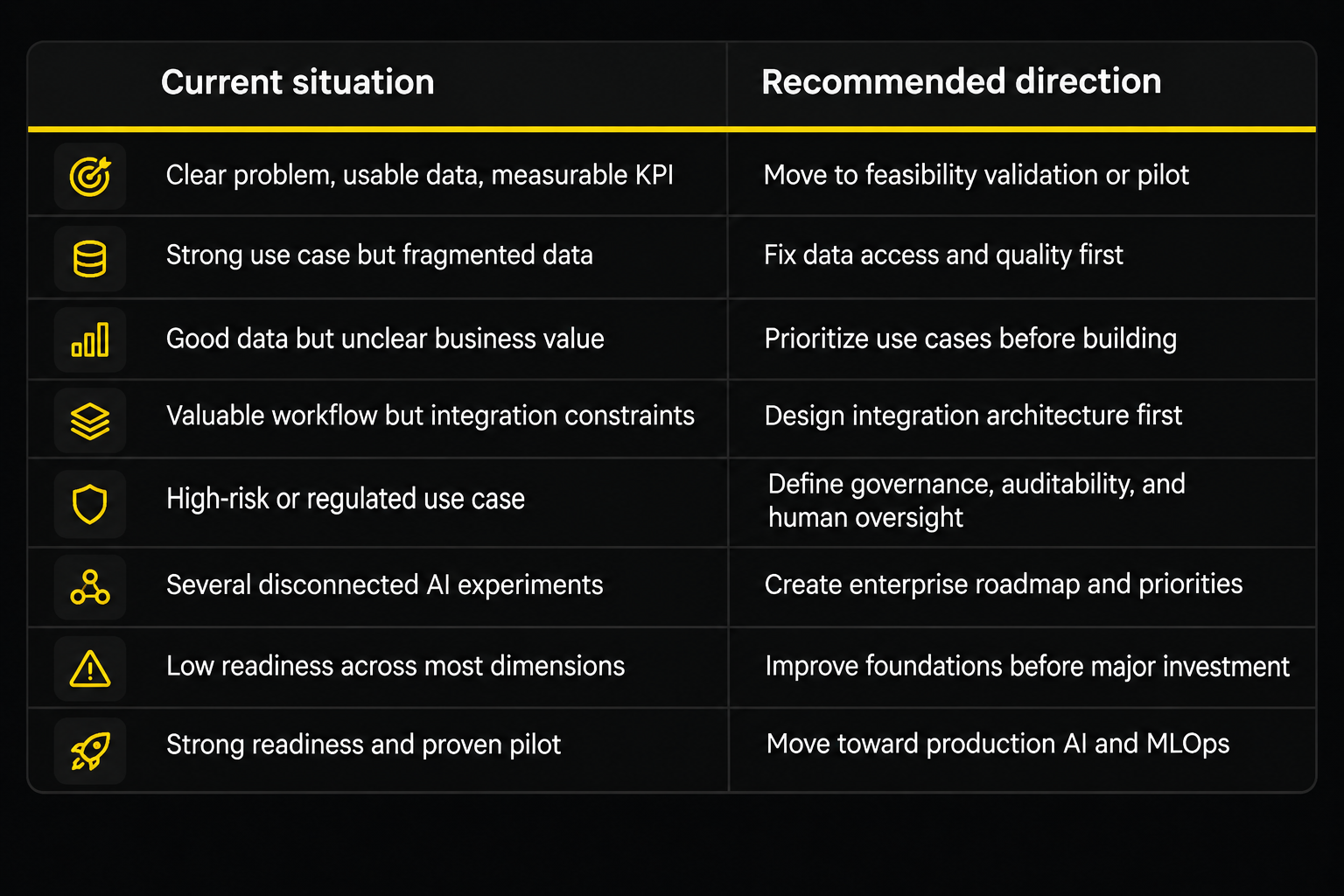
This framework helps avoid two mistakes: building too early and waiting for perfect readiness.
From AI Readiness to Implementation
Assessment creates value only when it changes what happens next.
High-readiness organizations can move into feasibility work, architecture, MVP development, or production implementation. UppLabs' AI/ML Development services cover custom models, RAG pipelines, NLP, computer vision, integrations, and MLOps.
Lower-readiness organizations often benefit more from fixing one or two foundational problems first.
Data may need consolidation. APIs may need modernization. Security controls may need clarification. Use cases may need stronger ROI modeling.
Production AI works only when data, models, human review, auditability, and system integrations are designed to work together from the start.
When AI Consulting Services Make Sense
Internal teams can run an initial assessment themselves.
External ai consulting services become useful when investment is significant, several use cases compete for budget, architecture is complex, data quality is uncertain, or leadership needs an independent feasibility view.
Good consulting should not begin by recommending AI.
Strong process may conclude that standard automation is enough, an existing vendor is better than custom development, data preparation should come first, or one narrow use case offers much higher ROI than a broad transformation program.
UppLabs' AI Consulting connects readiness assessment with opportunity scoring, architecture design, build-vs-buy decisions, data strategy, governance, and implementation planning.
Final Takeaway
AI readiness is not a score that determines whether a company is “good at AI.”
Useful assessment determines whether a specific investment can create value under current business, data, technology, and operating conditions.
Companies considering investing in AI should validate the problem first, then evaluate data, infrastructure, people, governance, and implementation constraints.
Strong ai adoption readiness means knowing what to build, why it matters, what it depends on, and how success will be measured.
UppLabs can help companies move from assessment to a practical roadmap through AI Consulting, or from validated opportunity to production through AI/ML Development.
Before investing in ai technology at scale, knowing what not to build can be just as valuable as knowing what to build.
FAQ
What is an AI readiness assessment?
AI readiness assessment evaluates whether an organization has the business case, data, infrastructure, people, governance, and operational capability needed to implement AI successfully.
Why is AI readiness important?
AI readiness helps companies identify gaps before committing significant budget and reduces the risk of building around weak data, unclear goals, poor integrations, or missing ownership.
What should an AI readiness assessment include?
Assessment should review use-case clarity, ROI, data maturity, infrastructure, integrations, security, governance, team capability, compliance, and implementation ownership.
What is an AI readiness framework?
AI readiness framework is a structured method for evaluating the capabilities needed for successful AI adoption across business value, data, technology, people, and governance.
What is an AI readiness assessment tool?
AI readiness assessment tool provides a structured questionnaire or scoring process that helps organizations benchmark current maturity and identify major gaps.
What is enterprise AI readiness?
Enterprise AI readiness evaluates whether AI can be adopted consistently across a larger organization, including shared data practices, architecture, governance, security, talent, and investment priorities.
How do I know if my business is ready for AI?
Business is more likely to be ready when a valuable use case is clearly defined, relevant data is accessible, systems can support integration, ownership is established, risks are understood, and success can be measured.
Should we improve readiness before building AI pilot?
Not always. Controlled pilot can validate assumptions when major blockers are absent. Critical gaps in data, security, compliance, or use-case clarity should usually be addressed first.
