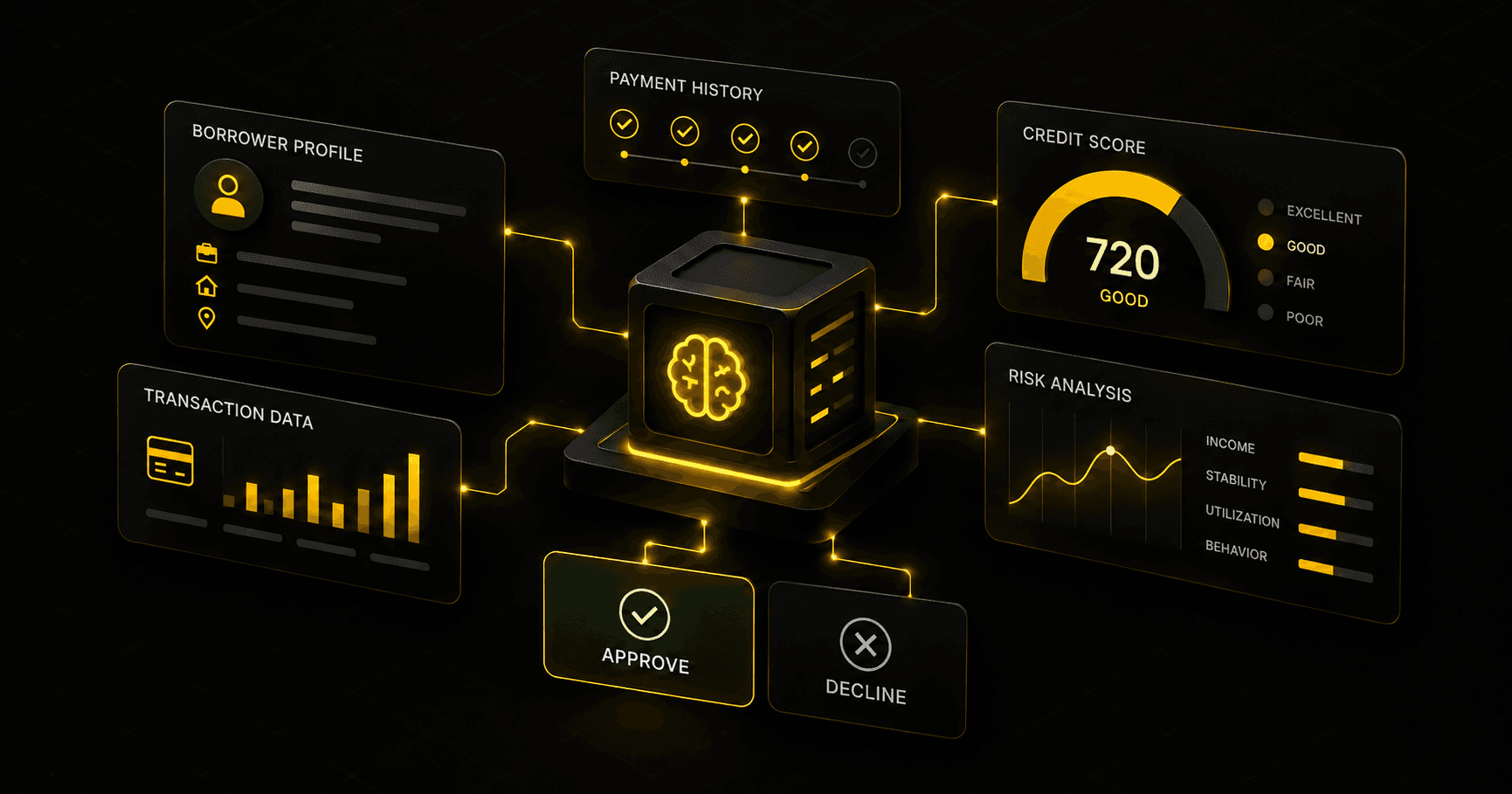
Borrower can look risky in a traditional score and still be a strong customer. Another can look safe on paper while recent behavior signals a rising probability of default.
That gap is why AI credit scoring is becoming a practical product and engineering problem for fintech companies. The opportunity is to use richer signals, update risk estimates faster, and support lending decisions with models that reflect how customers actually behave. The challenge is doing it without creating a black box that risk, product, compliance, and operations teams cannot control.
If you are evaluating credit scoring using AI for a lending platform, neobank, marketplace, or embedded-finance product, this guide explains how machine learning evaluates credit risk, what production architecture requires, and when custom scoring makes sense.
TL;DR
- AI credit scoring uses machine learning to estimate borrower risk from financial, behavioral, transactional, and other permitted data.
- Production credit scoring model needs more than a trained algorithm: reliable data, feature logic, decision rules, explainability, model monitoring, and feedback loops.
- Machine learning in credit risk is most useful when product-specific data contains patterns that static scorecards or simple thresholds cannot capture well.
- Explainable AI, model explainability, validation, and model bias controls should be designed into the system from the beginning.
- Build vs. buy depends on data uniqueness, regulatory constraints, internal ML expertise, and how central credit decisions are to the product.
What Is AI Credit Scoring?
AI credit scoring uses machine learning models to estimate whether a borrower is likely to meet credit obligations. The system converts relevant applicant, account, and behavioral data into an AI credit score, borrower risk category, or default probability that can support underwriting.
Terms such as credit scoring AI, credit score AI, AI based credit scoring, AI for credit scoring, and AI in credit scoring often describe the same broad approach. In practice, however, the system is larger than the model. It connects data collection, scoring, policy rules, approvals, manual review, and monitoring.
AI credit scoring models can evaluate larger feature sets and more complex relationships than many traditional scorecards. That can be valuable when repayment history, transaction activity, cash-flow patterns, account behavior, or other permitted signals add useful information.
The goal is not to replace every traditional model with machine learning. It is to improve credit risk assessment when better data and modeling can produce a more useful risk signal.
How Machine Learning Evaluates Credit Risk
Machine learning evaluates credit risk by learning relationships between historical borrower data and outcomes such as repayment, delinquency, or default. Those patterns are then applied to a new applicant or account.
A typical workflow looks like this:
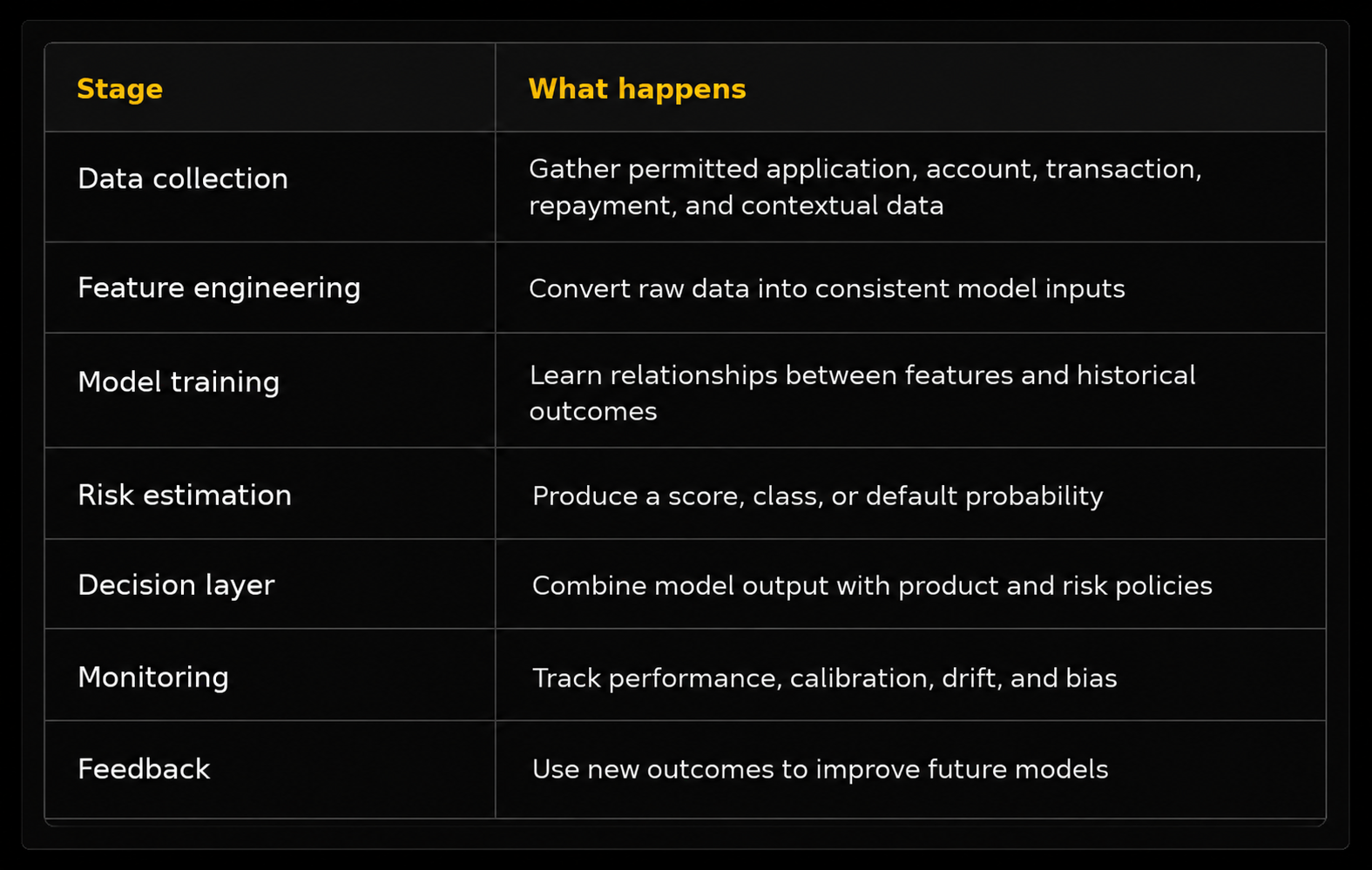
Credit risk machine learning therefore starts with the target, not the algorithm. Teams first need to define what “risk” means for the product and what period the model is predicting.
Credit risk assessment machine learning for a short-term product may optimize for a different outcome than credit risk prediction machine learning for a longer loan. This is why credit risk analysis using machine learning and credit risk modelling using machine learning should begin with a specific business decision.
Whether a team calls the work credit risk modeling machine learning, machine learning credit risk, or credit risk scoring machine learning, the model only creates value when its output maps to a real action.
Data and Features
Model quality depends heavily on input data. Missing values, inconsistent definitions, data leakage, stale features, or variables that cannot be reproduced at decision time can undermine an otherwise strong model.
Useful features may describe repayment behavior, income stability, debt burden, account tenure, cash-flow volatility, transaction patterns, or other permitted and product-relevant signals.
The important requirement is consistency. A feature used during training must be available and calculated the same way in production.
Models and Default Probability
Machine learning credit risk model may use logistic regression, tree-based models, gradient boosting, neural networks, or an ensemble. More complex is not automatically better.
For many products, a calibrated default probability is more useful than a raw score because risk teams can map probability ranges to approval thresholds, limits, pricing inputs, additional verification, or manual review.
Credit default risk machine learning models should therefore be evaluated not only on ranking ability but also on calibration and stability over time.
From Prediction to Decision
The model should usually inform a decision layer rather than become the entire decision system. Eligibility criteria, affordability rules, exposure limits, fraud checks, policy constraints, and human review may all sit around the score. This separation makes the system easier to govern and change.
UppLabs' FinTech Software Development services include AI credit scoring and risk assessment alongside lending, banking, payments, and compliance infrastructure. Its FinTech AI Solutions similarly position intelligent risk scoring as part of a broader production financial system rather than an isolated model.
AI Credit Scoring vs. Traditional Credit Scoring
AI does not automatically make traditional credit scoring obsolete. The right approach depends on the product, available data, predictive value, explainability requirements, and operational complexity.
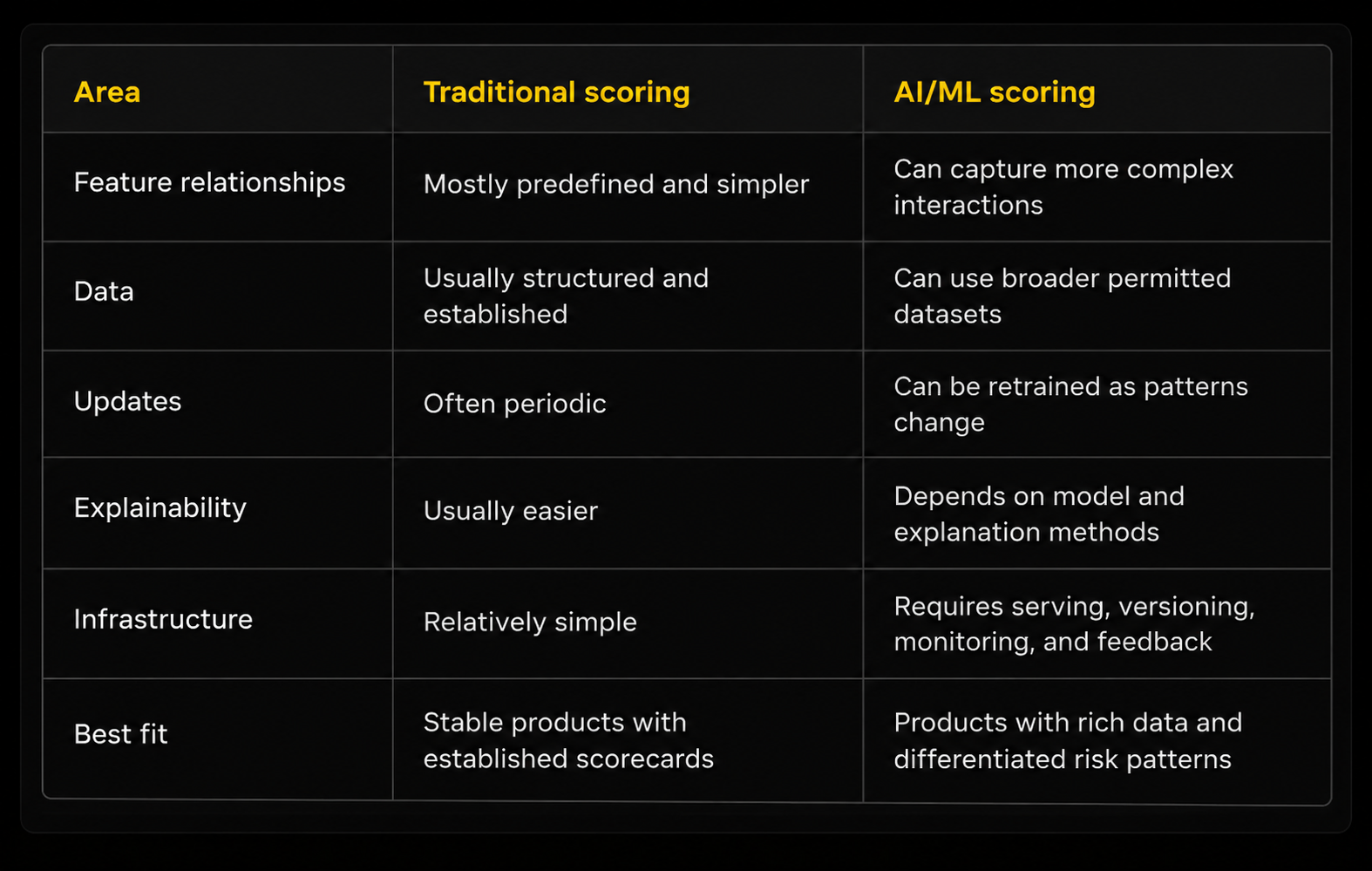
Hybrid systems are often practical because scorecards, deterministic policy rules, and machine learning can solve different parts of the same workflow.
AI credit scoring also sits next to other risk systems. A borrower can have acceptable credit risk while still triggering fraud or identity-risk signals. UppLabs' Fraud Detection in FinTech article explains how transaction and behavioral models can evaluate those risks separately from the credit decision.
Building AI Credit Scoring Models for Production
Prototype can generate a score from a notebook. A production system must generate the right score, from the right data and model version, within the required latency, while leaving enough evidence to understand the result later.
That means stable feature pipelines, versioned models, clear interfaces between scoring and decision logic, fallback behavior, auditability, and continuous monitoring.
This is where custom development can create an advantage when a fintech has proprietary data or unusual customer behavior. A generic score may not capture the risk patterns that matter most inside a specific product.
UppLabs' Neofin case study is relevant from an architecture perspective. Neofin supports 100K+ daily operations, uses a modular three-layer architecture, and integrates with 30+ financial services and APIs. It is not presented as a credit-scoring case study, but it demonstrates the type of scalable fintech infrastructure into which scoring and decision services need to fit.
UppLabs' real-world FinTech case studies also include bank credit collection and banking modernization projects, reinforcing the same point: risk logic must work inside the operational workflow, not beside it. Credit model creates value only when its prediction becomes a controlled, explainable, and operationally reliable lending decision.
Explainability, Model Bias, and Monitoring
Explainability should be designed into the system before deployment. For U.S. credit decisions, the CFPB has stated that creditors using complex algorithms still need to provide specific and accurate reasons for adverse actions. A model is not exempt simply because it is difficult to interpret.
NIST's AI Risk Management Framework also identifies explainability, interpretability, transparency, reliability, privacy, and fairness with harmful bias managed as relevant characteristics of trustworthy AI systems.
That makes explainable machine learning in credit risk management a product and governance concern, not just a data-science preference.
Model bias can enter through historical data, feature selection, target definitions, sampling, labeling, or changes in the customer population. Explainable AI techniques can help teams inspect behavior, but they do not replace validation of the underlying model and decision process.
Model monitoring should track predictive performance, calibration, drift, population changes, approval outcomes, overrides, and explanation stability.
This is the operational side of credit risk management machine learning. Machine learning in credit risk management and machine learning in banking risk management require controls that continue after deployment because borrower behavior and portfolio conditions change.
Where AI Credit Scoring Fits in a FinTech Product
AI credit score can support initial underwriting, credit limits, pricing inputs, repeat borrowing, portfolio monitoring, or early-warning risk detection.
Placement matters. If a model directly influences approval, explainability and validation become central. If it supports a human reviewer, the interface should provide useful reasons rather than only a score. If it updates existing-customer risk, the product needs clear rules for when that new score affects an account.
Consumer credit risk models via machine learning algorithms also have to fit identity verification, fraud controls, loan origination, servicing, payments, reporting, and data infrastructure.
That is why UppLabs positions intelligent credit scoring and risk assessment within its wider FinTech AI Solutions. The company also builds financial products and infrastructure where scoring can be integrated with the rest of the customer and risk workflow.
Decision Framework: Do You Need Custom AI Credit Scoring?
Before choosing a model or vendor, answer these questions:
- What outcome should the model predict: delinquency, default probability, loss, or another event?
- Do you have enough reliable historical data to train and validate it?
- Do proprietary customer or transaction patterns provide information a generic score misses?
- How directly will the model affect approvals, limits, pricing, or manual review?
- What explanations must be available to customers, internal teams, auditors, or regulators?
- How will you monitor model bias, drift, calibration, and performance?
- Can your team operate the model, data pipeline, and decision layer after launch?
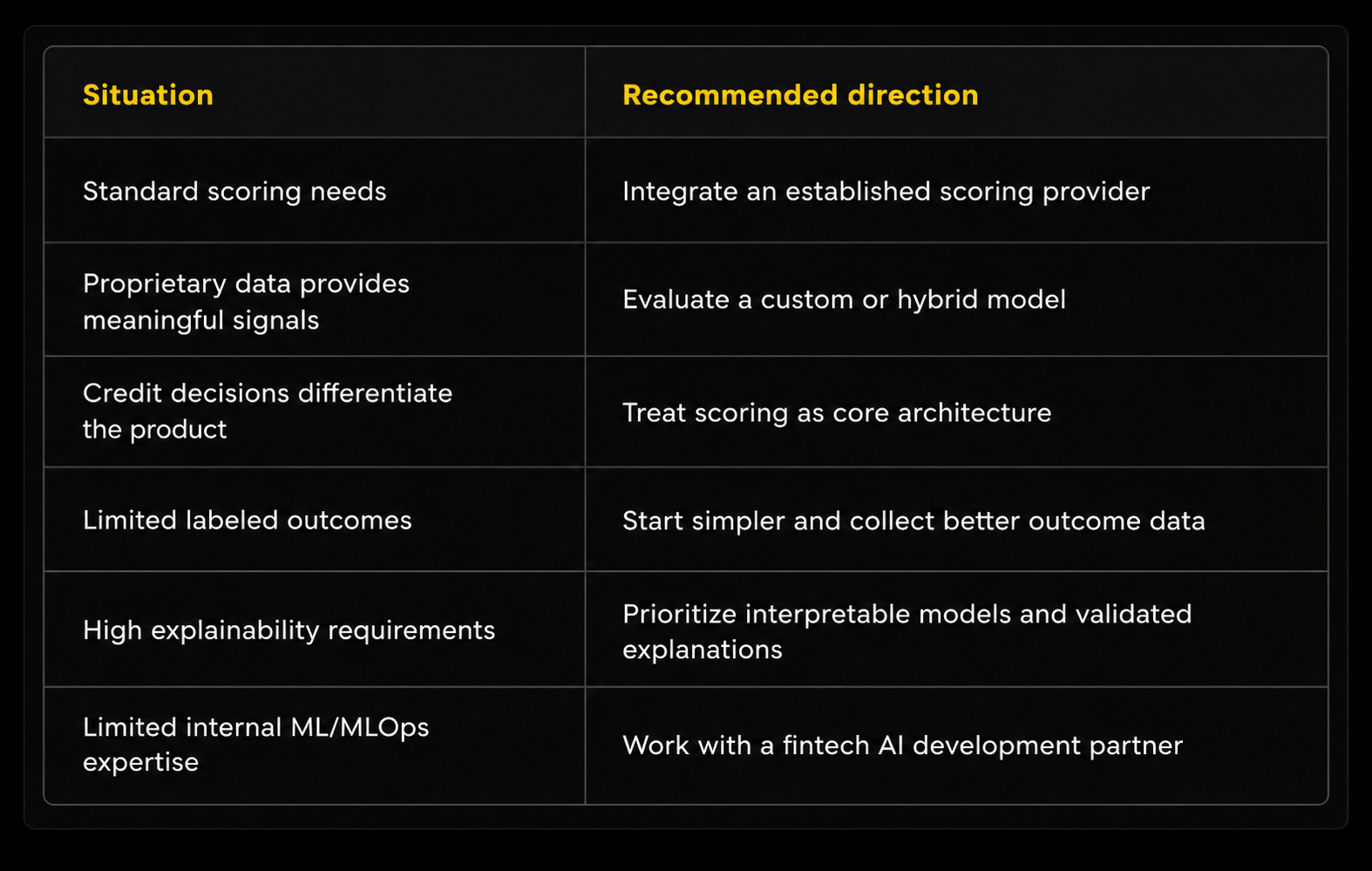
Custom model is not automatically the better choice. It makes sense when the company has differentiated data, a clear prediction target, enough historical outcomes, and a business reason to own more of the scoring logic.
Build Credit Scoring Around the Decision, Not the Algorithm
The strongest AI credit scoring system is not the one with the most sophisticated model. It is the one that makes credit risk assessment more useful without making the decision process harder to control.
That requires reliable data, reproducible features, a validated credit risk model, calibrated outputs, explainability, decision rules, model monitoring, and feedback from real repayment outcomes.
UppLabs builds AI-first fintech products across lending, payments, banking, compliance, and risk. Its FinTech Software Development services and FinTech AI Solutions include AI credit scoring and risk assessment, while projects such as Neofin demonstrate experience building scalable infrastructure for complex financial products.
If credit scoring is becoming a core capability rather than a third-party checkbox, the starting question is not
““Which model should we use?””
It is:
““Which decision are we trying to improve, what data can support it, and how will we operate that decision reliably in production?””
FAQ
What Is AI Credit Scoring?
AI credit scoring uses machine learning to estimate borrower risk from relevant financial, behavioral, transactional, and other permitted data. The output may be an AI credit score, risk category, or probability used in underwriting.
How Is Machine Learning Used in Credit Scoring?
Machine learning identifies relationships between historical borrower data and outcomes such as repayment or default. Those relationships are applied to new applications or accounts to support credit risk prediction.
What Is the Difference Between a Credit Scoring Model and a Credit Risk Model?
A credit scoring model usually produces a score or rank. A credit risk model is broader and can estimate default probability, expected loss, delinquency, or other portfolio risks. In fintech products, the two often overlap.
Is AI Credit Scoring Always Better Than Traditional Scoring?
No. Results depend on the data, target, model design, validation, and customer population. Machine learning can capture more complex patterns, but a simpler model may be preferable when it performs well and is easier to explain and operate.
When Should a FinTech Build Custom Credit Scoring?
Custom scoring is most useful when a fintech has proprietary risk data, sufficient historical outcomes, a differentiated lending model, and a reason to control its scoring logic, monitoring, and integrations. Standard products may be better served by an established provider.