Security problems rarely begin with a dramatic breach. More often, they start with a small architectural shortcut, an overprivileged account, an exposed secret, an outdated dependency, or a validation rule that never made it into development requirements.
By production, fixing those decisions becomes slower and more expensive. Security in SDLC changes that approach. Instead of treating security as a final audit before release, teams integrate it into planning, architecture, coding, testing, deployment, and maintenance.
Cybersecurity Awareness Month is a useful reminder of this principle: secure software is not created by one penetration test. It is built through decisions made throughout the software development life cycle.
TL;DR
- Security in SDLC means integrating security controls into every development stage.
- Secure SDLC combines threat modeling, secure coding practices, automated security testing, dependency management, access controls, monitoring, and continuous improvement.
- NIST and OWASP provide frameworks for building and assessing a secure software development lifecycle.
- DevSecOps helps automate security controls inside CI/CD, but automation does not replace architecture decisions or human review.
- FinTech and Healthcare products need stronger security because failures can create operational, financial, compliance, and reputational risks.
What Is Security in SDLC?
Security in SDLC means incorporating security activities directly into the software development life cycle instead of adding them after development is complete.
Traditional SDLC covers requirements, design, implementation, testing, deployment, and maintenance. Software development life cycle security adds security objectives and controls to each stage.
Requirements may define authentication, authorization, data protection, and compliance needs. Design includes threat modeling. Development follows secure coding practices. CI/CD includes automated security checks. Production environments require monitoring, secrets management, vulnerability management, and incident response.
This approach is commonly called a secure SDLC or secure software development lifecycle.
NIST Secure Software Development Framework provides practices that can be integrated into existing SDLC processes. OWASP SAMM helps organizations assess and improve software security maturity across governance, design, implementation, verification, and operations.
Why Security in the Software Development Life Cycle Matters
Finding a vulnerability in production usually means more than fixing code. Teams may need to identify affected users, rotate credentials, patch several environments, review logs, update dependencies, and verify whether the same weakness exists elsewhere.
Earlier detection reduces this cost. Security requirements identified during discovery can shape architecture before implementation begins. Threats found during design can be addressed before dependencies accumulate. Vulnerabilities detected during development can be fixed while engineers still have the relevant code in context.
Regulated products raise the stakes further.
UppLabs' TimelyCare case study shows how encryption, role-based access control, audit logging, OAuth 2.0, MFA, and HIPAA/HITECH requirements become part of product architecture.
FinTech creates similar pressure. Paynexa combines payment infrastructure, PCI DSS requirements, and ML-based fraud detection within one platform.
Security cannot be separated from product engineering in systems like these.
Security in SDLC Phases
Effective secure SDLC methodology applies the right controls at each development stage.
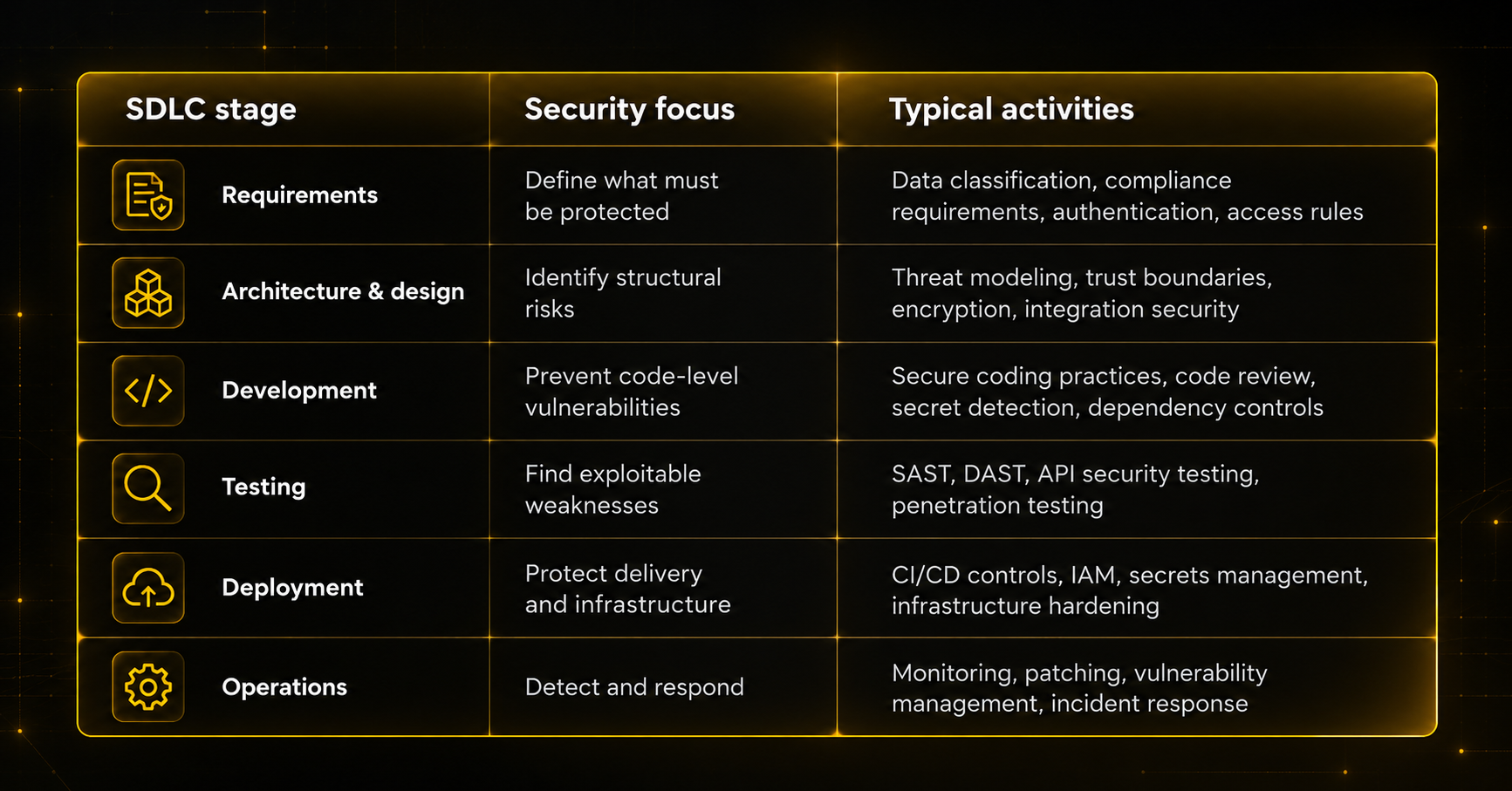
This security in SDLC phases model creates continuity between requirements, implementation, testing, and production.
Start With Threat Modeling in SDLC
Threat modeling in SDLC asks an important question before implementation becomes expensive: how could this system fail from a security perspective?
Teams map sensitive data, users, external integrations, trust boundaries, privileged operations, and possible attack paths.
Consider a FinTech product connected to payment and identity providers. Basic requirements may cover authentication, transactions, and account data. Threat modeling adds deeper questions:
- What happens if an API token leaks?
- Can one tenant access another tenant's data?
- Could transaction limits be bypassed through an internal API?
- Which systems can access financial data?
- What happens if a third-party provider becomes compromised?
Existing UppLabs work with financial infrastructure provides relevant examples. TenureX connects hundreds of financial entities and processes high transaction volumes, making security architecture part of system reliability.
Build Secure Coding Practices Into Development
Secure architecture can still fail through insecure implementation.
Secure coding practices should therefore be part of everyday engineering standards. Input validation, least-privilege access, secure API design, safe error handling, dependency control, and correct authentication and authorization logic all matter.
Code reviews should also ask security questions.
Does this endpoint enforce authorization? Could user-controlled data reach a database query? Does an integration expose credentials? Can sensitive information appear in logs? Does AI-generated code introduce an unsafe dependency or bypass validation?
Teams needing deeper visibility can use an AI-powered code audit to identify vulnerabilities, dependency risks, architecture issues, and modernization opportunities.
Make Security Testing in SDLC Continuous
Security testing in SDLC works best when feedback arrives close to the code change that introduced the risk.
Waiting until a pre-release penetration test often creates a bottleneck. Developers receive many findings at once, releases slow down, and teams face pressure to accept unresolved risks.
Continuous testing moves part of this feedback into development.
Static analysis can identify risky patterns. Dependency scanning detects known vulnerabilities. Secret scanning blocks exposed credentials. Dynamic testing probes running applications. API tests validate authentication and authorization rules.
UppLabs' Quality Engineering services combine automated testing with OWASP-focused security checks, dependency audits, SAST, DAST, and penetration testing.
Goal is not to replace security specialists, but to automate repetitive checks so experts can focus on higher-risk architecture and business logic.
Where DevSecOps Fits Into Secure SDLC
DevSecOps embeds security controls into development and delivery workflows.
Secure SDLC defines what security activities should happen across the lifecycle. DevSecOps helps teams automate many of them through CI/CD.
Pipelines can block deployment when critical tests fail. Infrastructure-as-code makes configuration reviewable. Secret managers reduce credentials stored in code. IAM limits unnecessary access. Container and dependency scanning can detect vulnerabilities before deployment.
UppLabs DevOps & Cloud services cover CI/CD automation, IAM, network segmentation, secrets management, monitoring, security hardening, and disaster recovery.
Application security in SDLC therefore continues beyond code and into infrastructure and operations.
NIST Secure SDLC and OWASP Secure SDLC
Teams searching for a NIST secure SDLC or OWASP secure SDLC often expect one mandatory process.
Reality is more flexible.
NIST SSDF provides secure software development practices designed to fit different SDLC models. OWASP SAMM focuses on assessing security maturity and improving development practices over time.
Both can work together.
NIST can provide a structured baseline, while OWASP resources offer practical application-security guidance, testing approaches, and maturity assessment.
Framework choice matters less than consistent implementation.
Secure SDLC Checklist
Use this secure SDLC checklist as a practical baseline:
- Define security, privacy, and compliance requirements during discovery.
- Identify sensitive data and ownership.
- Perform threat modeling before major architecture decisions.
- Establish secure coding and code-review standards.
- Scan code, dependencies, secrets, APIs, and deployed applications continuously.
- Enforce least privilege across infrastructure and CI/CD.
- Use proper secrets management.
- Include security tests in delivery pipelines.
- Log security-relevant events without exposing sensitive data.
- Maintain vulnerability, patching, and incident-response processes.
- Reassess architecture when integrations, regulations, or product scope change.
Checklist alone does not create secure software. Teams also need clear ownership, release criteria, remediation priorities, and risk acceptance rules.
Security Requirements Change by Industry
Security controls should reflect product risk.
Healthcare software may process PHI, integrate with EHRs, and require strict access and audit controls. UppLabs explores this further in its HIPAA-Compliant AI implementation guide and Healthcare projects such as TimelyCare.
FinTech products handle financial data, payments, identity verification, and fraud risk. Existing UppLabs resources on security practices for FinTech projects provide a sector-specific view, while KYC automation shows how identity verification and compliance workflows connect to wider platform architecture.
Security architecture should therefore start with actual data, workflows, integrations, threat models, and regulatory exposure rather than a generic checklist.
Decision Framework: How Much Secure SDLC Do You Need?
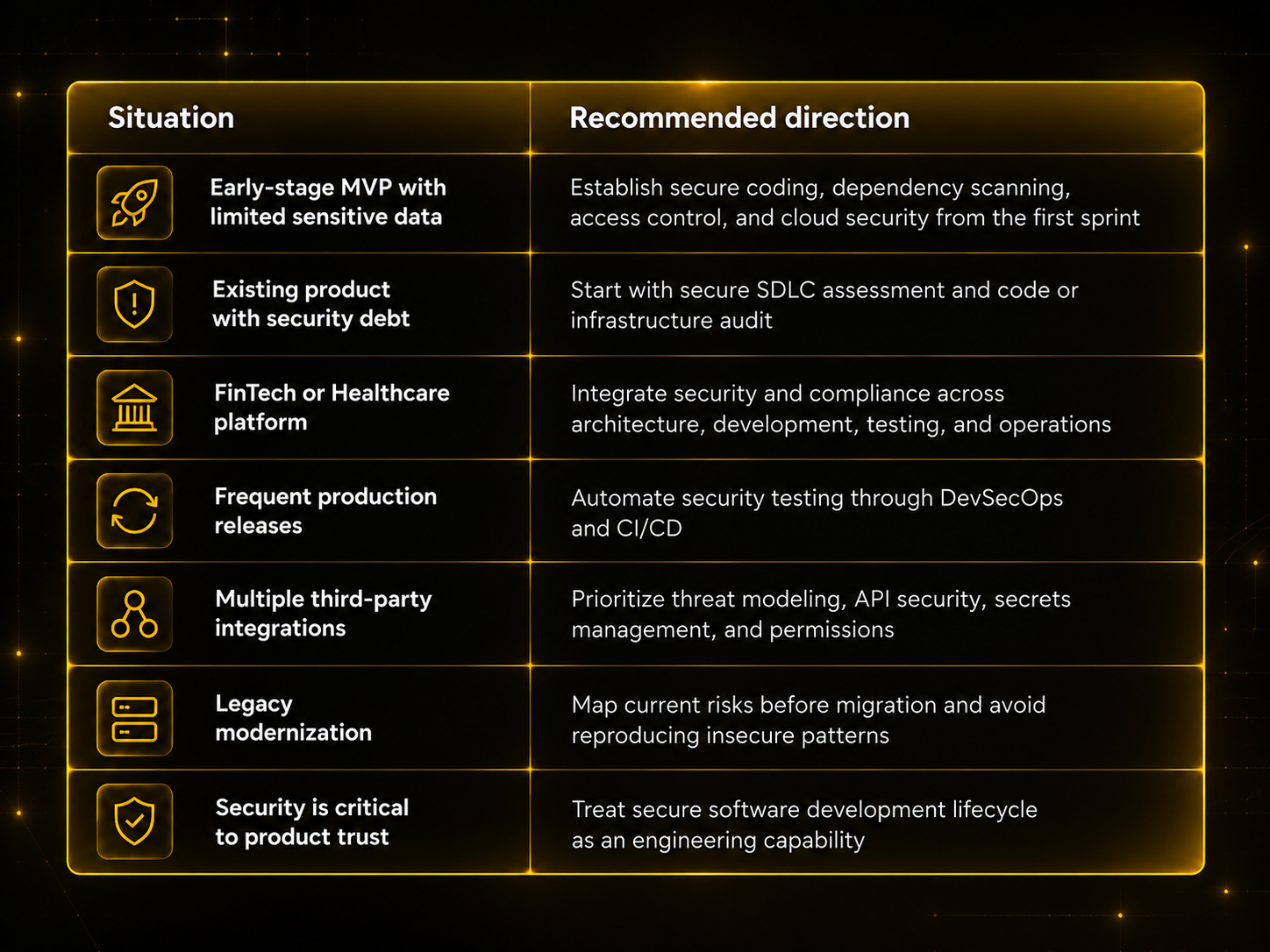
Mature teams usually combine automation, engineering standards, architecture review, and targeted human testing.
When to Consider Secure SDLC Assessment
Internal teams can implement many controls themselves. External support becomes useful when legacy architecture, compliance requirements, complex integrations, or rapid scaling make security risk harder to evaluate.
Secure SDLC assessment can help answer:
Where are the biggest gaps? Which vulnerabilities create actual business risk? Which controls should be automated? Which architectural decisions need to change?
New products can incorporate security directly through Web & Mobile Development. Existing products may benefit from Quality Engineering, DevOps & Cloud, or targeted code and architecture auditing.
UppLabs works with FinTech, Healthcare, PropTech, and other complex products where security must coexist with scalability, compliance, and fast delivery.
Final Takeaway
Security in software development life cycle works best when security becomes part of product engineering rather than a final-stage audit.
Strong secure SDLC connects requirements, threat modeling, architecture, secure coding practices, security testing in SDLC, DevSecOps, infrastructure security, monitoring, and continuous improvement.
NIST and OWASP can provide structure, but implementation should reflect actual product risk.
For teams building FinTech, Healthcare, or other data-sensitive platforms, waiting until launch to ask whether software is secure is already too late.
UppLabs can help assess existing systems, strengthen CI/CD and development workflows, or design security into new products from the first architecture decisions. Explore Quality Engineering, DevOps & Cloud, and Web & Mobile Development to identify where security improvements can have the highest impact.
FAQ
What is security in SDLC?
Security in SDLC means integrating security requirements, architecture controls, secure development, testing, deployment safeguards, and monitoring throughout the software development life cycle.
What is a secure SDLC?
Secure SDLC is a development process where security activities are included at every stage, from requirements and design to testing and operations.
What are the main security in SDLC phases?
Common phases include requirements, architecture and design, development, testing, deployment, and operations.
What is the difference between SDLC and secure SDLC?
Standard SDLC defines how software moves from requirements to production. Secure SDLC adds security practices throughout that process instead of relying on a final review.
How does DevSecOps relate to secure SDLC?
DevSecOps operationalizes secure SDLC practices through CI/CD, automated security scanning, secrets management, infrastructure-as-code, policy checks, and monitoring.
What is OWASP secure SDLC?
OWASP provides resources for secure application development. OWASP SAMM helps organizations assess and improve software security maturity across the development lifecycle.
What is NIST secure SDLC?
NIST Secure Software Development Framework provides secure development practices that organizations can integrate into different SDLC methodologies.
When should a company perform a secure SDLC assessment?
Assessment is useful when a product handles sensitive data, enters a regulated market, accumulates technical debt, scales quickly, adds complex integrations, or undergoes major modernization.
