KYC can take minutes for a customer and still create hours of work behind the scenes. Identity documents need to be checked. Names must be compared against sanctions and watchlists. Business ownership may need verification. Risk signals have to be reviewed, inconsistencies investigated, and evidence stored for future audits.
Manual processing makes each additional customer another operational task. KYC automation changes that model by turning verification into a structured workflow where document checks, identity matching, screening, risk scoring, and human review work together.
For fintech companies, real value does not come from making one automated KYC check faster. Value comes from building an onboarding process that can scale without losing control over risk, compliance, or customer experience.
TL;DR
- KYC automation replaces repetitive verification tasks with connected workflows for identity checks, document validation, screening, risk scoring, and review.
- Automated KYC verification works best when deterministic compliance rules and automated identity verification are combined with risk-based decision logic.
- AML automation should complement KYC rather than operate as an isolated system because customer identity, sanctions exposure, transaction behavior, and ongoing risk are connected.
- Existing KYC automation tools can work well for standard verification requirements, while custom architecture becomes more valuable when workflows, risk policies, or integrations are product-specific.
- Fintech KYC compliance still requires governance, auditability, escalation, and human oversight even when most routine checks are automated.
What Is KYC Automation?
KYC automation is the use of software to collect, verify, screen, assess, and document customer information with less manual intervention.
Traditional onboarding often requires compliance staff to move between document verification tools, sanctions databases, internal systems, spreadsheets, case-management platforms, and email. Automated KYC brings those steps into a coordinated process.
Depending on the product, an automated KYC solution may verify identity documents, compare customer information across data sources, perform sanctions and PEP screening, assess risk, flag inconsistencies, and route higher-risk cases to analysts.
FinCEN's customer due diligence framework for covered U.S. financial institutions includes customer identification and verification, beneficial-owner identification and verification where applicable, customer risk profiling, and ongoing monitoring. Current requirements also include 2026 exceptive relief affecting when beneficial-owner information must be re-collected at subsequent account openings, which reinforces why compliance workflows need configurable rules rather than hard-coded assumptions.
KYC process automation does not remove those responsibilities. It changes how efficiently they are executed and documented.
UppLabs already approaches compliance this way through its Compliance Automation solution, which combines KYC/AML verification, sanctions screening, transaction monitoring, regulatory reporting, and audit management in one workflow.
How Does Automated KYC Verification Work?
Automated KYC verification turns customer onboarding into a sequence of machine-executable checks with defined exceptions. Customer data enters the system through an onboarding form, mobile app, bank interface, API, or partner platform. Verification services then validate documents and identity information, while compliance engines perform screening and risk assessment.
Typical workflow looks like this:
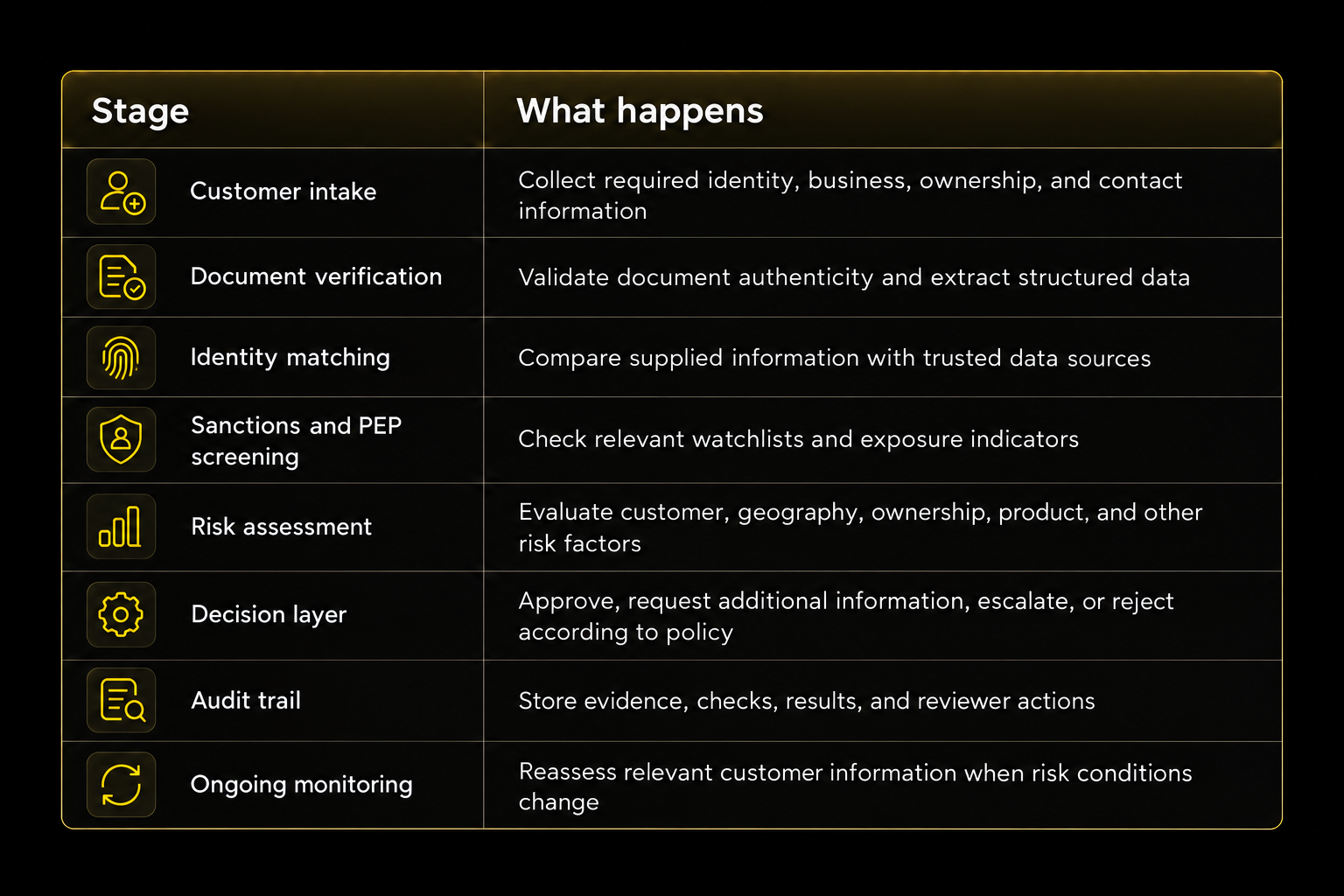
Automated identity verification is especially important because poor input data can undermine every later compliance step. Document extraction alone is not enough. System needs to detect inconsistencies, validate identity attributes, identify duplicate or suspicious profiles, and send uncertain cases to review.
AI identity verification can assist with document understanding, matching, anomaly detection, or risk classification, but high-impact decisions should still follow defined compliance policies.
UppLabs' Compliance Automation demo follows this structure: profile information enters the workflow, automated KYC verification runs alongside sanctions, PEP, adverse-media and risk checks, and the result includes check status, risk factors, and recommended next actions.
Automated KYC Check vs. Fully Automated Decision
Automating checks is easier than automating judgment. Automated KYC checks can determine whether a document passes validation, whether supplied information matches another source, or whether a name produces a potential sanctions match. Decision becomes harder when evidence is incomplete or conflicting.
Potential name match may be a false positive. Ownership structure may be unusually complex but legitimate. Customer may operate in a higher-risk geography without automatically presenting unacceptable risk.
For that reason, strong automated KYC solutions usually separate verification from final decision logic. Low-risk, clearly verified profiles can proceed with minimal intervention. Ambiguous results can request additional information. Higher-risk profiles can move into enhanced due diligence or human review.
This separation is particularly important for sanctions screening. OFAC recommends a risk-based sanctions compliance program and notes that no single compliance solution is appropriate for every organization; screening design should reflect business model, customers, geography, products, and risk profile.
KYC Automation and AML Automation Work Together
KYC answers who the customer is. AML controls must continue evaluating what that customer does. AML automation therefore belongs next to onboarding rather than behind a separate operational wall.
Automated AML screening may evaluate sanctions, PEP exposure, watchlists, adverse signals, and transaction-related risk. Transaction monitoring can then continue after onboarding and flag behavior that changes the customer's risk profile.
FinCEN's CDD framework specifically links customer risk profiles with ongoing monitoring and updates to customer information when relevant risk changes occur.
AI AML compliance can help prioritize alerts and identify relationships that simpler rules may miss. Human analysts still need enough evidence to understand why an alert exists and what action should follow.
UppLabs' Financial Compliance Agent demonstrates this broader lifecycle. System combines rule-based detection with ML anomaly detection, entity resolution, automated SAR generation, and risk-based escalation workflows.
This distinction also connects naturally with UppLabs' article on Fraud Detection in FinTech. Fraud models focus on suspicious transactional behavior, while KYC establishes who the customer is and AML controls help monitor broader compliance risk.
Where AI Adds Value to KYC Process Automation
AI is most useful where verification involves unstructured data, complex matching, or large review queues.
Document analysis is one example. Computer vision and NLP can extract names, dates, addresses, registration numbers, and other information from identity or corporate documents, then compare those fields with supplied onboarding data.
Entity matching is another. Minor spelling differences, aliases, transliteration, or inconsistent company names can make exact matching unreliable. Smarter matching can improve candidate detection while still leaving final risk policy under institutional control.
Risk prioritization can also help compliance teams focus on cases that deserve investigation rather than manually reviewing every successful automated KYC check.
UppLabs states that its compliance automation approach uses computer vision and NLP for document verification and applies ML to compliance monitoring, while retaining human oversight for cases where judgment matters.
KYC Automation Tools vs. Custom KYC Architecture
KYC automation tools solve an important problem: teams do not need to build every verification capability from scratch.
Existing providers may offer document verification, identity databases, sanctions lists, biometric checks, business verification, or orchestration APIs. Standard workflows can often be handled effectively through those services.
Complexity increases when a fintech needs several vendors, proprietary risk rules, multiple jurisdictions, unusual entity types, different onboarding paths, or deep integration with its core product.
Searches for KYC automated solutions or KYC automation solutions often hide the same underlying decision: buy a complete platform, integrate several specialist vendors, or build a custom orchestration layer around external services.
Custom architecture does not necessarily mean building document recognition or sanctions databases internally. More often, it means owning the workflow that connects those services, decides which checks run, normalizes results, applies product-specific policies, and records evidence.
This is where UppLabs' Fintech Software Development experience becomes relevant. Its public fintech offering includes automated KYC/AML, regulatory reporting, security architecture, audit trails, and financial system integrations.
KYC Automation for Banks and FinTech Platforms
KYC automation for banks tends to involve more than shortening account-opening time. Banks may need workflows for individuals, legal entities, beneficial owners, periodic reviews, triggered reassessment, sanctions screening, risk segmentation, and escalation across several internal systems.
Payment platforms face different challenges. Merchant onboarding may require business verification, ownership checks, payment-risk evaluation, sanctions controls, and integration with transaction monitoring.
UppLabs' Fintech Payment Network use case includes merchant onboarding and KYC inside a payment infrastructure processing high transaction volumes, illustrating why identity and compliance workflows need to fit into the wider financial architecture rather than sit in a standalone tool.
Portfolio projects reinforce that broader engineering context. TenureX, for example, connects 350+ financial entities across 35+ countries and processes more than 500K daily transactions, showing the scale and cross-system complexity that financial platforms can reach.
Onboarding KYC Automation Without Adding Friction
Fast onboarding and strong compliance are sometimes treated as opposing goals. Architecture can make them compatible. Onboarding KYC automation should remove unnecessary waiting from low-risk applications while preserving controls where uncertainty exists.
Clear cases can proceed automatically after required verification. Missing information can trigger a targeted request instead of restarting the application. Potential matches can move into a dedicated review queue. High-risk cases can enter enhanced due diligence.
Customer experience improves because automation removes repetitive steps rather than removing safeguards.
Automated KYC process design should also avoid asking customers for information that already exists and remains valid when regulations and internal policies permit reuse. FinCEN's updated 2026 guidance provides specific circumstances in which covered financial institutions may rely on previously obtained beneficial ownership information, subject to its conditions and risk-based procedures.
Decision Framework: Which KYC Automation Approach Fits?
Choosing between KYC automation tools, third-party platforms, and custom development depends on workflow complexity rather than technology preference.
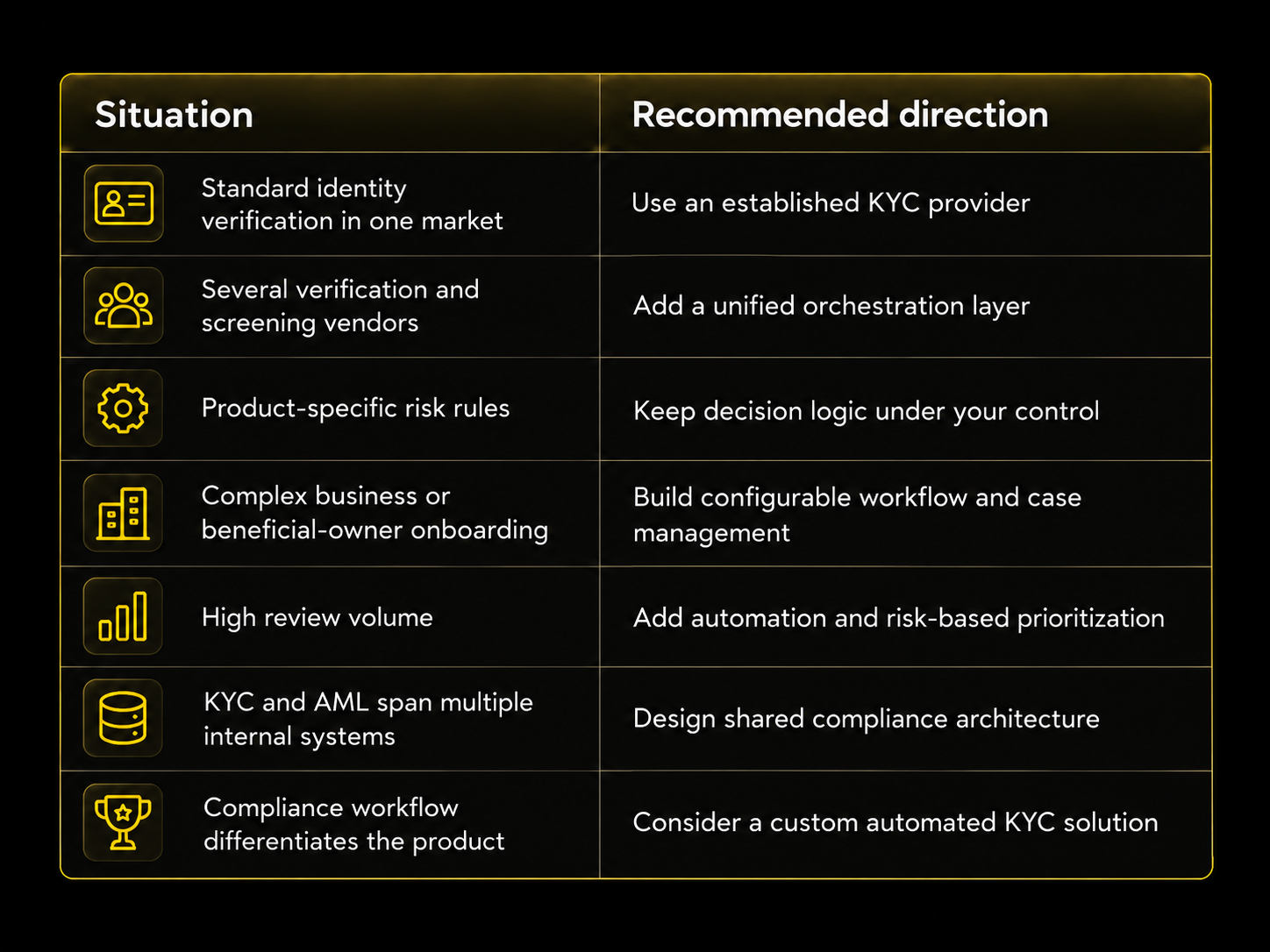
Existing platforms are often the right choice when requirements are predictable.
Custom KYC automation solutions become more valuable when onboarding logic changes by customer segment, geography, product, or risk profile. Owning the orchestration layer also makes vendor replacement easier because external checks do not have to define the whole compliance process.
How KYC Fits With Fraud and Credit Risk
Customer risk is not one score. KYC determines identity and onboarding eligibility. Fraud detection evaluates potentially deceptive behavior. Credit scoring estimates repayment risk. AML processes monitor financial-crime exposure and suspicious activity.
Connecting those functions can create better context without collapsing them into one model. UppLabs' AI Credit Scoring in FinTech article explains the decision architecture behind borrower risk, while its fraud-detection guide covers real-time transaction risk. KYC completes another part of that risk stack by establishing trustworthy customer identity and onboarding controls.
UppLabs' wider Fintech AI Solutions offering connects automated compliance with fraud detection, credit scoring, transaction analysis, and other financial AI capabilities.
Build KYC Around Compliance Workflow, Not One Tool
Strong KYC automation is not defined by how many checks can run automatically. Quality depends on whether customer information moves through a predictable, auditable workflow from collection to verification, screening, decision, escalation, and ongoing monitoring.
Fintech companies evaluating automated KYC solutions should therefore start with their compliance process: customer types, markets, risk policies, required evidence, review triggers, integrations, and audit requirements.
Technology follows that model. UppLabs builds compliance and financial software around this principle, combining fintech engineering, AI-assisted verification, workflow automation, integrations, security, and auditability. Teams that need more than an off-the-shelf KYC tool can use UppLabs' compliance automation capabilities to design an onboarding and AML architecture around their actual product and regulatory workflows.
FAQ
What Is KYC Automation?
KYC automation uses software to collect customer data, verify identities and documents, perform screening, calculate risk, route exceptions, and maintain compliance records with less manual processing.
What Is an Automated KYC Check?
Automated KYC check is a software-driven verification step such as identity validation, document authentication, sanctions screening, PEP screening, or comparison of customer information with trusted sources.
Can FinTech Companies Fully Automate KYC?
Routine low-risk verification can often be highly automated. Ambiguous matches, missing information, complex ownership, elevated risk, or other exceptions usually still require defined escalation and human review.
What Is the Difference Between KYC Automation and AML Automation?
KYC automation focuses primarily on customer identity and onboarding due diligence. AML automation covers broader financial-crime controls such as sanctions screening, risk monitoring, transaction analysis, alert handling, and reporting. Effective fintech platforms connect both workflows.
What Should KYC Automation Solutions Include?
Requirements vary by institution, but common capabilities include data collection, document verification, identity matching, sanctions and PEP screening, risk assessment, workflow routing, case management, audit trails, integrations, and ongoing monitoring.
Should a FinTech Build or Buy KYC Automation?
Existing KYC automation tools are usually efficient for standardized verification. Custom orchestration makes more sense when several vendors, markets, customer types, proprietary policies, or internal systems must work together.
How Does AI Improve Automated KYC Verification?
AI can support document extraction, identity matching, anomaly detection, entity resolution, and review prioritization. Compliance policy, regulatory requirements, evidence retention, and human escalation still need explicit controls around those models.