TL;DR
EHR integration connects an electronic health record with other healthcare applications so clinical data can move between them securely and consistently. The right approach depends on four things: what data needs to move, which systems exchange it, when the exchange happens, and which interoperability standards are supported.FHIR integration is typically well suited to modern API-based applications, while HL7 integration remains important for established hospital and clinical infrastructure. Many healthcare environments require both. A reliable integration should map the clinical workflow before selecting technology, normalize external data into a consistent internal model, separate EHR-specific logic from core application logic, and support authentication, validation, monitoring, and error handling. It should also consider bidirectional data exchange from the beginning. If clinicians still need workarounds after implementation, the integration is not finished.
What Is EHR Integration?
EHR integration is the process of connecting an electronic health record system with another healthcare application or data source so information can move between them securely and in a usable format. That system might be a telemedicine platform, patient portal, laboratory, billing application, analytics platform, mobile app, or AI clinical tool.Electronic health record integration is therefore about more than transferring records. The receiving system needs to understand and use the information correctly. For example, a telemedicine application may retrieve demographics, allergies, medications, diagnoses, and previous encounters before a consultation. After the visit, it may write updated clinical information back to the EHR. When this happens automatically, clinicians stay inside their normal workflow. When it does not, manual work appears.That is the practical difference between simply exchanging data and achieving healthcare interoperability.
Why EHR Integration Is Really a Workflow Problem
EHR system integration may sound simple: connect the EHR to an application through an API or integration layer and exchange the required information. Real clinical workflows are more complicated. A patient encounter can involve registration, medical history, medications, laboratory results, appointments, documentation, billing, and follow-up care. Different systems may be responsible for different parts of this process.Successful EHR data integration therefore needs to determine which patient the information belongs to, which version is current, who can access it, whether changes need to be written back, and what should happen when one of the connected systems becomes unavailable. These decisions should be made before API development begins.The same principle applies when designing a broader healthcare application: technology should support the clinical workflow rather than force users to adapt to the technology.
EHR Integration Architecture: What Should It Look Like?
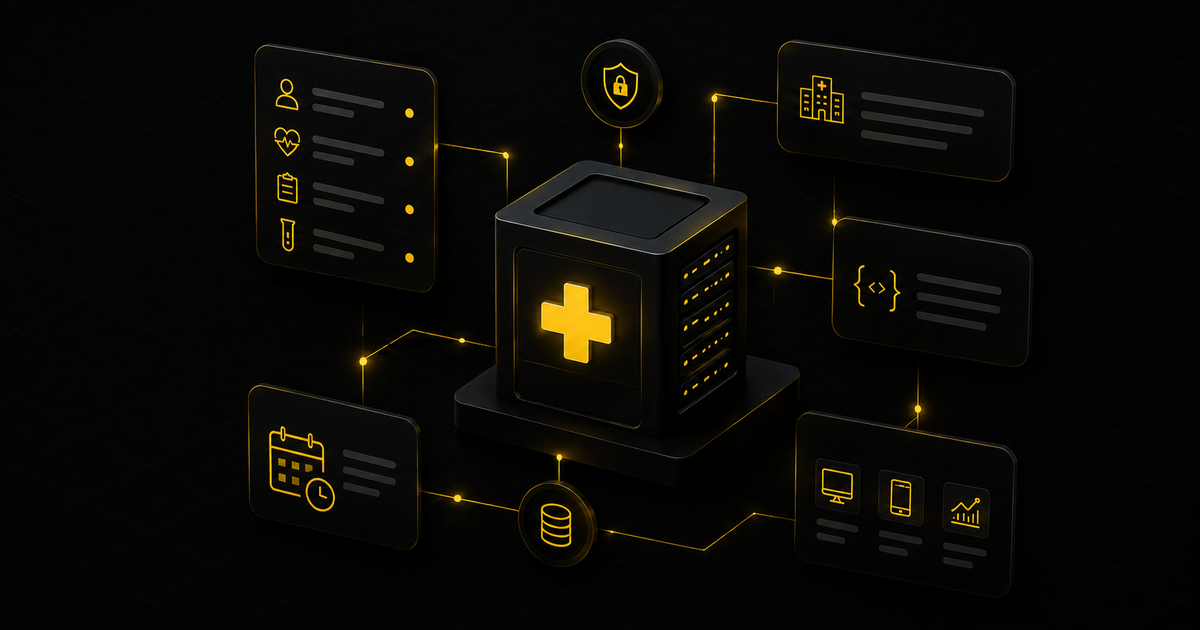
A scalable EHR integration architecture should avoid tightly coupling the entire application to one EHR vendor. Instead, an integration layer can sit between external healthcare systems and the application's internal logic. It receives information through FHIR, HL7, or vendor-specific interfaces, validates and maps that information, and transforms it into a consistent internal format before the application uses it. This separation matters.If external EHR data is normalized before entering the core product, changes to one vendor are less likely to affect the entire application. Security and monitoring can also be centralized, while business logic remains independent of individual EHR implementations.This architecture becomes particularly valuable when a healthcare product needs multiple EHR integrations rather than a single connection.
EHR API Integration: FHIR, HL7, or Vendor APIs?
There is no single integration standard that fits every healthcare workflow.
FHIR Integration
FHIR is an HL7 standard built around modular healthcare resources and modern API patterns.A FHIR-based EHR API can expose structured information about patients, observations, medications, conditions, encounters, practitioners, appointments, and other clinical concepts.FHIR integration is particularly useful for modern patient applications, telehealth products, analytics platforms, and clinical AI systems.
HL7 Integration
HL7 Version 2 remains common across established healthcare infrastructure.HL7 integration often relies on event-driven messages for workflows such as admissions, discharges, transfers, laboratory orders, and results.For products connecting with hospitals, laboratories, or legacy clinical infrastructure, HL7 may therefore remain essential.
Proprietary EHR APIs
Some vendors expose functionality through their own electronic health record API.These interfaces can provide capabilities that standard APIs do not, but they also create stronger vendor dependencies.Vendor-specific logic should therefore remain inside the integration layer instead of spreading throughout the product.
FHIR vs. HL7 vs. Proprietary EHR API
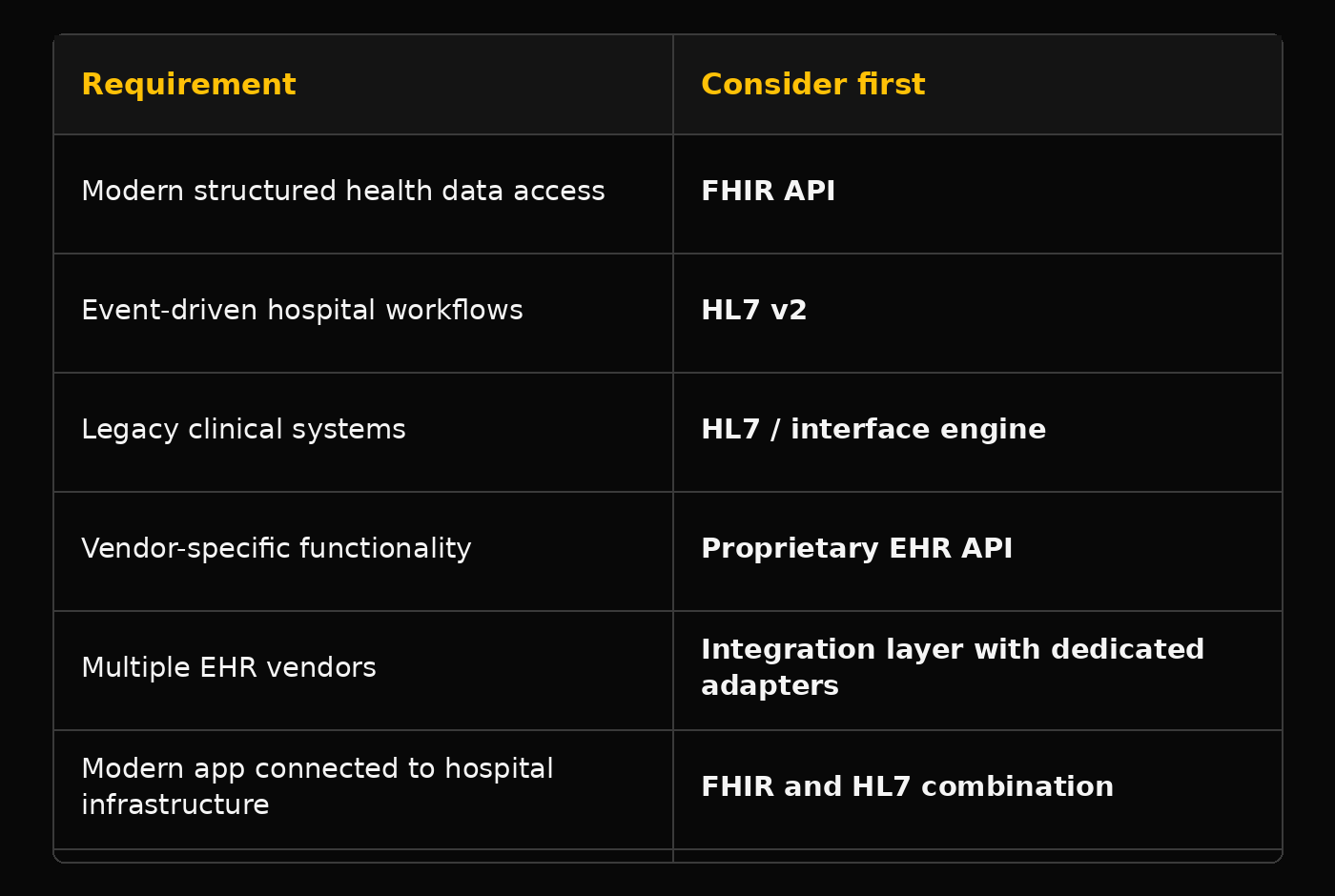
The key rule is simple: choose the workflow first and the integration standard second. FHIR is not automatically the right choice because it is newer, and HL7 is not irrelevant because it is older.
How EHR Data Integration Works
A reliable EHR data integration process usually includes five stages.
1. Define the Workflow
Do not start with “We need an Epic integration.” Start with the actual requirement.For example, before an appointment, an application may need medications, allergies, and recent conditions. After the consultation, the approved clinical note may need to return to the patient's record. Defining the workflow this way makes the required data, direction, timing, and permissions much clearer.
2. Connect to the EHR
The application communicates with the EHR through an EHR API, FHIR endpoint, HL7 interface, or another mechanism supported by the target system. Authentication and authorization should be part of the architecture from the beginning.
3. Validate and Normalize Data
External healthcare data should be validated before entering the application's internal model. Different systems can use different formats, identifiers, codes, and structures for similar information. A normalization layer allows the application to work with a consistent representation regardless of where the data originated.UppLabs encountered a similar challenge while developing WellBit: health data coming from different wearable services needed to be normalized into a unified structure.
4. Apply Product Logic
Once information has been validated and normalized, the product can use it for patient experiences, clinical workflows, analytics, automation, or AI. Keeping this business logic separate from EHR-specific integration logic makes the product easier to maintain and extend.
5. Write Data Back When Necessary
Do not overlook the return path. If clinicians have to manually copy the application's output into the EHR, the integration has automated only part of the workflow. Whether write-back is required should therefore be determined during discovery rather than after the application has already been built.
A Real Example: Integrating AI With an EHR
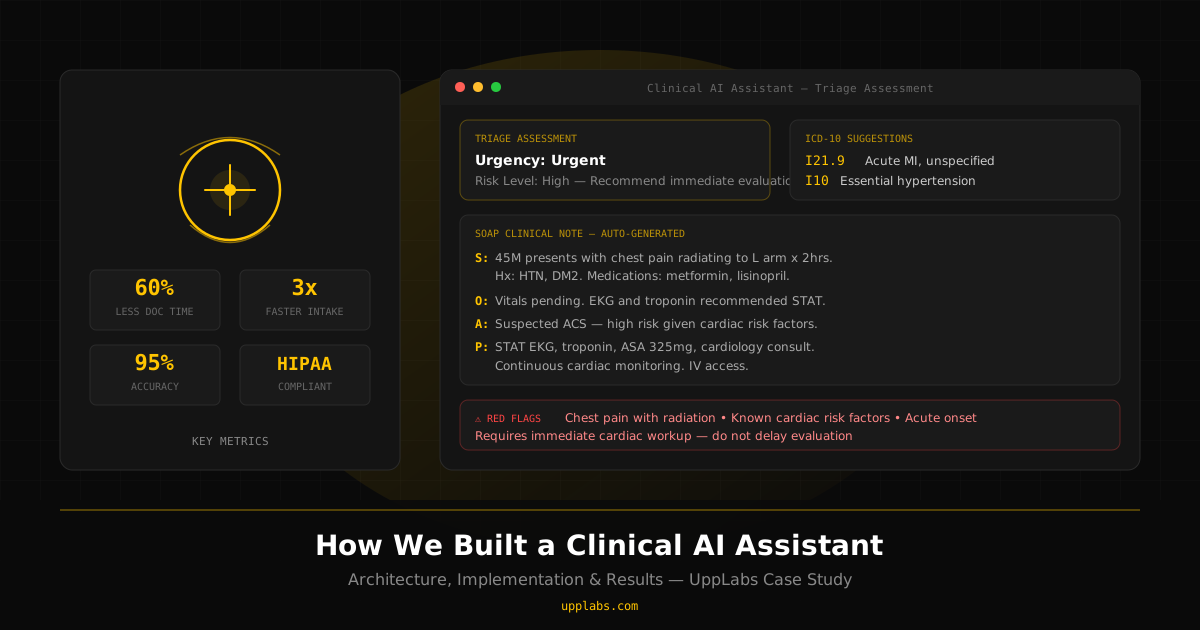
This problem becomes especially visible with clinical AI. In UppLabs' Clinical AI Assistant, patient information can enter the platform from an EHR through FHIR APIs and provide context for clinical processing and documentation. But generating the result was not enough.A standalone workflow still required clinicians to copy notes manually. Direct EHR integration and FHIR write-back were needed to remove that friction. The lesson is important: optimize the complete workflow, not just the inbound connection. An integration that automatically retrieves data but creates manual work at the end has simply moved the bottleneck.
Common EHR Integration Challenges
Most EHR integration challenges come from differences between systems rather than the API connection itself.Different data models. Systems can represent the same clinical information using different structures, codes, units, and required fields. Mapping and normalization must therefore be built into EHR integration software.Patient identity. The integration needs reliable rules for identifiers, duplicate records, demographic discrepancies, and patient matching.Incomplete interoperability. Two platforms supporting FHIR do not necessarily expose every resource or workflow identically. EHR interoperability needs to be validated against the actual target system.Legacy infrastructure. Modern healthcare software may need FHIR for one workflow and HL7 for another.Security and compliance. Authentication, authorization, encryption, audit logging, access control, and PHI handling must be designed into healthcare software integration. For more on this layer, see our HIPAA-Compliant AI implementation guide.External failures. APIs go down, messages can arrive twice, credentials expire, and data can arrive out of order. Production EHR integration solutions need retries, monitoring, error handling, and reconciliation mechanisms.
EHR Integration Best Practices
The strongest EHR integration solutions share several principles:
- Map workflows before fields. Understand what clinicians and patients actually do before defining API calls.
- Use a consistent internal data model. Normalize external information at the integration boundary instead of allowing each EHR to shape the product architecture.
- Plan bidirectional workflows early. Determine whether the product needs read-only access or must also return information to the EHR.
- Design for failure. Define retries, fallback behavior, synchronization rules, and recovery processes.
- Monitor the integration. Track API failures, latency, synchronization delays, mapping errors, retries, and failed write-backs.
- Test complete clinical scenarios. Validate the full workflow rather than individual endpoints in isolation.
A successful API call does not necessarily mean a successful healthcare workflow.
Build In-House or Use EHR Integration Services?
The right approach depends primarily on integration complexity.
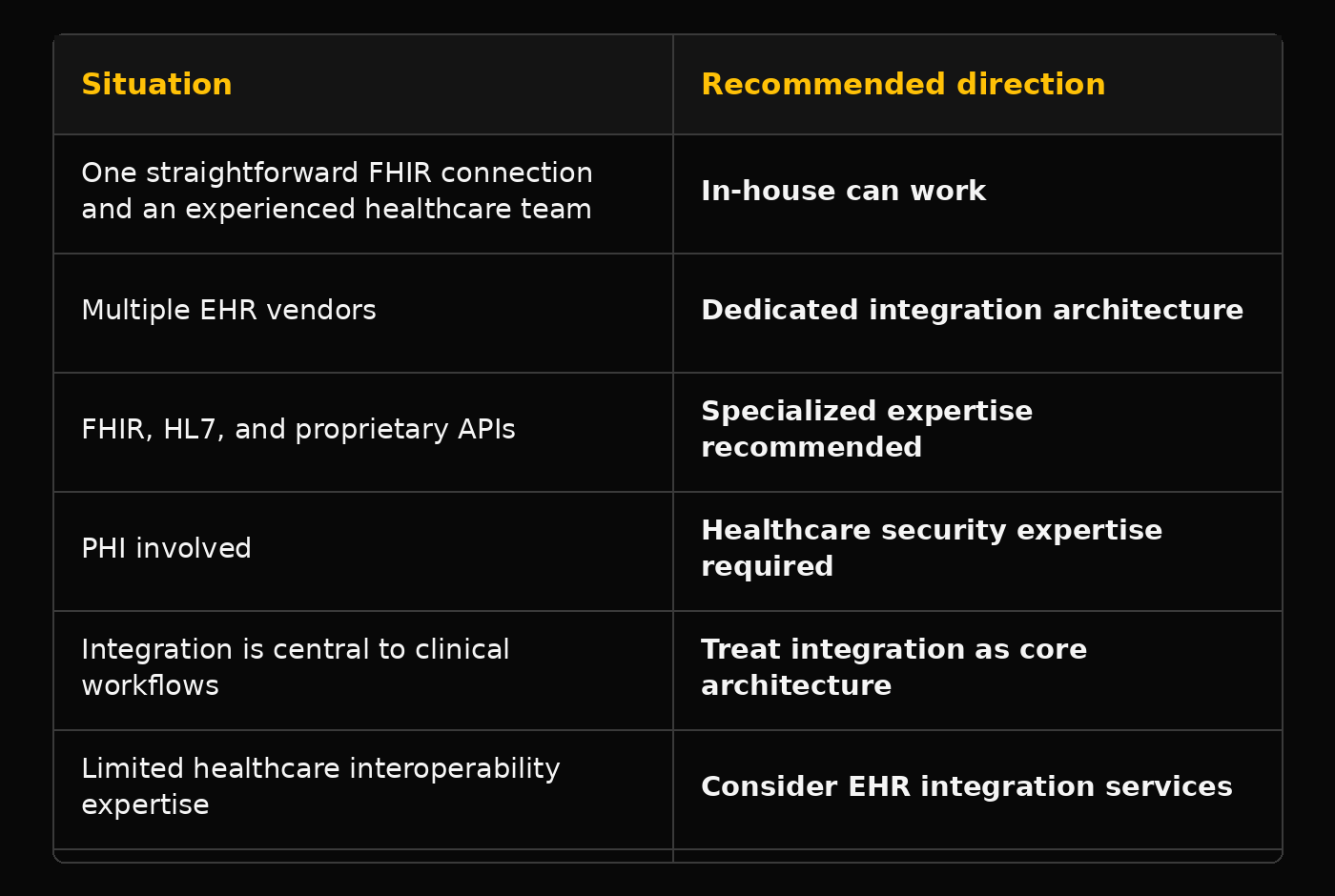
When evaluating EHR integration services, do not ask only whether a development team knows FHIR or HL7. Look at whether the team can handle the entire lifecycle: connecting the EHR, validating and normalizing data, integrating it into product workflows, supporting write-back, securing the exchange, and monitoring the connection in production.UppLabs' Healthcare AI Solutions include healthcare integrations and interoperability as part of broader product architecture.
EHR Integration Decision Framework
Before implementation, answer seven questions:
- Which clinical or operational workflow are we integrating?
- What data needs to move between systems?
- Is the exchange read-only or bidirectional?
- Does data move in real time, on schedule, or after a specific event?
- Does the target system support FHIR, HL7, proprietary APIs, or several options?
- What should happen if the EHR or another connected system becomes unavailable?
- How will the team monitor integration health after launch?
These decisions should come before choosing EHR integration software or writing integration code.
Build EHR Integration Around the Workflow
The best EHR integration becomes almost invisible. Patient information appears where clinicians need it. Updates move between systems without copy-paste. Errors are detected before they disrupt clinical work. New EHR integrations can be added without rebuilding the entire product.Getting there requires more than an API connection. It requires architecture built around interoperability, data normalization, security, reliability, and real healthcare workflows.UppLabs has worked on healthcare products ranging from large-scale virtual care platforms such as TimelyCare to health data platforms such as WellBit.If your product needs electronic health record integration without creating another disconnected data silo, UppLabs can help design the integration around the workflow first and the technology second.
FAQ
What is EHR integration?
EHR integration connects an electronic health record with other healthcare software so clinical and administrative information can move securely between systems.
What is an EHR API?
An EHR API allows authorized applications to access or exchange information with an electronic health record. An electronic health record API may use FHIR, proprietary endpoints, or both.
What is the difference between FHIR and HL7 integration?
FHIR uses resource-based models and modern API patterns. HL7 v2 commonly uses event-driven messages and remains widely used across established healthcare infrastructure.
Does FHIR replace HL7?
Not necessarily. Healthcare environments frequently use FHIR and existing HL7 standards for different workflows.
What should EHR integration software include?
Depending on the product, it may include API connectors, authentication, mapping, normalization, validation, error handling, monitoring, audit logging, and bidirectional synchronization.
When should a company use EHR integration services?
They become particularly valuable when a product must support multiple EHRs, combine FHIR and HL7, handle PHI, or implement complex bidirectional clinical workflows.