Healthcare apps are no longer just digital appointment books. They can connect patients with clinicians, provide access to health information, support remote care, automate workflows, and keep critical services available when demand suddenly increases. But building one is fundamentally different from developing an ordinary consumer app. A healthcare product may need to handle sensitive health data, integrate with existing systems, remain accessible to different user groups, perform reliably under peak loads, and meet regulatory and security requirements without making the experience frustrating for patients or healthcare professionals. That makes successful healthcare app development a balance of usability, security, interoperability, scalability, and real-world healthcare workflows. This guide explains the key types and features of healthcare applications, how the development process works, which challenges teams should plan for, and the best practices that help turn an idea into a reliable healthcare product.
What Is Healthcare App Development?
Healthcare app development is the process of designing, building, testing, deploying, and maintaining digital applications for patients, healthcare providers, clinics, wellness organizations, and other healthcare businesses. Depending on the product, healthcare application development can cover mobile applications, web platforms, patient portals, telehealth solutions, clinical tools, health monitoring products, and software connected to existing healthcare infrastructure. Unlike general-purpose software, healthcare applications often operate in an environment where product decisions have implications for privacy, compliance, accessibility, and continuity of care. This is why medical app development should begin with the healthcare workflow and business problem rather than with a list of features.Before deciding what to build, teams should understand:
- who will use the product;
- what problem it should solve;
- which data it will collect and process;
- whether it needs to exchange data with other systems;
- which regulatory requirements apply;
- what level of availability and scalability is required;
- how the application fits into existing patient or clinical workflows.
The answers influence virtually every decision that follows from architecture and technology stack to UX and testing.
Types of Healthcare Apps
The term "healthcare app" covers products with very different users and purposes. Identifying the product category early helps define requirements and avoid unnecessary functionality.
Telehealth and Virtual Care Apps
Telehealth applications connect patients with healthcare professionals remotely. Depending on the use case, they may provide video consultations, appointment management, secure communication, notifications, and access to healthcare information. Scalability is particularly important for these platforms because demand may change significantly during peak periods. UppLabs has worked on this challenge with TimelyCare, a U.S. virtual health platform serving 300+ colleges and universities and more than 2 million students. The project involved web and mobile development, workflow redesign, HIPAA and HITECH compliance, and infrastructure improvements designed to handle sudden increases in user activity.
Patient-Facing Healthcare Apps
Patient applications can give users a more convenient way to interact with healthcare services.Typical functionality may include:
- appointment scheduling and management;
- access to health information;
- reminders and notifications;
- secure communication;
- personalized health insights;
- telehealth functionality;
- health and wellness tracking.
The challenge is to make these functions easy to use without compromising security.For example, in UppLabs' Community Clinic healthcare project, a cross-platform mobile application enabled patients to access health records and interact with the clinic while the underlying solution connected legacy EHR systems with Salesforce Health Cloud.
Health and Wellness Apps
Not every healthcare application is designed for clinical care. Wellness applications may focus on lifestyle management, activity tracking, nutrition, mental well-being, or other health-related goals. One example is START, an intermittent fasting mobile product developed as an MVP. UppLabs delivered the initial product in two months; it later reached more than 1.5 million downloads across 20+ countries.This type of product illustrates another side of healthcare mobile app development: sometimes the priority is not complex clinical infrastructure but rapid validation, intuitive mobile UX, and an architecture that can grow with the product.
Apps for Healthcare Professionals
Healthcare software can also be built primarily for clinicians and staff.These products may support:
- patient intake;
- clinical documentation;
- internal communication;
- workflow automation;
- data analysis;
- decision support;
- administrative processes.
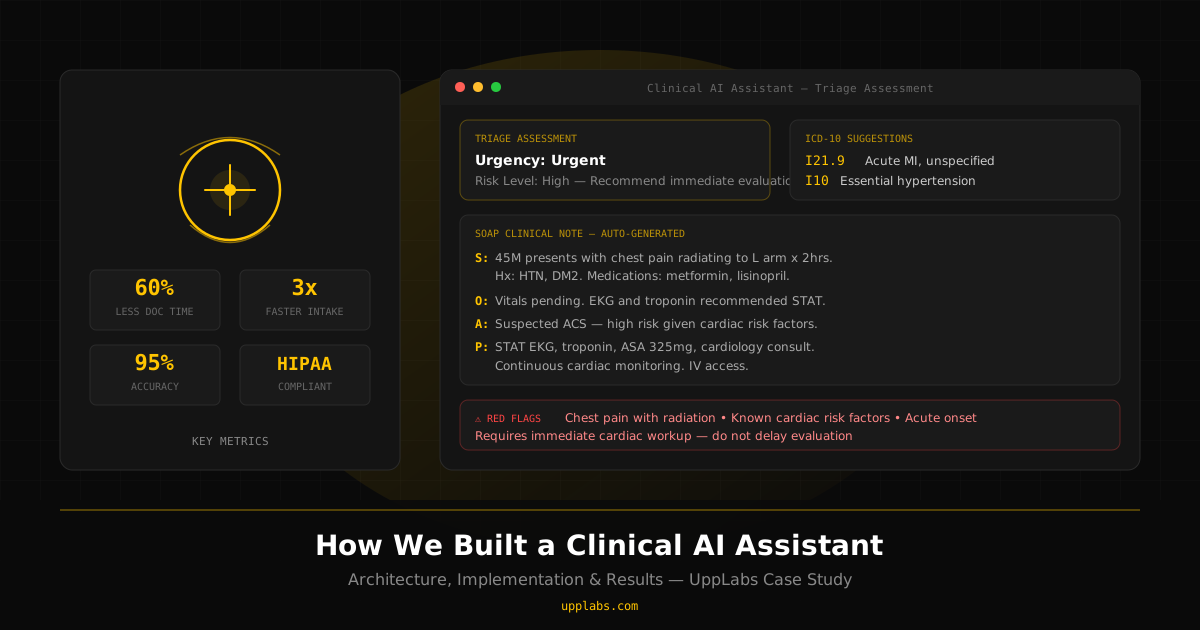
AI is expanding this category further. UppLabs' Clinical AI Assistant case study demonstrates how conversational intake, clinical NLP, automated SOAP notes, and ICD-10 coding can be combined to reduce repetitive administrative work while maintaining HIPAA compliance.
Essential Features of a Healthcare App
There is no universal healthcare feature set. A telehealth platform and a wellness tracker solve very different problems. However, several capabilities frequently appear in custom healthcare app development projects.
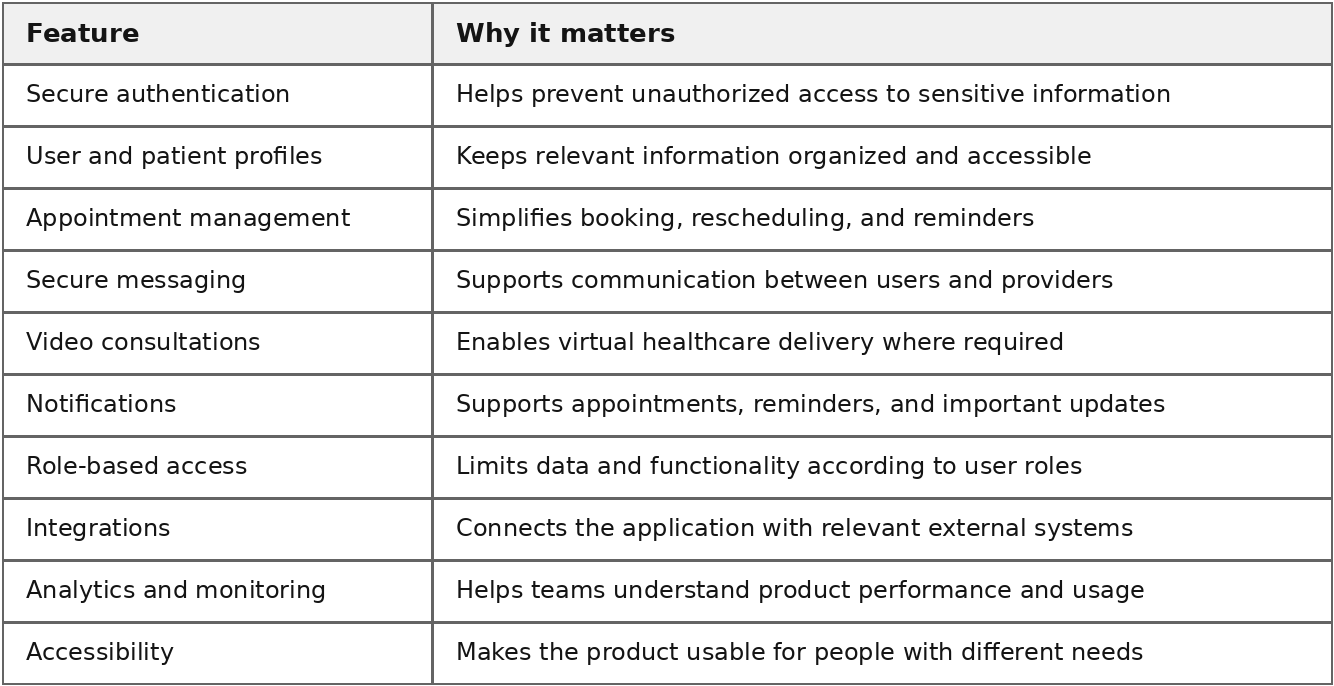
The right feature set should come from actual user journeys rather than a competitor's feature list. Adding functionality that does not solve a real problem increases development and maintenance complexity. Missing a critical workflow can be much more expensive because it may require redesigning the product after launch.
Healthcare App Development Process
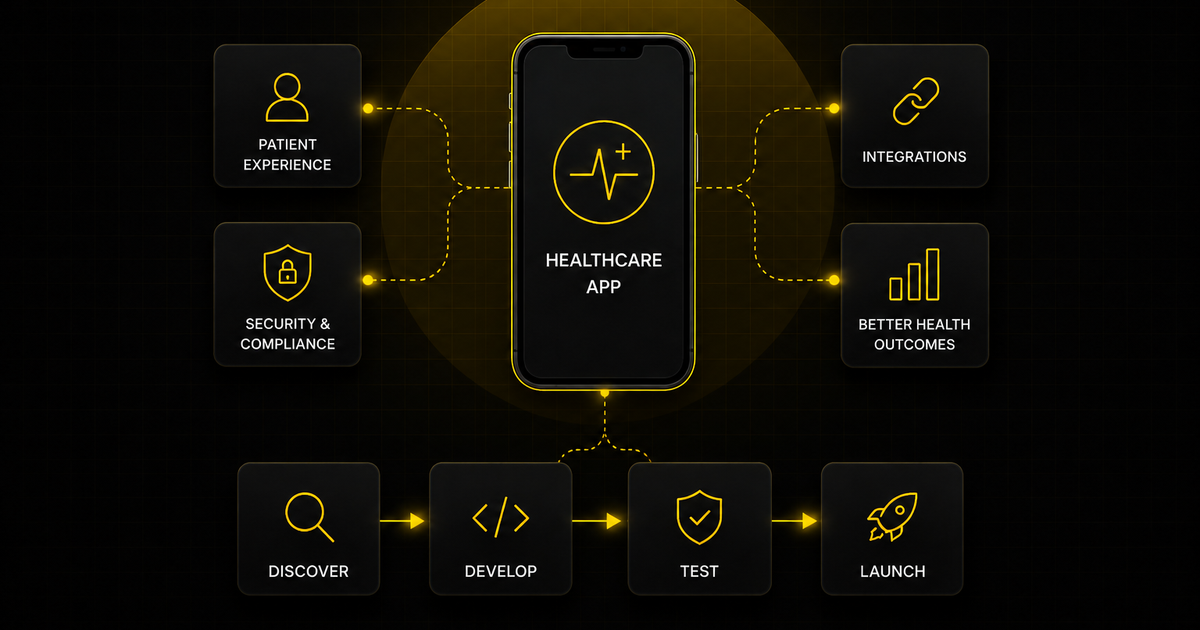
A successful healthcare app development process should reduce uncertainty before expensive technical decisions become difficult to reverse. The exact workflow depends on the product, but most projects move through several core stages.
1. Discovery and Requirements
Development should begin with the problem. At this stage, the team defines target users, business objectives, workflows, functional requirements, technical constraints, and relevant regulatory considerations.Questions worth answering include:
- Who is the primary user?
- What task should become easier or faster?
- What sensitive information will the application process?
- Which systems need to exchange data?
- What happens if the application becomes temporarily unavailable?
- Which requirements are essential for the first release?
This stage also helps distinguish an MVP requirement from something that can wait.
2. UX and UI Design
Healthcare UX has to minimize friction without hiding important information or security controls. Consider a patient trying to schedule an urgent virtual consultation. A technically sophisticated application is of little value if that user cannot quickly understand where to go. Accessibility should therefore be considered early. During its work with TimelyCare, UppLabs redesigned the mobile interface with accessibility requirements such as contrast, clickability, and voiceover compatibility in mind.
3. Architecture and Technology Selection
There is no single "best" technology stack for healthcare applications.The right architecture depends on factors such as:
- expected number of users;
- web, mobile, or cross-platform requirements;
- real-time functionality;
- integrations;
- data volume;
- security requirements;
- scalability expectations;
- existing client infrastructure.
Architecture decisions should also consider future development. A successful MVP may need to support a much larger user base later without requiring a complete rebuild.Once requirements, UX, and architecture are established, engineering moves into implementation. For healthcare mobile app development, teams also need to decide between native and cross-platform approaches. Cross-platform development can be effective when a business needs to support both iOS and Android while sharing a significant part of the codebase. UppLabs, for example, used React Native for both TimelyCare and the Community Clinic project. The choice should still follow product requirements rather than a predetermined technology preference.
5. Integrations
Healthcare applications rarely exist in complete isolation. Depending on the product, integration may be required with existing healthcare platforms, APIs, identity systems, cloud infrastructure, payment services, or other third-party software. This can become one of the most technically demanding parts of medical app development, particularly when modern applications need to communicate with legacy infrastructure. In the Community Clinic project, UppLabs had to connect legacy EHR systems with Salesforce Health Cloud. Different data structures were transformed into FHIR-compliant formats, while middleware supported real-time synchronization. The lesson is straightforward: integration requirements should be investigated early rather than treated as an add-on near launch.
6. Security and Compliance
Security cannot be a final pre-release task. If an application handles protected health information, security and applicable compliance requirements should influence architecture, authentication, access control, data storage, transmission, logging, and operational processes from the beginning.Common safeguards can include:
- encryption at rest and in transit;
- role-based access controls;
- multi-factor authentication;
- audit logging;
- secure authentication protocols;
- input validation;
- vulnerability testing;
- continuous security monitoring.
For a deeper look at healthcare compliance, see UppLabs' Complete Checklist to Create HIPAA-Compliant Software. Teams incorporating AI into healthcare products face additional considerations around how protected health information interacts with models and third-party infrastructure. UppLabs covers these challenges separately in its HIPAA-Compliant AI Implementation Guide.
7. Testing
Healthcare software needs more than a check that buttons work.Testing can cover:
- functional behavior;
- API and integration reliability;
- security;
- performance;
- accessibility;
- compatibility across devices;
- usability;
- regression after updates.
Performance testing becomes particularly important when a platform must remain stable during unpredictable demand. TimelyCare, for example, experienced sudden user spikes during high-stress periods. Its infrastructure therefore needed auto-scaling, load balancing, monitoring, and alerting to maintain reliable service.
8. Deployment, Monitoring, and Continuous Improvement
Launch is not the end of healthcare application development. Real users reveal workflow problems and edge cases that controlled testing cannot always predict. Regulations, security threats, integrations, operating systems, and user expectations also continue to change. Post-launch work should therefore include monitoring, security updates, performance optimization, user feedback analysis, bug fixing, and iterative product improvements.
Key Challenges in Healthcare Mobile App Development
Healthcare products introduce constraints that ordinary applications may not face. Understanding these challenges before development can prevent costly architectural changes later.
Protecting Sensitive Data
Healthcare information requires careful handling throughout its lifecycle. Protection needs to cover not only the database but also APIs, authentication, backups, logs, integrations, administrative tools, and infrastructure. Security by design is considerably more effective than attempting to retrofit protection after the application has already been built.
Balancing Security With Usability
Security measures that make a product nearly impossible to use can create a different kind of failure. Clinicians may need fast access to information. Patients may include older adults or people with accessibility requirements. Authentication and authorization must therefore be secure without creating unnecessary friction. UppLabs encountered this challenge in its Community Clinic project, where the team needed to protect sensitive patient information while maintaining quick, practical access for both doctors and patients.
Integrating Legacy and Modern Systems
A modern mobile interface does not automatically make the underlying healthcare ecosystem modern. Many organizations still depend on established systems containing critical patient or operational data. A new application may therefore need to exchange information reliably with technology that was not originally designed for modern mobile workflows. This makes interoperability an architectural concern, not simply an API task.
Designing for Scale
A product that works for 1,000 users may behave very differently with 100,000. Teams should consider expected growth, concurrent activity, database load, API performance, monitoring, and failure recovery before scale becomes an emergency.
Building for Real Healthcare Workflows
A technically correct application can still fail if it adds work instead of removing it. That is particularly important for clinician-facing software. In the UppLabs Clinical AI Assistant project, the team found that high-quality structured patient input was crucial to downstream AI accuracy. The experience also showed the value of integrating directly with existing clinical workflows rather than forcing users to copy information manually between systems.
Best Practices for Healthcare App Development
The strongest healthcare products are not necessarily the ones with the most features. They are the ones that solve the right problem reliably.
Start With the Workflow, Not the Feature List
Map what patients, clinicians, administrators, or other users actually need to accomplish. Only then define features. This keeps the product focused and reduces the risk of building expensive functionality with little practical value.
Build Security and Compliance Into the Architecture
Do not wait until launch to ask whether the system meets relevant requirements. Identify sensitive data flows early and design authentication, encryption, access control, logging, and infrastructure accordingly. UppLabs follows the same principle in healthcare AI projects: compliance is considerably easier to manage when it is treated as an architectural requirement from the start rather than a later patch.
Plan Integrations Early
If the product depends on an EHR, CRM, external API, wearable device, or another third-party system, investigate the integration during discovery. Understand data formats, authentication methods, rate limits, system limitations, and failure scenarios before finalizing the architecture.
Prioritize Accessibility
Healthcare applications serve diverse audiences. Clear navigation, readable interfaces, appropriate contrast, accessible controls, and assistive-technology compatibility should be considered part of product quality rather than optional enhancements.
Design for Growth
Not every MVP needs enterprise-scale infrastructure on day one. It does, however, need a technical foundation that will not become an immediate barrier if adoption grows faster than expected. The START case illustrates the value of this approach: the initial MVP was delivered quickly, while the product ultimately scaled to more than 1.5 million downloads.
Measure Outcomes, Not Just Releases
Shipping features is not the same as improving a healthcare product.Useful metrics depend on the application but may include:
- patient engagement;
- task completion;
- workflow time;
- application stability;
- adoption;
- administrative workload;
- feature usage;
- user satisfaction.
The metrics should connect technical work with the business or healthcare problem the application was created to address.
Choosing the Right Healthcare App Development Partner
A healthcare development partner should understand more than mobile frameworks.Before choosing a team, evaluate whether it has experience with:
- healthcare-specific security and compliance requirements;
- web and mobile product development;
- integrations and complex data flows;
- scalable architecture;
- accessibility and real-world user workflows;
- testing and post-launch support;
- products similar to the one you plan to build.
Real case studies are particularly useful here. They show not only what technologies a company lists on its website, but what problems its engineers have actually solved. UppLabs has delivered healthcare products across virtual care, patient engagement, wellness, and clinical AI. Its portfolio includes TimelyCare, serving more than 2 million students, a Community Clinic application integrating healthcare data with Salesforce Health Cloud, and the START mobile product with more than 1.5 million downloads. For organizations that need a product adapted to their workflows rather than an off-the-shelf solution, custom healthcare app development also provides more control over architecture, integrations, user experience, and future product development.
Building a Healthcare App That Works Beyond Launch
Successful healthcare software is not defined by the number of features in its first release. It is defined by whether people can use it easily, sensitive information remains protected, integrations work reliably, the product can handle real-world demand, and the architecture can evolve as requirements change. That is why effective healthcare app development starts long before coding. Product discovery, UX, security, architecture, integrations, testing, and scalability all influence whether an application becomes a sustainable healthcare product or another system that needs to be rebuilt. UppLabs brings hands-on experience in healthcare mobile app development, web platforms, compliant healthcare systems, and AI-powered clinical products. From validating an MVP to extending an existing platform or developing a custom healthcare solution, the goal is the same: build technology around the real workflow and business problem. If you are planning a healthcare product, explore UppLabs' healthcare case studies or discuss your requirements with the team before turning the idea into a development roadmap.
FAQ
What is healthcare app development?
Healthcare app development is the process of creating mobile or web applications for patients, healthcare professionals, clinics, wellness businesses, and other healthcare organizations. It can include product discovery, UX/UI design, software engineering, integrations, security, testing, deployment, and ongoing maintenance.
What are the essential features of a healthcare app?
Features depend on the product. Common capabilities include secure authentication, user profiles, appointment management, notifications, secure communication, video consultations, integrations, role-based access, analytics, and accessibility features.
How is healthcare app development different from regular app development?
Healthcare applications can introduce additional requirements around sensitive data, privacy, regulatory compliance, interoperability, accessibility, reliability, and clinical or patient workflows. These requirements can influence architecture and development from the earliest stages.
How do you choose a healthcare app development company?
Look for relevant healthcare case studies, security and compliance experience, integration expertise, mobile and web engineering capabilities, scalable architecture experience, and evidence that the team understands healthcare workflows rather than only the technology.
Should a healthcare app be native or cross-platform?
It depends on product requirements. Native development can be appropriate when deep platform-specific capabilities are required, while cross-platform technologies can reduce duplicated development effort when an application needs to serve both iOS and Android users. The decision should be made after evaluating functionality, performance, integrations, timeline, and long-term maintenance.