Patient calls rarely arrive at a convenient time. Someone needs to reschedule an appointment during lunch, another patient calls after hours about a prescription refill, and front-desk staff are already handling check-ins, insurance questions, and clinical requests.
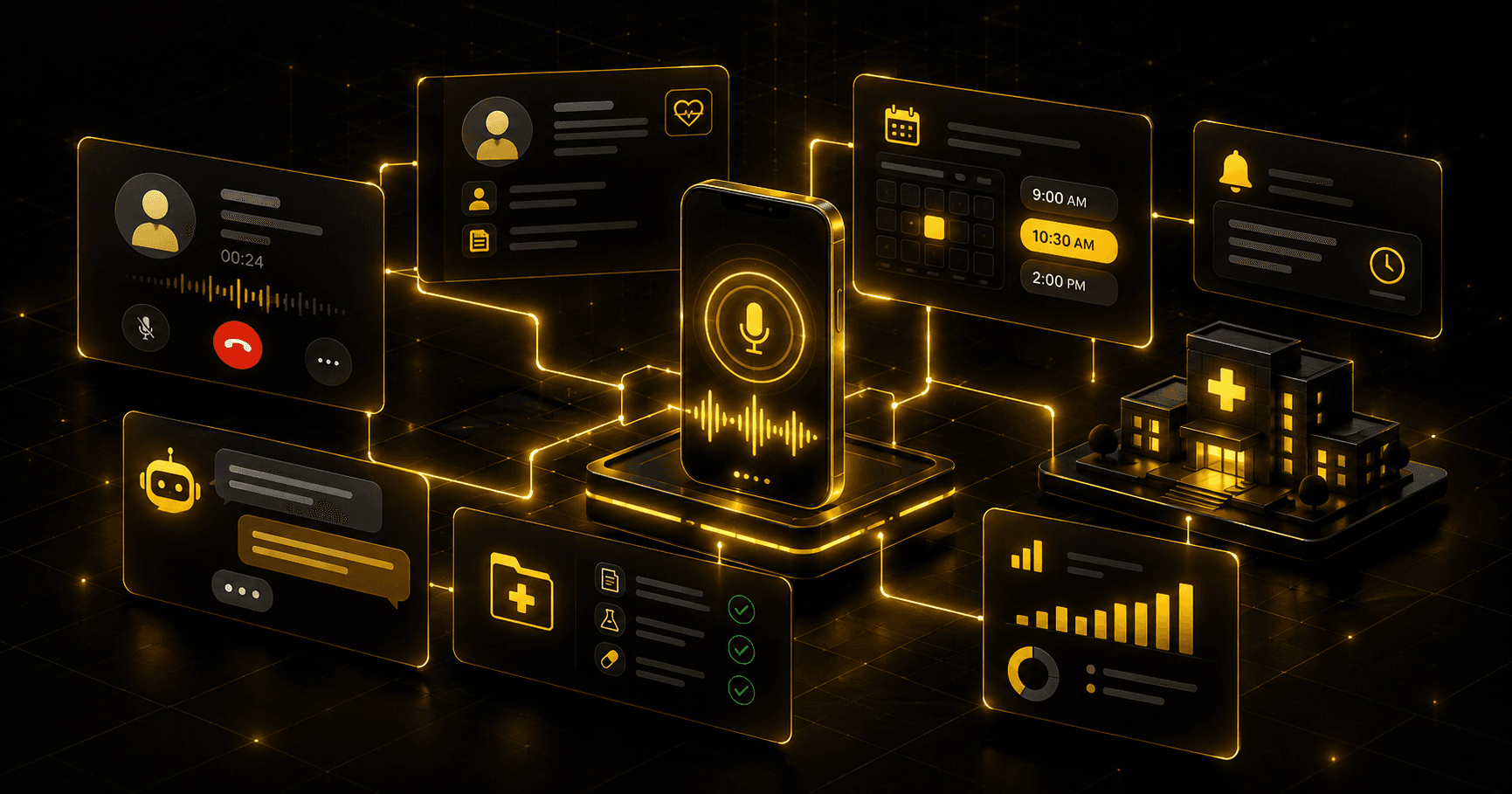
Conversational AI in healthcare can take repetitive communication out of that queue without reducing every interaction to a rigid phone tree. Voice agents can understand natural speech, connect to scheduling and patient systems, complete routine actions, and transfer complex conversations to staff with context intact.
Value comes from more than answering the phone. Healthcare conversational AI becomes useful when it can safely move a patient from conversation to completed workflow.
TL;DR
- Conversational AI for healthcare can automate appointment booking, rescheduling, reminders, follow-ups, refill requests, and routine patient questions.
- Voice AI in healthcare combines speech recognition, language understanding, workflow logic, system integrations, and speech generation rather than functioning as simple transcription software.
- Automated patient scheduling works best when the agent can access live availability, apply scheduling rules, verify identity when needed, and write confirmed changes back to the source system.
- HIPAA requirements, PHI handling, escalation rules, auditability, and human handoff should be designed into architecture from the start.
- Custom voice AI becomes especially relevant when call volume is high, workflows differ by clinic, or automation must integrate deeply with EHR, scheduling, CRM, and telephony infrastructure.
What Is Conversational AI in Healthcare?
Conversational AI in healthcare refers to software that can understand patient language, maintain the context of a conversation, access connected healthcare systems, and respond or perform an appropriate action.
Voice makes that interaction available through the channel patients already use every day: the phone. Healthcare conversational AI can support inbound and outbound communication across appointment management, follow-up workflows, prescription requests, FAQs, insurance-related questions, and patient routing. More advanced systems can recognize when a request falls outside approved automation boundaries and transfer it to a person.
UppLabs' Voice AI for Patient Communication follows this model. Voice agent capabilities include appointment booking, rescheduling and cancellation, follow-up reminders, refill requests, insurance verification, multilingual conversations, and warm handoffs to staff.
Terms such as conversational AI healthcare are sometimes used as shorthand for this wider category. Scope still matters: conversational AI does not automatically mean a system can access schedules, update an EHR, verify information, or complete a healthcare workflow. Integration determines whether the agent only talks or actually gets work done.
Voice AI vs. Medical Voice Recognition Software
Voice AI and medical transcription solve different problems. Medical voice recognition software primarily converts spoken language into text. Clinicians may use it to dictate documentation, create notes, or reduce manual typing. Search queries such as voice recognition software medical transcription generally point toward that documentation workflow.
Conversational voice AI has a different job. Voice agents must listen, understand intent, remember context, decide what action is allowed, interact with another system, respond naturally, and know when to escalate. Speech-to-text is only one component inside that pipeline.
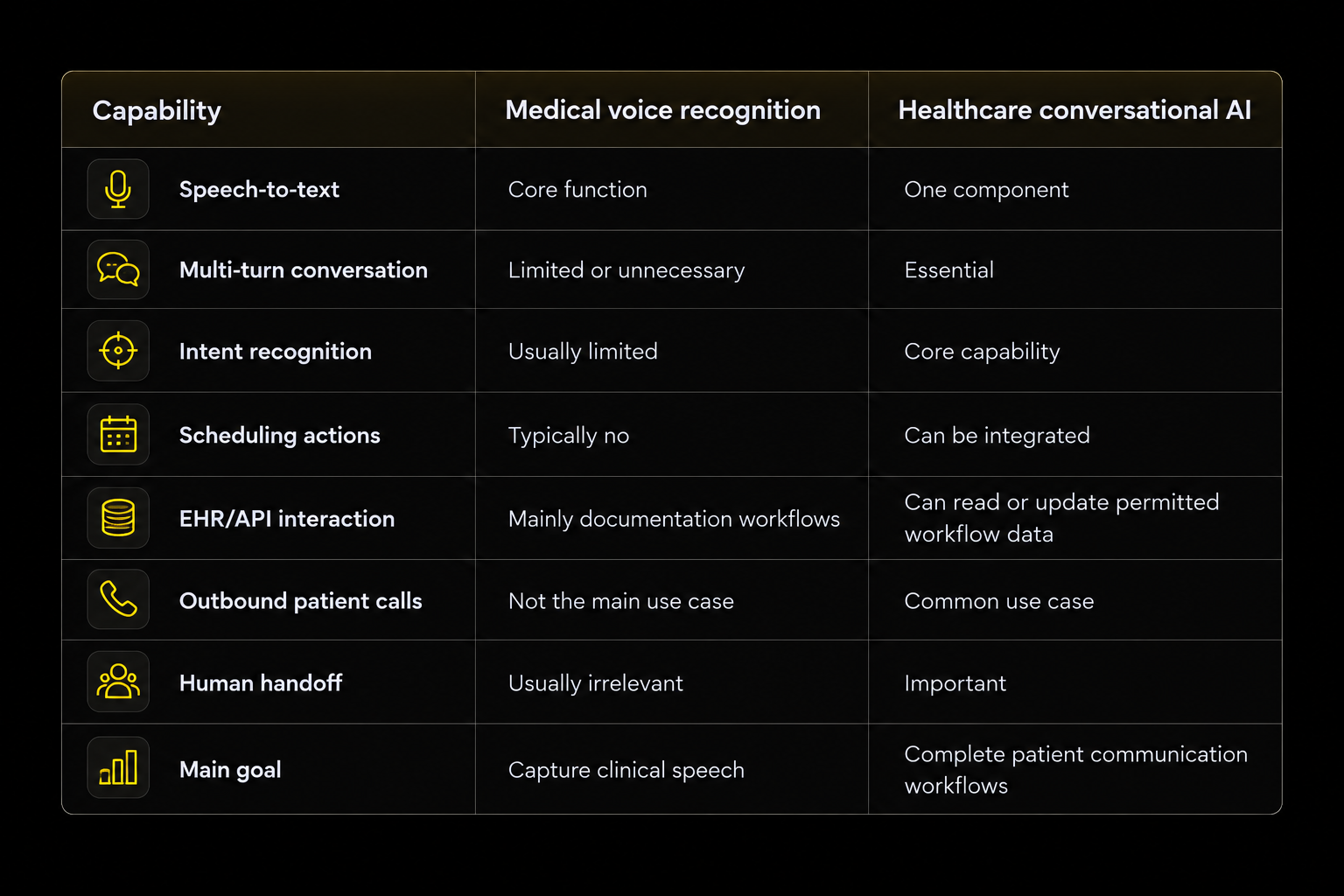
UppLabs already uses voice technology in another healthcare context through it's Clinical AI Assistant, where voice-to-text supports clinical documentation. Patient-facing voice agents extend the concept in a different direction: from documenting a clinician's work to handling operational conversations with patients.
How Voice AI Automates Patient Calls
Voice AI automates patient calls by combining conversation with workflow execution. Reliable systems do not simply generate a plausible answer; they determine what the patient wants, collect the required information, interact with connected systems, and confirm the result.Typical flow looks like this:
- Understand the request. Speech recognition converts the call into text while conversational logic identifies intent, such as booking, rescheduling, refill, follow-up, or a general inquiry.
- Validate context. System collects only information required for the workflow and applies identity verification when the requested action requires it.
- Execute an action. Agent queries scheduling, EHR, CRM, or another approved system and applies business rules before making a change.
- Confirm or escalate. Patient receives a clear confirmation, while ambiguous, sensitive, or unsupported cases move to human staff with relevant context.
Such architecture matters because patient communication rarely fits one fixed script. Scheduling rules differ between providers, specialties, appointment types, insurance plans, locations, and patient needs. Voice AI creates value when conversation ends in a completed workflow, not merely a correctly recognized sentence.
Automated Patient Scheduling: Where Voice AI Delivers Immediate Value
Automated patient scheduling is one of the clearest use cases because much of the workflow is structured but still consumes staff time.
Patient may ask for a specific physician, location, date range, appointment type, or time of day. Voice agent can interpret those preferences, query real-time availability, apply scheduling constraints, propose available slots, confirm a selection, and update the scheduling system.
Rescheduling follows the same principle. Cancellation can also trigger another workflow, such as opening the slot to a waitlist.
Automated patient scheduling software becomes significantly more useful when it operates across channels rather than as an isolated booking widget. Phone-based conversation can serve patients who prefer calling, while web or mobile interfaces continue using the same scheduling logic underneath.
UppLabs' voice AI solution is designed to integrate with scheduling systems, EHRs, and phone infrastructure instead of acting as a separate conversational layer.
Healthcare teams building similar workflows also need to think beyond booking. UppLabs' guide to Healthcare App Development covers the broader integration, security, scalability, and workflow requirements involved in healthcare products.
Automated Patient Reminder Calls and Follow-Ups
Automated patient reminder calls can reduce repetitive outbound work while giving patients an immediate way to respond. Reminder does not need to end with “Press 1 to confirm.” Conversational system can let a patient confirm, ask to reschedule, request another time, or indicate that staff assistance is needed.
Follow-ups can use the same infrastructure for post-visit check-ins, preventive-care notifications, referral coordination, or other approved workflows. HHS states that appointment reminders are considered part of treatment and can be made without HIPAA authorization. HHS also permits providers to communicate with patients by phone, while recommending that providers limit the information disclosed in voicemail or answering-machine messages to reasonably safeguard privacy.
Privacy-aware workflow should therefore decide not only what the agent says during a verified conversation, but also what happens when nobody answers, another person answers, or voicemail is reached.
What Does Production Voice AI Architecture Need?
Production voice AI needs multiple layers working together. Language model quality matters, but integration, latency, reliability, and control determine whether a system can operate safely in real patient workflows.
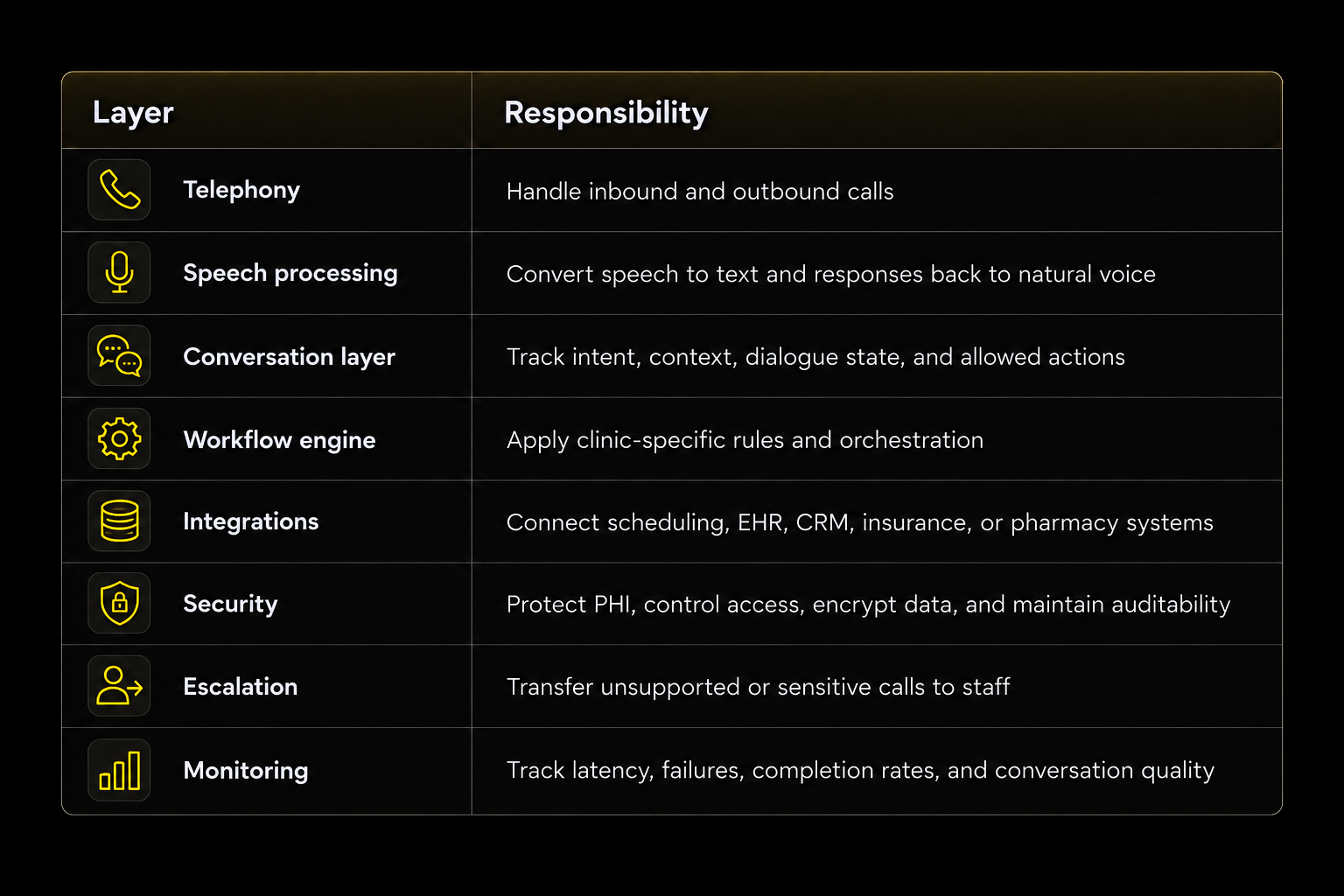
Latency deserves particular attention. Long pauses make even accurate AI feel broken on a phone call, so architecture needs fast speech recognition, model responses, API calls, and voice generation.
Fallbacks matter just as much. Scheduling API may become unavailable, patient information may conflict, or conversation may move into clinical territory that should not be automated. Safe workflow needs a predictable path out.
EHR Integration Turns Conversation Into Workflow Automation
EHR and scheduling integrations separate useful voice agents from standalone demos. Patient who books an appointment should not force staff to copy the result into another system later. Refill request should reach the correct workflow. Updated appointment status should remain consistent across systems.
UppLabs' EHR Integration guide explains why healthcare integration is fundamentally a workflow problem rather than only an API connection. FHIR, HL7, vendor APIs, identity matching, normalization, write-back, monitoring, and error handling all affect whether connected healthcare software works reliably.
Same principle applies to conversational AI for healthcare. Voice should become another interface to existing clinical and operational systems, not another disconnected source of data.
HIPAA, PHI, and Human Handoff
HIPAA compliance starts with architecture, not with a disclaimer at the end of a call. Voice systems may create, receive, maintain, or transmit protected health information depending on their role. HHS explains that vendors performing services involving PHI on behalf of covered entities can qualify as business associates and specifically lists a third-party AI chatbot handling medical reminders and appointment scheduling as an example. Appropriate business associate agreements and safeguards can therefore become part of deployment requirements.
Conversation logs, audio recordings, transcripts, model prompts, analytics, integrations, and observability tools should all be reviewed for PHI exposure. UppLabs' HIPAA-Compliant AI implementation guide covers healthcare AI architecture through encryption, access controls, de-identification, BAAs, and other implementation considerations.
Human escalation should also be deliberate. Clinical concerns, sensitive requests, unclear identity, repeated misunderstandings, and unsupported workflows should reach staff instead of pushing the model to improvise.
Where Voice AI Fits Into Patient Experience
Voice AI works best as one channel within a broader healthcare product ecosystem. Phone remains useful for patients who do not want to navigate another portal or app. Digital channels remain better for other tasks. Consistent backend workflows allow both to coexist.
UppLabs' TimelyCare case study provides relevant broader experience here. Virtual health platform serves more than two million students across 300+ colleges and universities and requires secure, scalable, continuously available digital healthcare infrastructure. Voice automation is not presented as part of that case, but the project demonstrates the operational context in which patient communication systems need to function.
Similar workflow thinking appears in UppLabs' Healthcare AI Solutions, which brings voice agents, clinical AI, patient management, medical-record analysis, and healthcare integrations into one healthcare technology offering.
Decision Framework: Build, Integrate, or Customize?
Choice depends less on whether voice AI is technically possible and more on how deeply it must understand and execute your workflows.
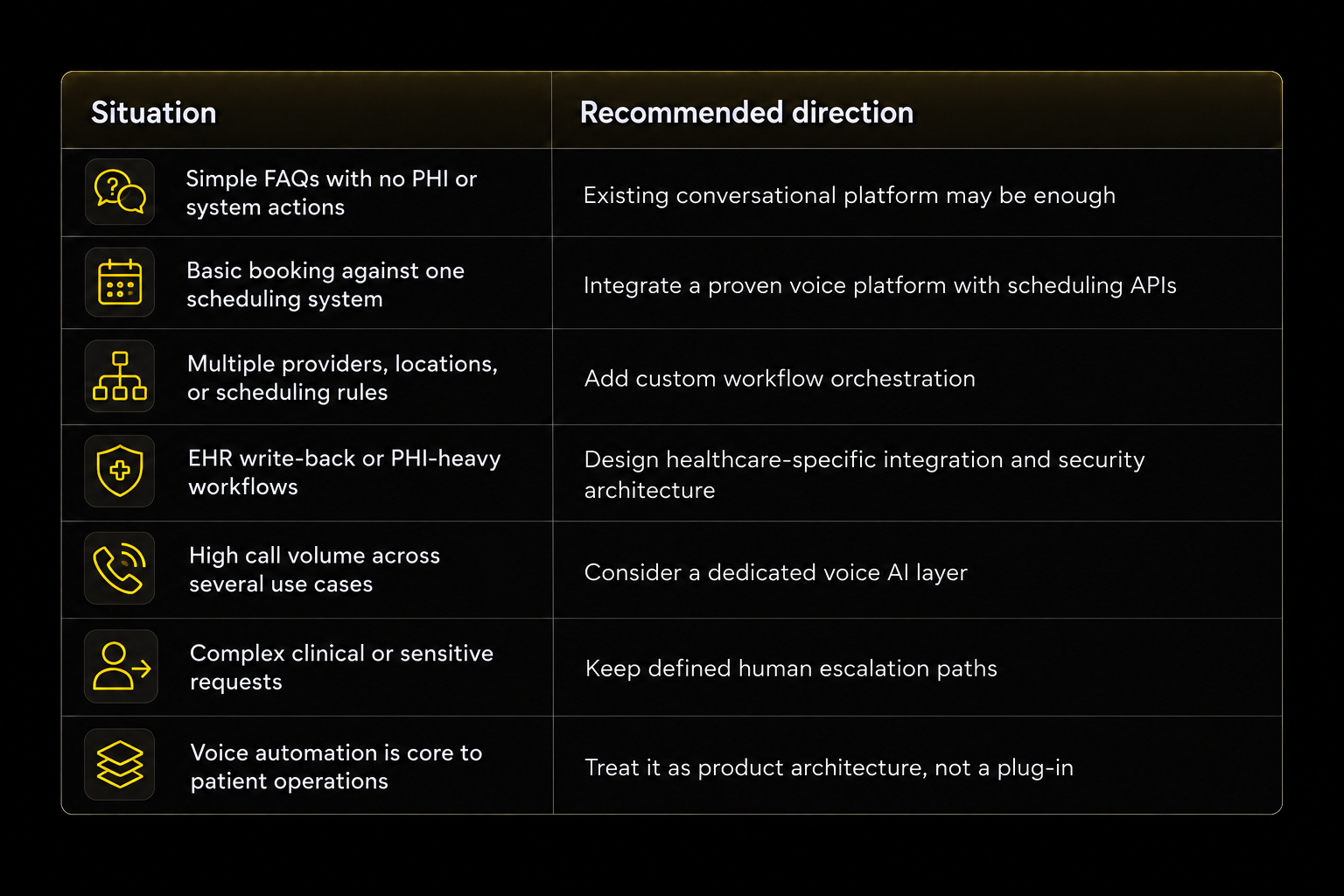
Custom development becomes especially valuable when scheduling rules, integrations, call routing, languages, verification, or reporting differ significantly from standard workflows.
UppLabs' Voice AI Agent for Healthcare demo demonstrates scheduling, reminders, prescription workflows, system actions, and human handoff as parts of one patient-call experience.
Build Voice AI Around Completed Patient Workflows
Strong voice automation does not start with choosing a speech model. Healthcare teams should start with calls they want to resolve: booking appointments, changing schedules, answering common questions, handling reminders, collecting refill requests, or routing patients to staff.
Conversation can then be designed around those workflows, followed by integrations, permissions, security boundaries, fallback behavior, monitoring, and model selection.
Voice AI in healthcare becomes commercially useful when fewer calls require repetitive staff handling while patients still get a reliable path to a person when automation is not appropriate.
UppLabs builds healthcare AI across voice automation, EHR integration, clinical workflows, patient-facing applications, and scalable healthcare platforms. Teams evaluating patient call automation can use UppLabs' Voice AI solution together with healthcare AI and integration expertise to move from a conversational prototype to a system connected to real operational workflows.
FAQ
What Is Conversational AI in Healthcare?
Conversational AI in healthcare uses natural language technologies to understand patient requests, maintain dialogue context, provide relevant responses, and perform permitted actions through connected healthcare systems.
How Does Voice AI Automate Patient Scheduling?
Voice agent understands scheduling intent, gathers necessary information, checks live availability through an integration, applies scheduling rules, confirms a slot, and writes the result back to the scheduling system.
Can Voice AI Make Automated Patient Reminder Calls?
Yes. Voice agents can place automated patient reminder calls and allow patients to confirm, reschedule, or request staff assistance during the same conversation. HIPAA Privacy Rule permits appointment reminders as part of treatment, although privacy safeguards still matter.
Is Voice AI Different From Medical Voice Recognition Software?
Yes. Medical voice recognition software mainly converts clinical speech into text, while conversational voice AI manages multi-turn dialogue, recognizes intent, connects to external systems, completes workflows, and handles escalation.
Does Healthcare Voice AI Need EHR Integration?
Not every use case needs EHR access. Scheduling, refill, patient-status, and personalized workflows often become more useful when voice AI can securely interact with EHR or other healthcare systems through appropriate APIs.
How Should Voice AI Handle PHI?
Systems processing PHI need architecture and operating controls appropriate to HIPAA requirements, including safeguards around access, storage, transmission, vendors, and auditability. Business associate requirements may apply when third-party vendors handle PHI on behalf of covered entities.
When Should Healthcare Organizations Build Custom Voice AI?
Custom development makes sense when call workflows are business-critical, several healthcare systems must be integrated, scheduling rules are complex, PHI is involved, or standard voice platforms cannot provide sufficient workflow control, monitoring, or human escalation.