Managing a few properties with spreadsheets, email, and separate accounting tools may work. Managing hundreds or thousands of units that way does not.As a portfolio grows, leases, payments, maintenance requests, tenant communication, and financial data become increasingly difficult to coordinate across disconnected systems.That is where property management software development becomes more than a technical project. The right platform can bring tenant management, lease workflows, rent collection, maintenance, reporting, and integrations into one connected environment.This guide explains what goes into custom property management software, which features and integrations matter most, how the development process works, and what businesses should consider before building their own platform.
What Is Property Management Software?
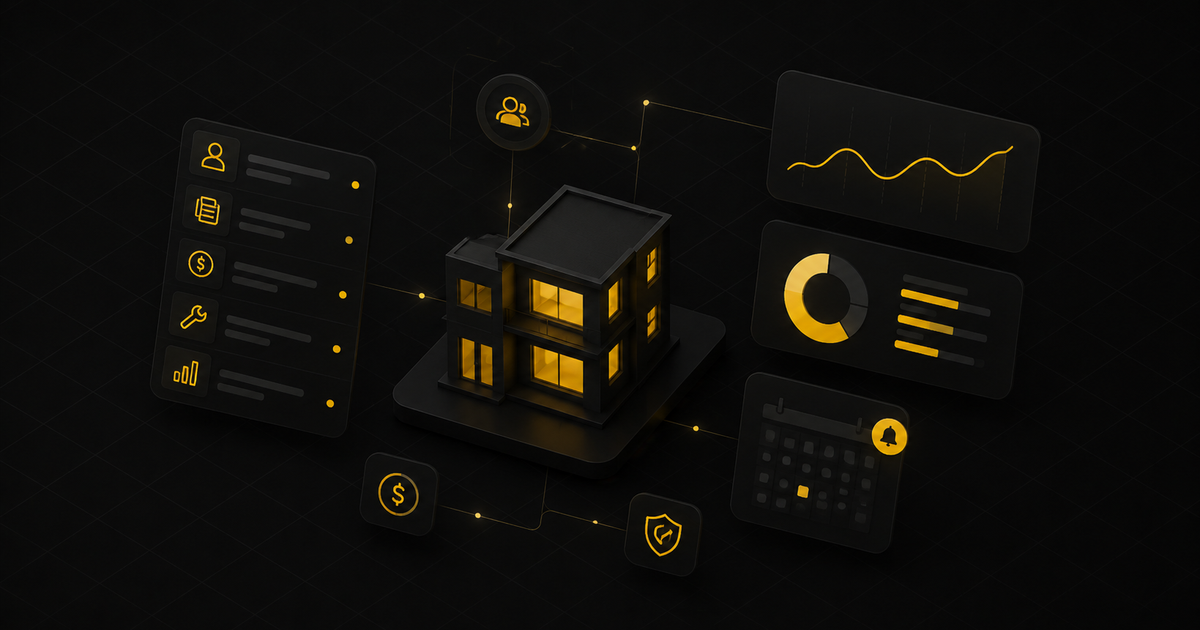
Property management software centralizes and automates everyday real estate operations across residential, commercial, or mixed portfolios.Depending on the product, it may support property managers, owners, tenants, maintenance teams, vendors, accountants, and administrators.Instead of moving information manually between spreadsheets, payment providers, accounting software, and tenant tools, a connected property management system keeps data and workflows in one environment.For example, a tenant payment can update the tenant balance, create a transaction record, refresh financial reporting, and automatically generate a receipt.That is why property management system development should start with workflows rather than a long feature list. Two businesses managing the same number of properties may still require very different software.
When Does Custom Property Management Software Make Sense?
For smaller portfolios with standard processes, an established SaaS platform may be enough.Custom property management software development becomes more relevant when:
- teams rely on multiple disconnected tools or manual data entry;
- standard software cannot support specific operational workflows;
- critical systems do not integrate properly;
- reporting across properties or regions is fragmented;
- the company needs more control over data and product development;
- the software itself is being built as a PropTech product.
The main question is not simply whether custom software is more flexible. It is whether existing technology continues to support how the business operates and grows. UppLabs, for example, helped develop a data-driven property management platform that connects property operations, tenant acquisition, and financial data. The platform supports 200K+ multifamily units, 30K+ active users, and more than $1 billion in managed assets, showing how different software requirements become at scale.
Essential Property Management Software Features
The right property management software features depend on the property type, business model, and users. Still, most platforms rely on several core capabilities.
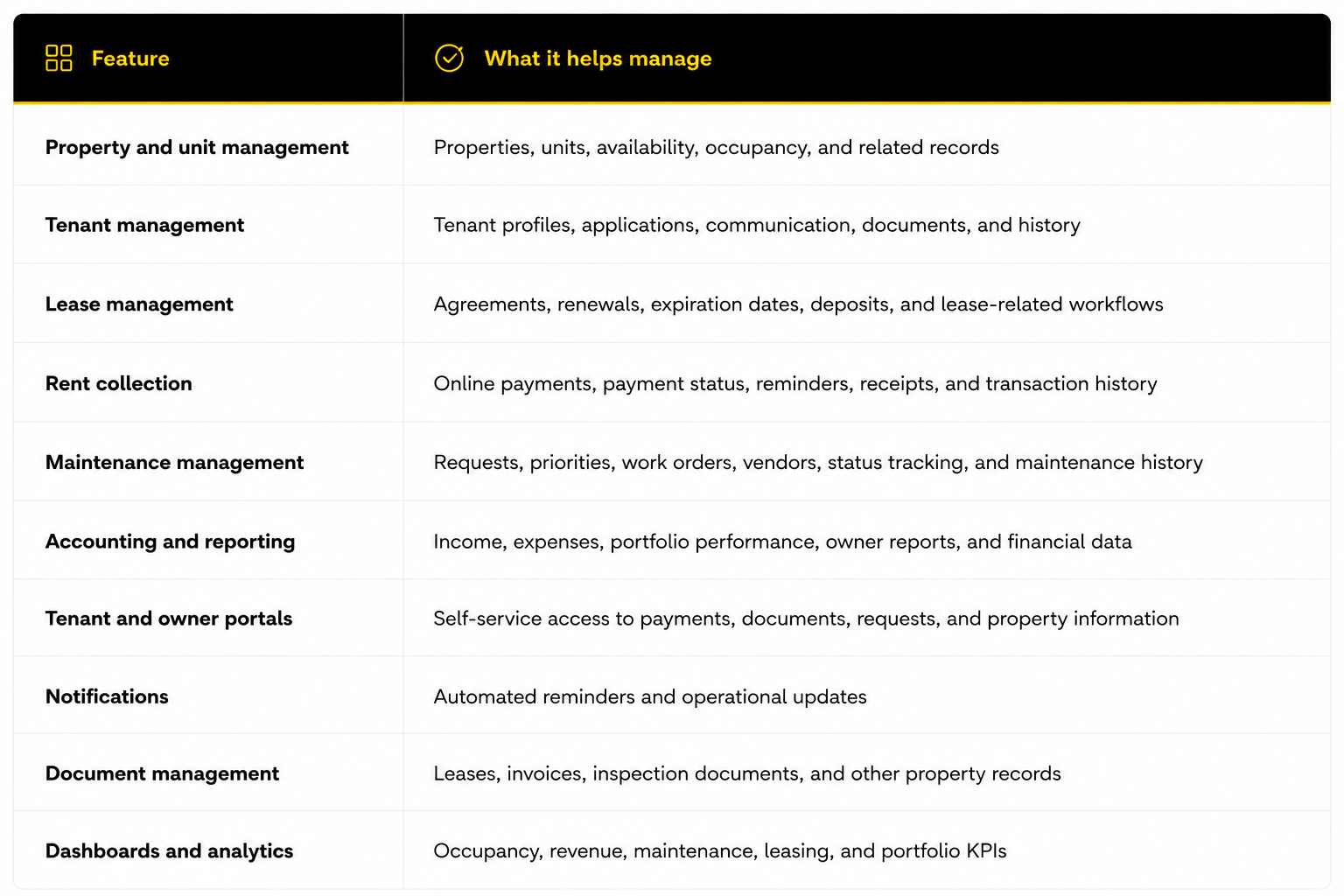
The value is not in having the longest feature list. It is in connecting these functions into efficient workflows. For example, a maintenance request should not simply create a ticket. A mature workflow can classify the problem, assign a vendor, notify the tenant, track progress, and preserve maintenance history for future decisions.
Property Management Software Integrations
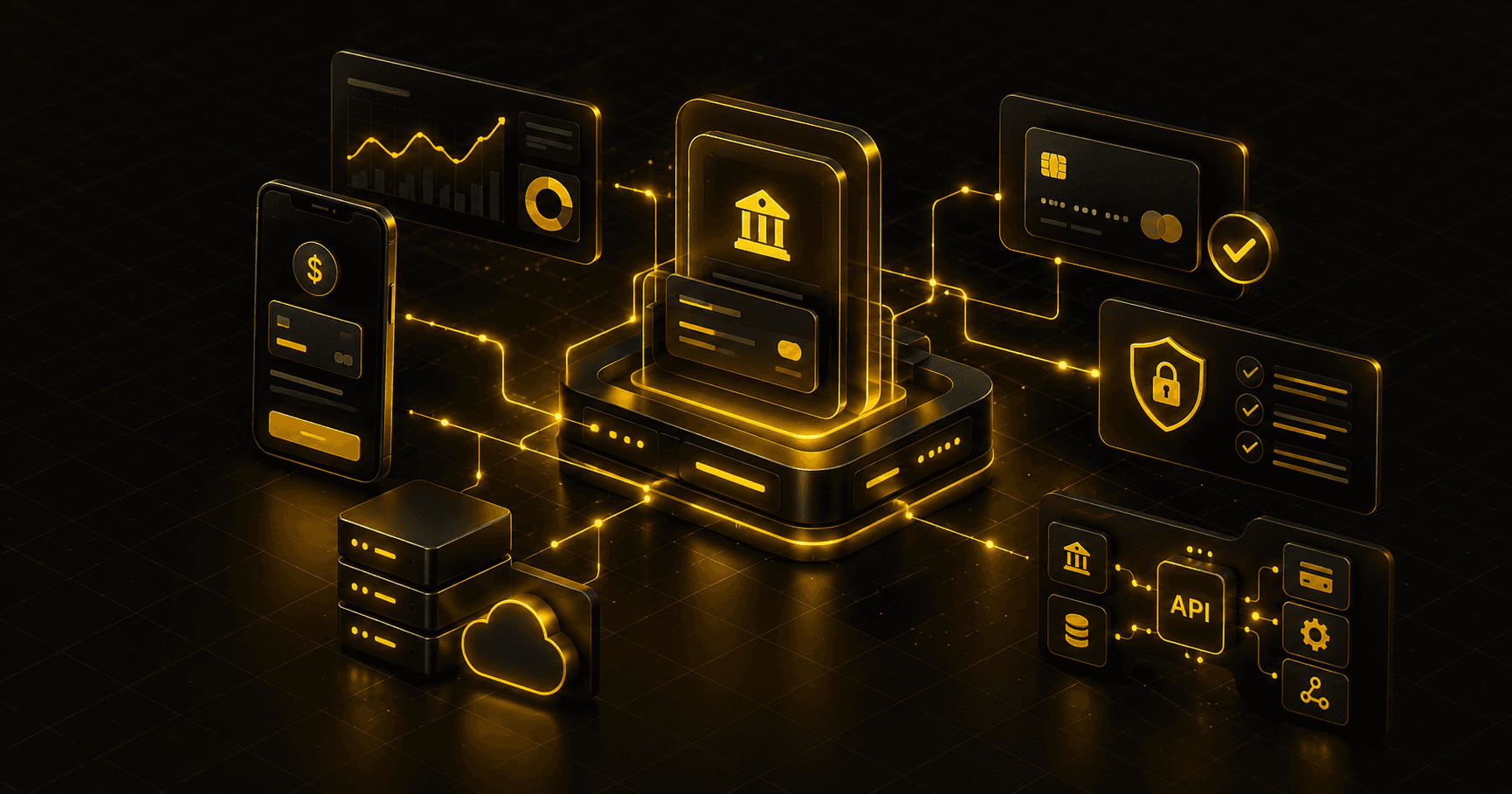
A property management platform rarely operates alone. Payments, accounting, listings, communications, tenant screening, e-signatures, and IoT systems may all come from external providers. That makes property management software integrations an architectural requirement rather than an add-on.Common integrations include: Payments and banking. For rent collection, deposits, recurring payments, refunds, and reconciliation. Accounting systems. To synchronize financial and property data while reducing duplicate entry. Property and listing services. For listing distribution, availability, maps, and real estate data. CRM and communication platforms. To manage leads, prospects, tenants, and internal communication. Screening and verification services. For identity verification, tenant screening, and related workflows.E-signature and document systems. To automate lease creation, approval, signing, and storage.IoT and smart-building technology. For equipment monitoring, access control, energy management, and preventive maintenance.A reliable property management software API layer makes it easier to add or replace providers and connect web, mobile, and third-party services. UppLabs has worked with this type of integration-heavy architecture in practice. Its Property Management Platform case study includes Stripe, Zillow API, and Twilio alongside the core platform. For more complex scenarios involving legacy property systems, AI services, payments, and IoT data, see the AI-powered property management case study.
Property Management Software Development Process
Successful property management app development starts with understanding business workflows, not writing code.
1. Discovery and Requirements
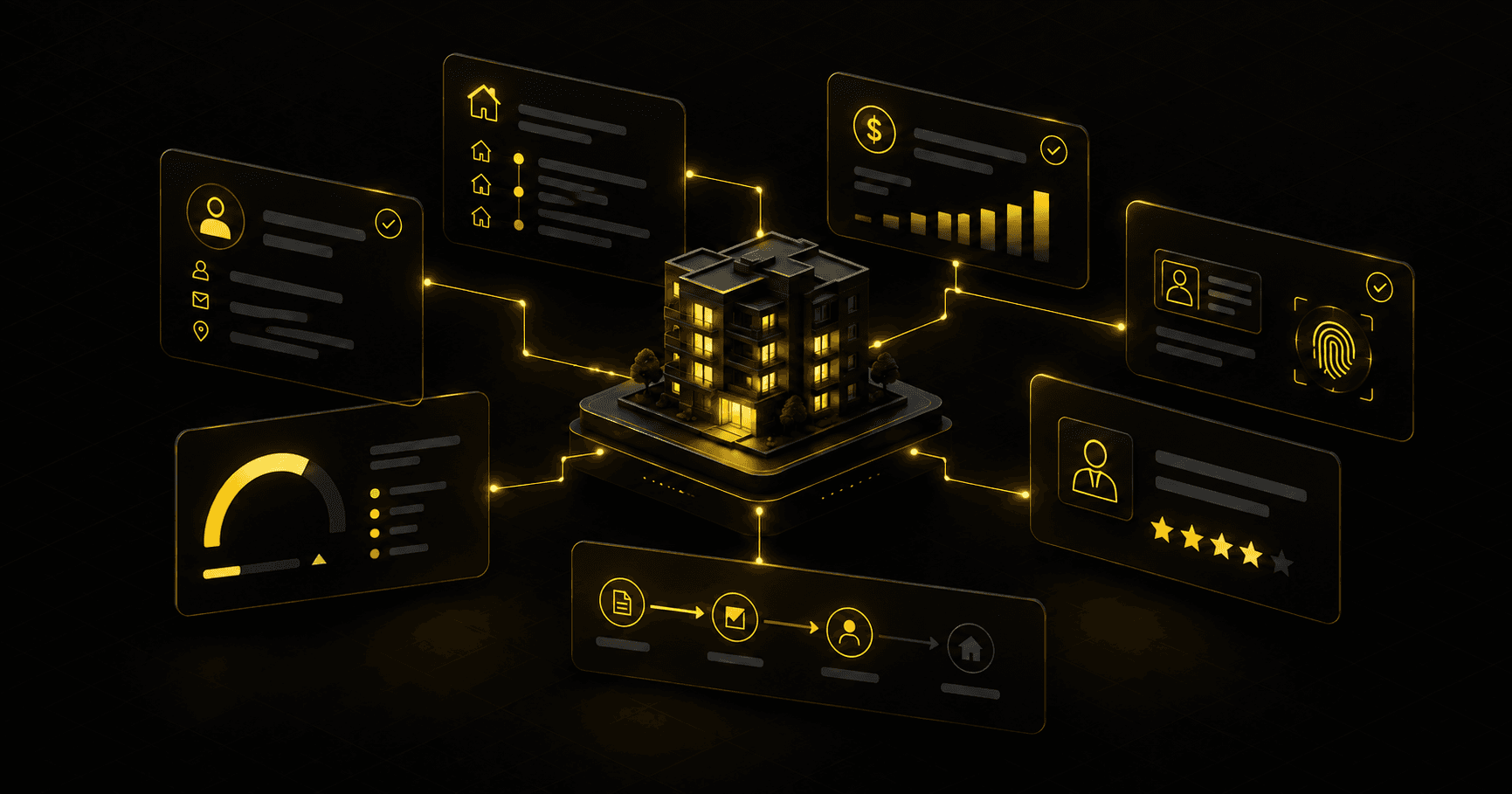
The first step is to understand how properties are managed today. Discovery usually covers user roles, workflows, integrations, existing systems, security requirements, bottlenecks, and future growth. The goal is to define a realistic product scope and prioritize the workflows that deliver the most business value.
2. UX and Product Design
Property managers, tenants, owners, and vendors use the same platform very differently. A tenant may need payments, documents, and maintenance requests, while a portfolio manager needs financial indicators, vacancies, alerts, and operational data. Interfaces should therefore be designed around user roles and decisions rather than simply displaying every available feature.
3. Architecture and Technology
Architecture determines how property and tenant data is stored, how permissions work, how external services connect, and how the system handles growth. For SaaS platforms, multi-tenancy and data isolation also need to be planned early. The aim is not to build the most complex architecture possible, but one that will not make future integrations and features unnecessarily difficult.
4. Development and Integrations
Development should focus first on the workflows that create the most value. For an MVP, that might include property and tenant management, lease workflows, payments, maintenance requests, and a management dashboard. Integrations should be implemented early because external systems often influence both architecture and user experience.
5. Testing and Launch
Testing should cover not only interfaces but also integrations, permissions, transactions, security, performance, and data accuracy. After launch, real usage data can show where workflows still create friction and which processes should be improved next.
Build vs. Buy Property Management Software
Buying existing software usually makes sense when business requirements are standard and speed of implementation is more important than flexibility.Building becomes more attractive when a company has:
- proprietary workflows;
- complex integrations;
- specific analytics or reporting needs;
- unusual scalability requirements;
- plans to offer the platform as its own PropTech product.
There is also a hybrid option: keep established tools for standard functions while building a custom layer for workflows, integrations, analytics, or user experiences that differentiate the business.The key question is simple:
“Are you recreating functionality that already exists, or solving a problem existing platforms cannot handle effectively?”
What Determines Property Management Software Development Cost?
There is no universal property management software development cost because platforms with the same label can have very different scopes.The estimate depends mainly on:
- feature complexity;
- number of user roles;
- web versus web and mobile development;
- third-party integrations;
- data migration;
- payments and financial workflows;
- analytics and reporting;
- AI or IoT functionality;
- security requirements;
- expected scale.
A platform for a regional property manager is fundamentally different from a multi-tenant SaaS product serving thousands of properties. For this reason, meaningful estimates should start with scope and architecture rather than generic market averages. Teams still defining their product can also use the UppLabs AI Project Estimator to get an initial view of potential project scope, team, technology, timeline, and budget range.
AI and Automation in Property Management
AI can create value in property management, but only when applied to suitable workflows and reliable data.Useful applications include:
- predictive maintenance;
- automated document processing;
- tenant screening support;
- request classification and routing;
- pricing and occupancy analysis;
- intelligent search across property data.
UppLabs has already applied these approaches in its AI-powered property management platform, combining predictive maintenance, AI-assisted tenant screening, lease optimization, document automation, and integrations with existing property systems.The main principle is simple: AI works best when it improves an already well-designed process. Adding automation to fragmented workflows usually adds complexity instead of removing it.
Best Practices for Property Management Software Development
Design Around Workflows
Do not evaluate the product by feature count alone. Map complete processes such as tenant onboarding, lease renewal, rent collection, or maintenance and identify where manual handoffs can be eliminated.
Plan Integrations Early
Validate important APIs during discovery. Discovering integration limitations late in development can require expensive architecture or UX changes.
Create a Single Source of Truth
Tenant, lease, property, maintenance, and financial information should remain consistent across the platform. A shared data model prevents different modules from becoming separate information silos.
Build Around Roles and Permissions
Tenants, owners, property managers, vendors, accountants, and administrators need different access levels. Role-based permissions should therefore be part of the core architecture.
Automate High-Frequency Tasks First
Rent reminders, maintenance routing, reporting, notifications, and data synchronization are often better automation opportunities than complex features used only occasionally.
Plan for Scale
The architecture that supports dozens of properties may not work for thousands. UppLabs faced this challenge while developing its property management platform, where infrastructure had to support increasing numbers of users, properties, and data without sacrificing performance.
Choosing a Property Management Software Development Partner
A development partner needs more than strong web and mobile engineering skills. Property management products combine real estate operations, financial workflows, third-party integrations, data, cloud infrastructure, and increasingly AI. Relevant experience can therefore be particularly valuable.UppLabs' PropTech software development experience includes property management platforms, real estate marketplaces, tenant systems, valuation technology, analytics, and AI-powered real estate workflows.The company has also worked on Limehome, a digital property and hospitality platform with automated check-in and check-out, access management, booking workflows, payments, and guest communication.These projects demonstrate why successful property software is not just a collection of screens. It has to connect users, operational workflows, data, and third-party services into one reliable system.
Building Property Management Software That Can Grow
The best property management platform is not necessarily the one with the most features. It is the one that reduces friction, connects fragmented data, automates repetitive operations, and can evolve as portfolios and business models change.For some businesses, established SaaS software remains the best option. For others, integration limitations, unique workflows, operational scale, or plans to launch a PropTech product make custom property management software a stronger long-term choice.UppLabs combines PropTech expertise with web and mobile engineering, integrations, cloud infrastructure, and AI development.If you are planning a new property platform or modernizing an existing product, explore UppLabs PropTech development services or use the AI Project Estimator to start defining your product scope.
FAQ
What is property management software development?
Property management software development is the process of building digital systems for managing properties, tenants, leases, payments, maintenance, documents, reporting, and related real estate workflows.
What features should property management software have?
Common features include property and tenant management, lease management, rent collection, maintenance workflows, reporting, documents, notifications, and tenant or owner portals.
How much does property management software cost to develop?
Cost depends on feature complexity, integrations, user roles, web and mobile requirements, data migration, security, infrastructure, AI functionality, and expected scale.
What integrations does property management software need?
Common integrations include payments, accounting systems, property-data providers, CRMs, tenant-screening services, e-signature platforms, communication tools, and IoT systems.
Should you build or buy property management software?
Buying is usually better for standardized processes. Custom development becomes more relevant when a company needs unique workflows, complex integrations, greater scalability, or plans to build its own PropTech product.