Implementing AI in healthcare is not just a technical challenge — it is a regulatory one. Every model that touches patient data, every LLM processing clinical notes, and every analytics dashboard displaying Protected Health Information (PHI) must comply with HIPAA. Violations are not theoretical: the average HIPAA fine now exceeds $1.5 million, and recent enforcement actions have specifically targeted organizations with inadequate AI governance.
The good news? Building HIPAA-compliant AI systems is entirely achievable when you design for compliance from day one. This guide walks through what you need to know — from the 2025 Security Rule updates to a practical 4-phase implementation checklist.
The HIPAA Reality Check
There are no exemptions for AI systems under HIPAA. If your AI touches PHI — whether for training, inference, or analytics — it falls under the same regulatory framework as any other system handling patient data. The January 2025 proposed updates to the HIPAA Security Rule introduced significantly stricter requirements that every healthcare AI team needs to understand.
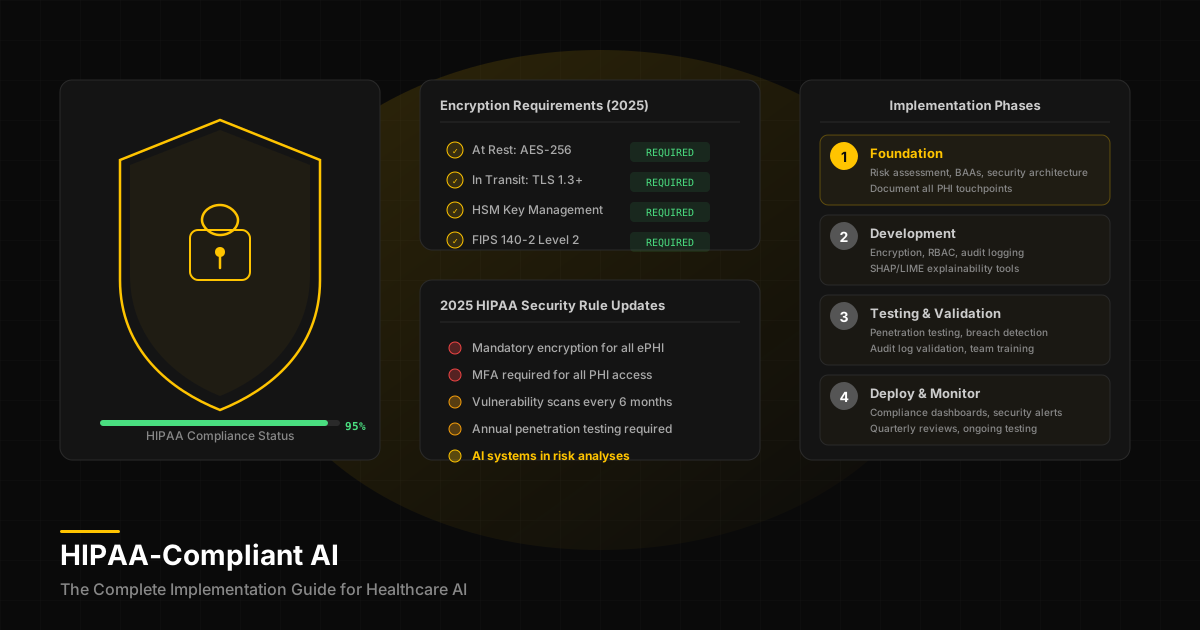
- Encryption is now mandatory — previously considered merely "addressable," it is now a hard requirement for all ePHI
- Multi-factor authentication is required for all systems accessing PHI
- Vulnerability assessments must be conducted every six months
- Annual penetration testing is now explicitly required
- AI systems must be explicitly included in organizational risk analyses
These are not suggestions. Organizations that treat AI systems as exempt from HIPAA compliance are setting themselves up for enforcement actions, data breaches, and loss of partner trust.
What Makes AI "HIPAA-Compliant"?
Compliance is not a single checkbox — it requires technology, contracts, and processes working together. There are four pillars that every HIPAA-compliant AI implementation must address.
Business Associate Agreements (BAAs)
Any third-party AI service that handles PHI requires a signed Business Associate Agreement. This includes cloud AI providers, model hosting platforms, and data processing services. Azure OpenAI, AWS HealthLake, and Google Cloud Healthcare API all offer HIPAA-eligible configurations — but even with a BAA, you still need to configure things correctly. A BAA is a legal starting point, not a technical solution.
Encryption Requirements
The 2025 updates make encryption non-negotiable. Every piece of electronic PHI must be encrypted — at rest and in transit — with no exceptions.
- At rest: AES-256 minimum encryption for all stored ePHI
- In transit: TLS 1.3 or higher for all data transmission
- Key management through Hardware Security Modules (HSMs)
- FIPS 140-2 Level 2 certification minimum for cryptographic modules
De-Identification Methods
When training AI models, de-identifying patient data is often the safest path. HIPAA recognizes two approaches: the Safe Harbor Method, which requires removing 18 specified identifiers (names, dates, geographic data, SSNs, etc.), and Expert Determination, which uses statistical methods to verify that the risk of re-identification is very small.
Be cautious — de-identification is not foolproof. A notable 2023 case involving the University of Chicago Medical Center and data shared with Google demonstrated that de-identification failures can lead to serious legal and ethical consequences. Modern AI models are particularly good at re-identification, which makes rigorous de-identification even more critical.
Access Controls and Audit Logs
Every interaction with PHI must be controlled and logged. This means multi-factor authentication for all users, role-based access control (RBAC) that limits data access to what each role actually needs, comprehensive audit trails that record who accessed what data and when, and regular access reviews to remove unnecessary permissions. For AI systems specifically, this extends to model training pipelines, inference endpoints, and any automated processes that touch patient data.
AI-Specific Challenges
AI systems introduce unique compliance challenges that traditional healthcare IT does not face. Three areas demand special attention.
Model Training on PHI
When patient data is used for model training, it must be protected throughout the entire pipeline — from data extraction through preprocessing, training, evaluation, and model storage. Never use public LLM APIs with fine-tuning on patient data unless the vendor has explicit controls preventing data leakage. Even "anonymized" training data can leak through model memorization, where the model learns to reproduce specific patient records verbatim.
The Black Box Problem
Neural networks and deep learning models present explainability challenges that directly impact HIPAA compliance. When a model makes a clinical recommendation, you need to be able to explain why — both for regulatory purposes and for clinical trust. The recommendation: implement explainability tools like SHAP (SHapley Additive exPlanations) and LIME (Local Interpretable Model-agnostic Explanations) from day one, not as an afterthought.
Continuous Learning Systems
AI systems that adapt from new patient data — learning from new diagnoses, treatment outcomes, or patient interactions — require ongoing risk assessment. A model that was compliant at deployment can drift into non-compliance as it learns from new data. This is not a one-time evaluation; it requires continuous monitoring, periodic re-validation, and automated drift detection.
Common Mistakes to Avoid
In our experience building healthcare AI systems, four patterns appear repeatedly — and all of them are avoidable.
- Using public ChatGPT or similar consumer AI tools with patient information — these services do not have BAAs and may use your data for training
- Assuming cloud services are automatically HIPAA-compliant — signing up for AWS does not make your application compliant; you must configure services correctly and sign BAAs
- Leaving application logs containing PHI unprotected — log files are often the forgotten attack surface; if your AI logs contain patient identifiers, those logs need the same protections as your database
- Lacking incident response procedures for AI-specific breaches — when a model leaks PHI through inference, you need a tested response plan, not improvisation
The 4-Phase Implementation Checklist
Based on our healthcare AI projects, we have refined a 4-phase approach that systematically builds compliance into every layer of the system.
Phase 1: Foundation
- Conduct a comprehensive risk assessment covering all AI components
- Document every point where PHI is collected, processed, stored, or transmitted
- Execute BAAs with all AI vendors and cloud providers
- Design the security architecture with encryption, access controls, and audit logging
Phase 2: Development
- Implement AES-256 encryption at rest and TLS 1.3 in transit
- Build role-based access controls and MFA into every access point
- Set up comprehensive audit logging for all PHI interactions
- Integrate explainability tools (SHAP, LIME) into model pipelines
- Build secure, isolated data pipelines for model training
Phase 3: Testing & Validation
- Execute vulnerability assessments and penetration testing
- Verify breach detection and notification systems work correctly
- Validate that audit logs capture all required events
- Conduct team-wide HIPAA training with AI-specific scenarios
Phase 4: Deployment & Monitoring
- Deploy active monitoring dashboards for compliance metrics
- Set up automated security alerts for anomalous access patterns
- Schedule quarterly access reviews and permission audits
- Establish regular penetration testing and vulnerability scanning cadence
The Bottom Line
HIPAA compliance for AI systems is not something you bolt on at the end — it must be intentional from the very first architecture decision. The organizations getting this right are designing for compliance from day one, treating security as a feature rather than a constraint.
The 2025 HIPAA Security Rule updates are a clear signal: the regulatory landscape is catching up to AI. Final rules are expected in late 2025 or early 2026, with compliance deadlines 12 to 24 months after that. Organizations that start building compliant AI infrastructure now will have a significant competitive advantage over those scrambling to retrofit.
“Most healthcare organizations are not prepared for the 2025 HIPAA standards. The ones that start now will not just avoid fines — they will build trust that becomes a competitive moat.”
At UppLabs, we build HIPAA-compliant AI systems for healthcare organizations — from clinical NLP platforms to patient analytics dashboards. If you are navigating AI compliance, we would love to talk.